
An artificial intelligence platform is a managed environment where teams prepare data, build or select models, deploy them and monitor them in production, with security and governance applied across the whole lifecycle. For enterprise teams in regulated sectors, the right choice depends less on model quality than on data residency, integration with existing systems and the ability to prove control to auditors. This article compares five established platforms, positions an Azure-based approach for Microsoft-centred organisations and sets out how to choose.
The pressure to decide is real. In Gartner's May to June 2025 survey of 360 IT application leaders, Most respondents said they were piloting, deploying or had deployed some form of AI agents. Yet only 14% strongly agreed that IT, business users and leadership were aligned on the problems AI should solve. Platform selection is therefore as much an alignment exercise as a technical one.
What an AI platform actually includes
An enterprise AI platform bundles the services needed to move a use case from data to a monitored production system. The components are broadly consistent across vendors:
- Data preparation and storage: pipelines, feature stores and connectors to source systems.
- Model development: notebooks, experiment tracking, access to foundation models and fine-tuning tools.
- Deployment and serving: endpoints, scaling and cost controls for inference.
- MLOps and monitoring: versioning, drift detection, retraining and audit logs.
- Security and governance: identity, encryption, network isolation, policy enforcement and approval workflows.
A framework such as a deep-learning library gives you building blocks. A platform gives you the operating environment around them. Enterprise teams usually need the latter, because the hard problems are access control, repeatability and accountability rather than model code.
For a broader view of how the pieces fit, Stellium Consulting's overview of a platform for AI covers the architectural layers in more detail.
1. Google Vertex AI
Google Vertex AI is Google Cloud's managed service for building, deploying and operating AI applications, including machine-learning models and generative AI workloads.
Key specifics:
- Available in the Zurich region (
europe-west6), which matters for Swiss data-residency requirements. - Usage-based pricing by compute resource. Listed Zurich rates include $0.0350968 per vCPU-hour and $0.0047035 per GB-hour for one listed operation, and $0.0547055 per vCPU-hour for another.
- Billing is granular, so cost forecasting needs a clear view of which operations a workload triggers.
Suits: Enterprise teams building and operating AI applications on Google Cloud, particularly where a Swiss in-country region is a procurement requirement and the wider data estate already sits on Google infrastructure.
Verdict: A strong choice for Google Cloud-centred organisations, though pricing complexity calls for careful estimation before scaling.
2. Amazon SageMaker
Amazon SageMaker is Amazon Web Services' managed service for developing, training and deploying machine-learning workloads.
Key specifics:
- Usage-based pricing with no minimum fees or upfront commitments.
- A free tier for the first two months, including 250 hours per month of ml.t3.medium notebook usage.
- Free-tier training of 50 hours per month on m4.xlarge or m5.xlarge instances, and 125 hours per month of real-time inference on the same instance types.
- Free-tier Feature Store allowance of 10 million write units, 10 million read units and 25 GB of storage per month.
Suits: Teams developing and deploying machine-learning workloads on AWS, with the free tier giving a low-cost way to run a proof of concept before committing budget.
Verdict: Mature and flexible for AWS-based engineering teams; the free tier lowers the cost of early experimentation, though it expires after two months.
3. IBM watsonx.ai
IBM watsonx.ai is IBM's studio for foundation models, machine learning and document text extraction, offered with pay-as-you-go options.
Key specifics:
- A free plan with up to 300,000 foundation-model tokens, 20 compute-usage hours and text extraction for up to 100 documents per month, according to IBM’s pricing page.
- A Standard enterprise production plan starting at USD 1,110 per month. IBM notes that prices vary by country and may exclude taxes and duties.
Suits: Enterprises that want a defined entry price for production use and built-in text extraction, for example for document-heavy workflows in insurance or public services.
Verdict: A transparent pricing ladder from free to production makes budgeting easier, and the document-extraction capability suits paperwork-intensive processes.
4. Stellium Consulting Cloud and AI Platforms
Stellium Consulting's Cloud and AI Platforms service delivers secure, scalable AI infrastructure on Microsoft Azure, from compliant landing zones to advanced AI deployments.
Key specifics:
- Built natively on the Microsoft ecosystem, so identity, security and data tooling are integrated.
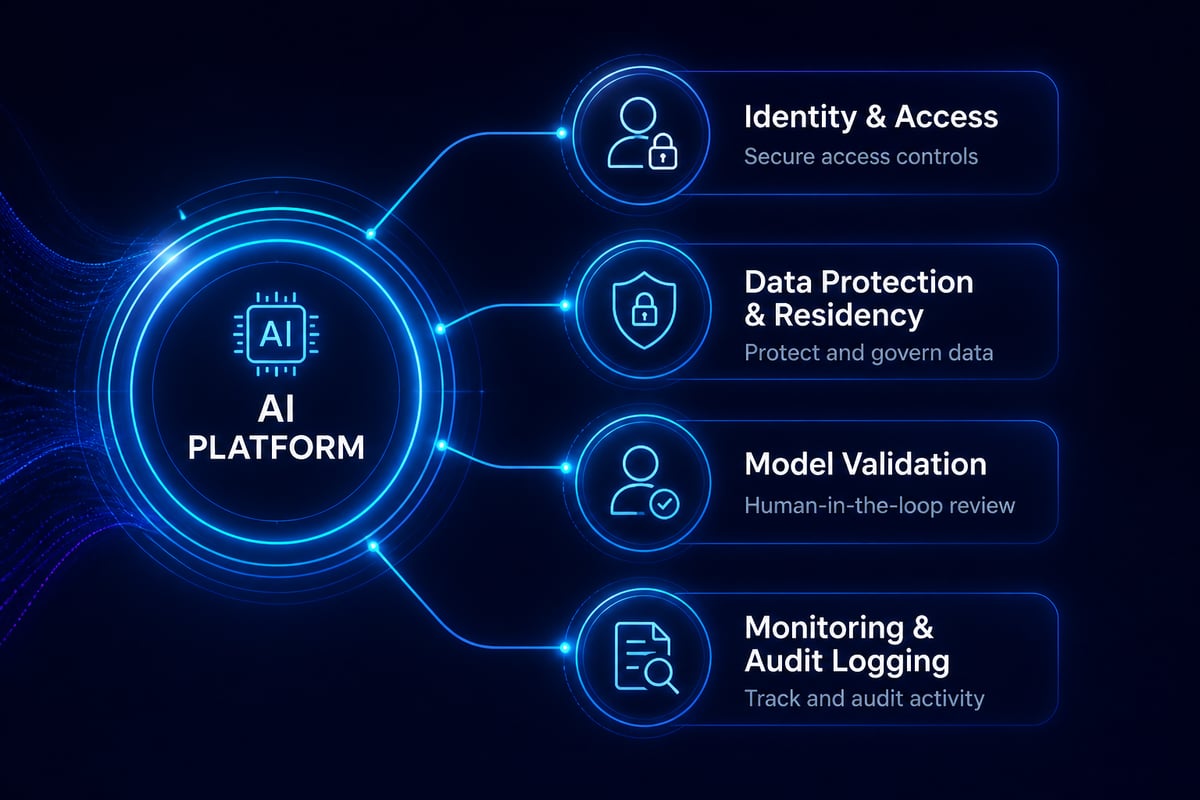
- Responsible AI is built into each solution, with human-in-the-loop validation, privacy safeguards and bias checks.
- Designed around each client's business goals rather than a template.
- Delivered by a Microsoft Solutions Partner.
- Pricing is not listed; it is scoped through the contact page.
Suits: Organisations already invested in Microsoft 365, Entra ID and Azure that need a governed AI environment without assembling it from separate components.
Verdict: A service-led route for Microsoft-centred teams who want implementation support alongside the platform rather than a self-assembled stack.
5. AI Landing Zone Quick-Start
The AI Landing Zone Quick-Start is a 4-week setup of a compliant, reusable Azure environment ready for AI workloads.
Key specifics:
- A fixed 4-week setup window.
- Produces a reusable Azure environment, so later use cases inherit the same controls instead of rebuilding them.
- Positioned as the foundation step before advanced AI deployments.
- Pricing is not listed on the page.
Suits: Teams that have agreed on a first use case but lack an approved, compliant environment to run it in, a common blocker in pharma, finance and public-sector programmes.
Verdict: A practical starting point when the main obstacle is the foundation rather than the model.
Comparison at a glance
| Platform | Provider | Region note | Pricing model | Best fit |
|---|---|---|---|---|
| Vertex AI | Google Cloud | Zurich region available | Usage-based, per vCPU-hour and GB-hour | Google Cloud estates |
| SageMaker | Amazon Web Services | Not specified in research | Usage-based, two-month free tier | AWS machine-learning teams |
| watsonx.ai | IBM | Prices vary by country | Free plan; Standard from USD 1,110/month | Document-heavy enterprise workflows |
| Cloud and AI Platforms | Stellium Consulting | Azure-based | Scoped per engagement | Microsoft-centred organisations |
| AI Landing Zone Quick-Start | Stellium Consulting | Azure-based | Scoped per engagement | Teams needing a compliant foundation first |
How to choose an artificial intelligence platform
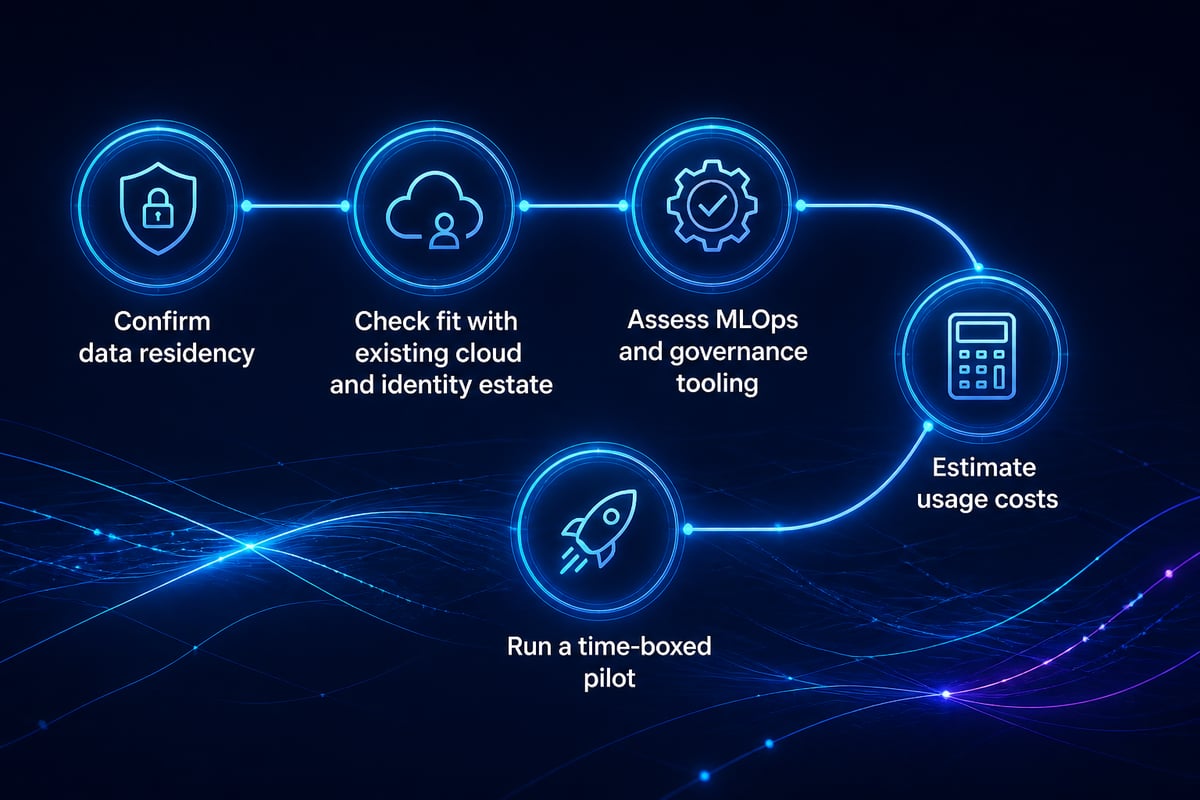
Choose by working through five filters in order, because the early ones eliminate options quickly.
- Data residency and sovereignty. Confirm where data, prompts and logs are stored and processed. For Swiss and European regulated sectors, an in-country or EU region is often a hard requirement.
- Fit with your existing estate. A platform that shares identity, networking and data services with your current cloud avoids duplicated security work. Microsoft-centred organisations gain a lot from staying inside Azure.
- Governance tooling. Look for audit trails, role-based access, approval workflows and policy enforcement. Stellium Consulting's guide to an AI governance platform explains what to require.
- Cost predictability. Usage-based pricing is flexible but can surprise finance teams. Run a pilot to measure real consumption before forecasting annual spend.
- Portability and integration. Check how easily models, data and pipelines can move if requirements change, and how the platform connects to line-of-business systems.
Governance and responsible AI are selection criteria
Governance should be assessed before the first model is built, because retrofitting controls is slower and riskier than designing them in. Regulated teams generally need evidence of who approved a model, what data trained it, how outputs are reviewed and how bias is checked.
Human-in-the-loop validation matters most where outputs affect customers, patients or citizens. It gives a named reviewer accountability for decisions the model only supports. Privacy safeguards, such as limiting what data reaches a model and logging access, address data-protection obligations under Swiss and European rules.
Stellium Consulting's article on AI implementation challenges outlines common failure points, including unclear ownership and weak data foundations. For example, a hypothetical insurer piloting claims-document summarisation would need to decide in advance who validates outputs, how personal data is masked and where logs are kept, before any platform contract is signed.

Closing the alignment gap before choosing
The Gartner finding that only a small minority of leaders strongly agreed that IT, business users and leadership were aligned on the problems AI should solve points to a practical step: agree the use case and success measure first. Platform comparison then becomes a question of which option serves that defined problem.
A workable sequence runs as follows:
- Name one or two use cases with a measurable outcome, such as reduced document-review time.
- Assign a business owner and a technical owner for each.
- Define the data sources, sensitivity classification and approval path.
- Select the platform that meets the residency and governance needs of those use cases.
- Run a time-boxed pilot, then decide whether to scale.
Stellium Consulting's 90-day pilot guidance sets out use-case selection, governance foundations and a pilot plan. For employee-facing examples, its page on AI for your employees describes a governed retrieval-augmented generation solution integrated with a cloud landing zone. The wider AI services page shows how these capabilities fit together.
Organisations that also manage physical sites or fleets sometimes track related operational data alongside their AI programme. For example, Pilotlog offers a digital pilot logbook for tracking flight hours, currency and licence expiries, which shows how structured logging underpins any compliance-sensitive workflow.
Where the platform ends and the programme begins
A platform is infrastructure; value comes from the programme around it. Training, change management and clear usage policies determine whether employees adopt the tools. Integration work connects the platform to the systems where decisions are made. Ongoing monitoring catches model drift and cost creep.
Planning for these items alongside the platform decision keeps projects from stalling after a successful pilot. It also helps to review emerging direction, such as Stellium Consulting's view of 2026 AI trends, so that the chosen platform remains relevant as agent-based and generative workloads mature.
FAQ
What are the top AI platforms for enterprises?
Established enterprise options include Google Vertex AI, Amazon SageMaker and IBM watsonx.ai, alongside Azure-based platforms for Microsoft-centred organisations. The best option depends on your existing cloud, data-residency needs and governance requirements rather than a global ranking.
What does it mean to be AI proficient?
AI proficiency means being able to select suitable AI tools for a task, write effective instructions, judge the quality and risk of outputs, and apply organisational policy on data and privacy. It is a practical skill set that sits alongside domain expertise rather than replacing it.
What should you not ask an AI?
Avoid entering confidential, personal or regulated data into tools that your organisation has not approved, and do not rely on an AI alone for legal, medical or financial decisions. Sensitive requests should go through governed enterprise tooling with human review.
Start by naming one use case with a measurable outcome and mapping the data it needs, because that single decision narrows your platform shortlist more than any feature comparison. Stellium Consulting, a Microsoft Solutions Partner, builds AI solutions natively on the Microsoft ecosystem, and its Cloud and AI Platforms service is designed around each client's business goals. If you want to test your shortlist against your own compliance and integration needs, Let’s Talk with the team about the right starting point.