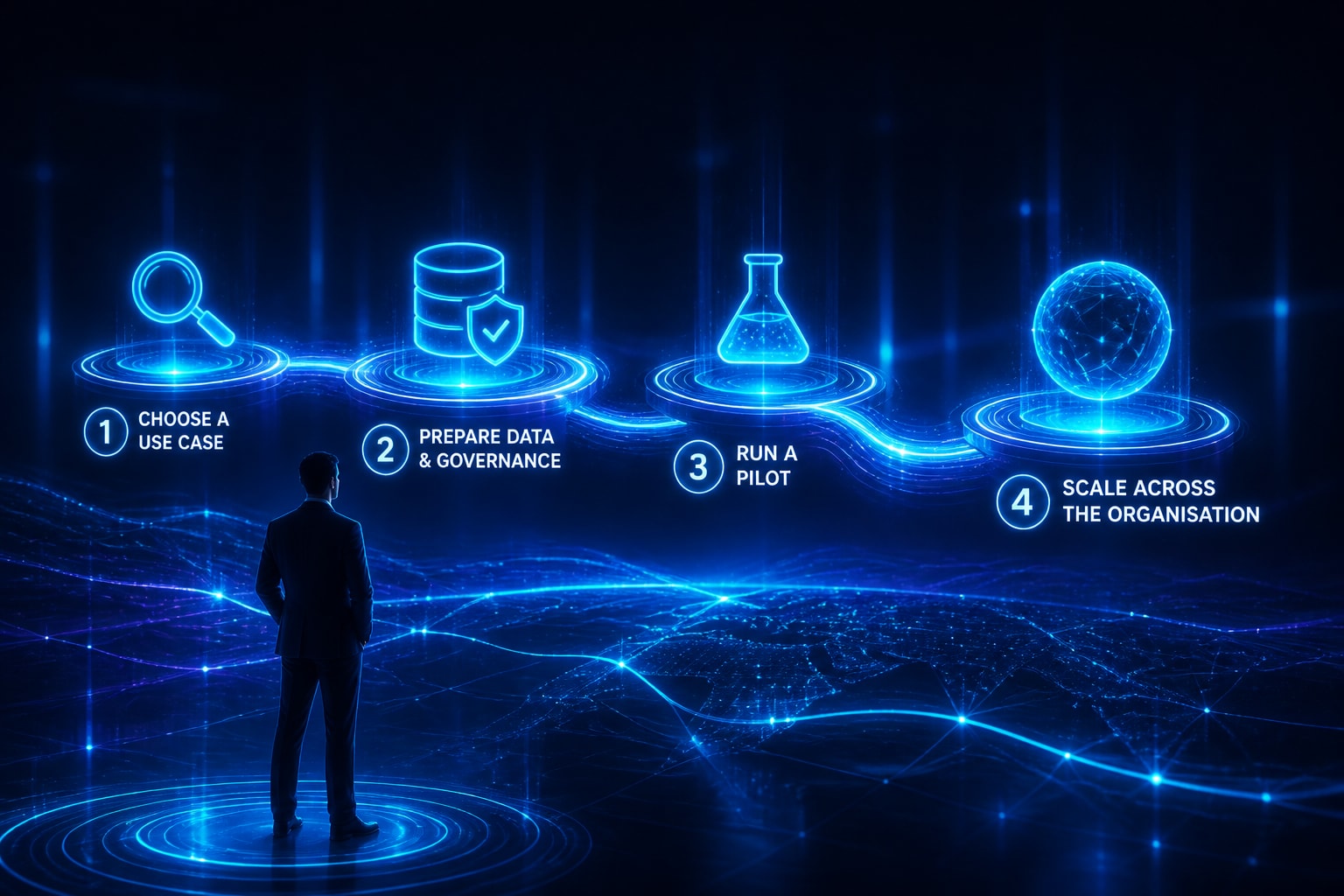
New AI refers to the latest generation of generative models, copilots and autonomous agents that can draft, analyse, reason over company data and carry out multi-step tasks. For enterprises, the sensible place to start is not the newest model but a single, well-defined business problem, backed by clean data, clear governance and a platform your IT team already runs.
This guide takes you from the basics to a confident first deployment. It is written for IT and innovation leaders at mid-to-large organisations in Switzerland and Europe who are working with Microsoft technology.
What counts as new AI for an enterprise?
New AI, in an enterprise setting, means generative and agentic systems that work with unstructured information such as documents, emails, meetings and code, rather than only the structured data that traditional analytics handled.
Three developments define the current wave:
- Generative AI assistants that draft text, summarise long documents and answer questions in natural language.
- Copilots embedded in existing software, which bring those capabilities into tools staff already use, with access to organisational data under existing permissions.
- AI agents that plan and execute multi-step workflows, such as triaging a service request, retrieving the relevant policy and preparing a response for human approval.
The practical question for a leader is rarely "what is the newest model?" It is "which of these capabilities fits a process we already own, and can we run it safely?" Models change every few months. Your data, your controls and your people persist, so they deserve the early attention.
How widely is AI used by companies today?
Enterprise AI use is rising quickly but remains uneven. According to the OECD, 20.2% of firms across OECD countries with available data reported using AI in 2025, up from 14.2% in 2024 and 8.7% in 2023.
Size matters considerably. The same OECD release reports that large firms were far more likely than small firms to use AI in 2025. If you lead technology at a mid-to-large organisation, you are therefore operating in the segment where adoption is already mainstream, and the competitive question is shifting from "whether" to "how well".
For a broader view of how adoption compares with cloud computing and big-data analytics, the OECD’s digital technology diffusion analysis is a useful reference. Our own overview of AI in businesses covers how these trends translate into day-to-day operations.
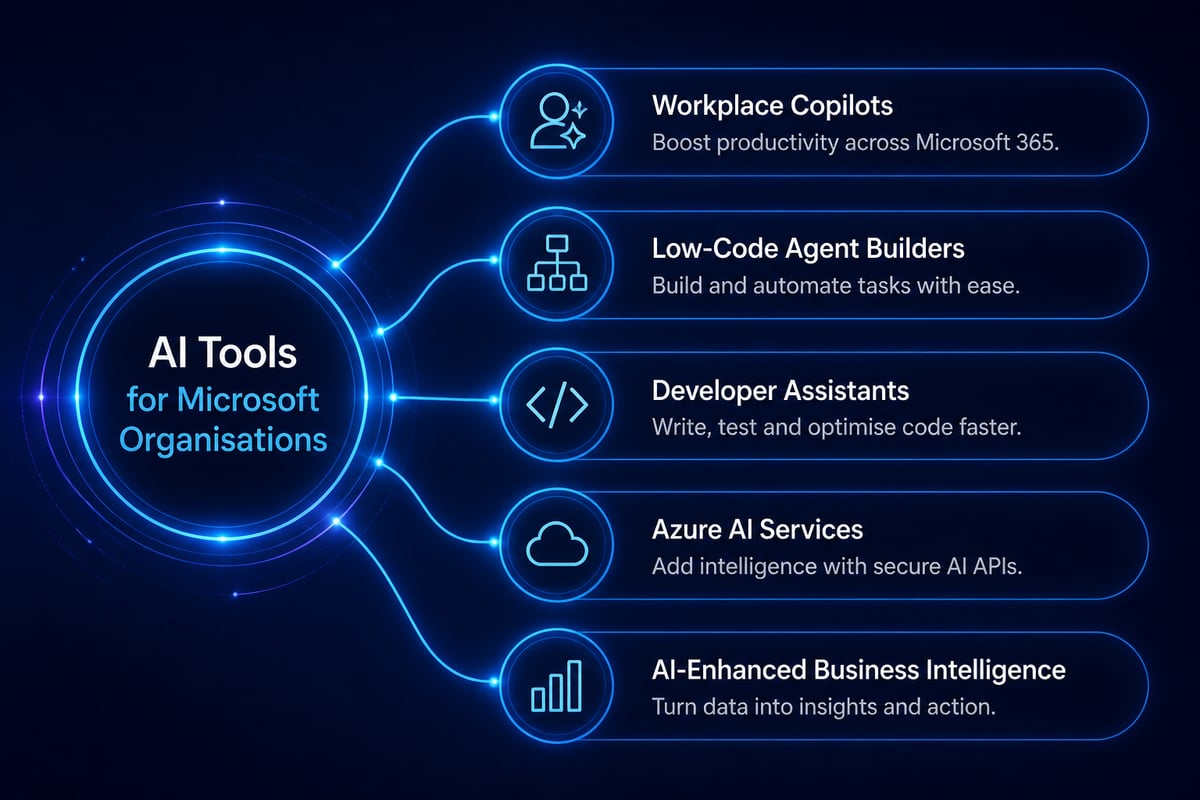
Which new AI tools matter most to Microsoft-based organisations?
For organisations built on Microsoft 365 and Azure, the tools that matter most are those that sit inside the environment you already govern, rather than standalone products that need separate security reviews.
The main categories are:
- Workplace copilots. Assistants integrated into email, documents, spreadsheets, meetings and chat, which draw on information a user is already permitted to see.
- Low-code agent builders. Platforms such as Copilot Studio allow teams to create bespoke assistants connected to internal knowledge and systems. Our guide to Copilot Studio explains where it fits.
- Developer assistants. Tools that accelerate coding, review and testing. See how GitHub Copilot works with Azure DevOps.
- Cloud AI services and model catalogues. Azure-hosted models and services for custom solutions where an off-the-shelf copilot is not enough.
- Business intelligence with AI. Natural-language querying and automated insight generation on top of existing data models, covered in our piece on business intelligence using AI.
Choosing within the Microsoft ecosystem reduces integration effort, keeps identity and access management consistent and simplifies compliance conversations with your data protection officer. A broader perspective on this is available in our article on AI and Microsoft.
How do you choose the right first use case?
The right first use case is a process that is frequent, document-heavy, measurable and low in regulatory risk, so that you can show value within a quarter without exposing the organisation to avoidable harm.
Score each candidate against five criteria:
- Volume: the task happens often enough for savings to accumulate.
- Information intensity: it involves reading, writing, searching or summarising.
- Measurability: you can capture a baseline, such as handling time or error rate.
- Data readiness: the relevant content is accessible, current and permissioned correctly.
- Risk profile: errors are recoverable and a human can review outputs before they take effect.
Strong early candidates in European enterprises tend to include internal knowledge search, meeting summarisation and follow-up, drafting of routine correspondence, first-line IT or HR service responses, and contract or policy comparison. Weaker starting points include fully automated decisions affecting customers or employees, or processes with fragmented, unreliable data.
Avoid the temptation to launch ten pilots at once. Two or three focused use cases, each with a named business owner, produce more learning than a scattered portfolio. Our AI adoption best practices article expands on sequencing and ownership.
What do you need in place before deploying new AI?
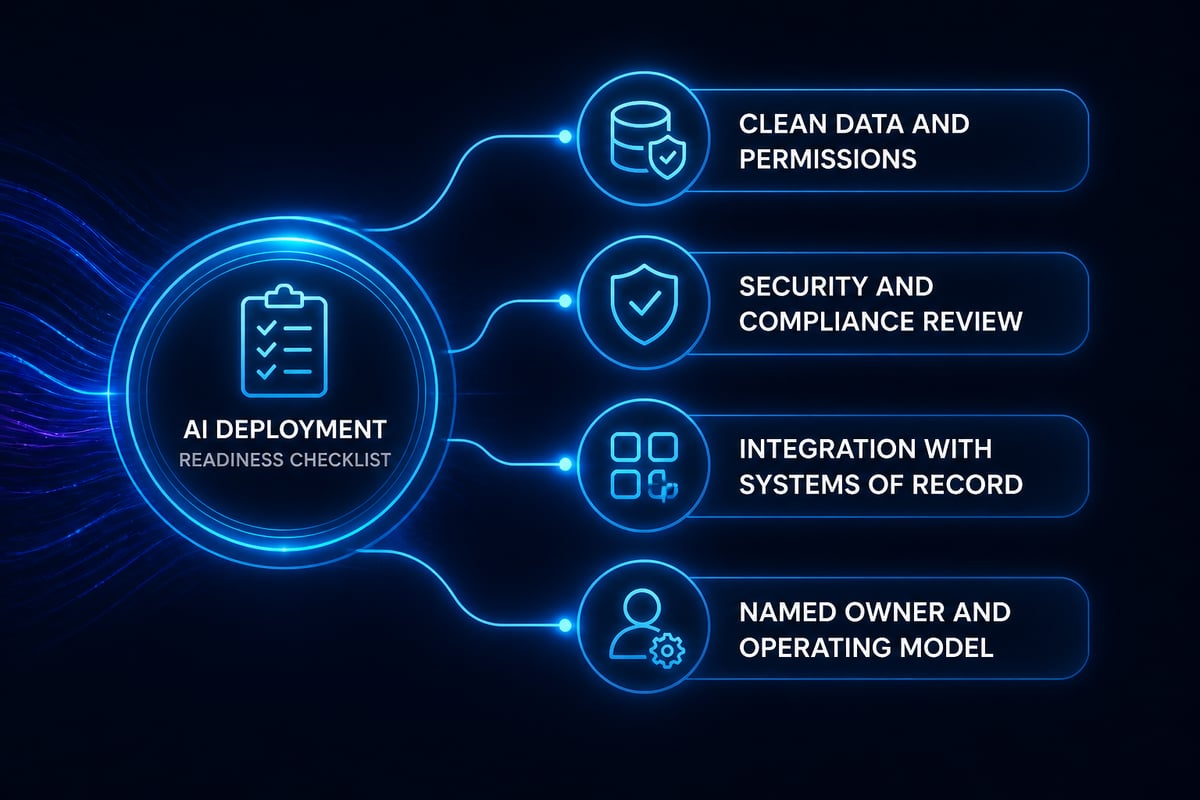
Before deploying new AI, you need four foundations: well-governed data, appropriate access controls, a security and compliance review, and an agreed operating model for who owns the solution after launch.
Data and permissions. A copilot that reads your SharePoint, Teams and mailbox content will surface whatever a user can technically access. Over-shared sites and stale permissions, tolerated for years, become visible overnight. Audit and tidy them first.
Security and compliance. Confirm where data is processed and stored, how prompts and outputs are retained, and how the solution aligns with the Swiss Federal Act on Data Protection and the GDPR where relevant. Involve legal and data protection colleagues at design stage, not at sign-off.
Integration and infrastructure. Identify the systems of record the AI must reach, and whether APIs, connectors or data pipelines already exist. Our overview of artificial intelligence integration services describes what this typically involves.
Operating model. Decide who monitors quality, handles user feedback, manages costs and updates the solution as models change. Organisations that treat this as a product rather than a project sustain value for longer. Some choose to outsource part of this through AI managed services.
How should you govern and manage the risks of new AI?
Govern new AI with a recognised risk framework, human oversight on consequential outputs and clear accountability, so that adoption speeds up rather than stalls under compliance concerns.
A solid reference point is the NIST AI Risk Management Framework, which explains how organisations can build trustworthiness considerations into the design, development, use and evaluation of AI systems. For generative systems specifically, NIST published its Generative AI Profile on 26 July 2024 as a companion resource to the framework, helping organisations identify and manage the risks that generative AI introduces. Further materials are collected on NIST's AI RMF resources page.
In practice, a workable governance baseline includes:
- An AI use policy stating permitted tools, prohibited data types and escalation routes.
- Human-in-the-loop validation for outputs that affect customers, employees or regulated decisions.
- Privacy safeguards, including data minimisation and clear retention rules.
- Bias and quality checks run before launch and repeated at intervals.
- An inventory of AI systems, so that nothing operates unseen.
Stellium Consulting builds responsible AI into the solutions it delivers, with human-in-the-loop validation, privacy safeguards and bias checks as elements of design rather than late additions. That approach mirrors where European regulation and good practice are heading.
How do you prepare people for new AI?
Prepare people by tying training to their actual roles, involving them early and measuring how work changes, because adoption depends on trust and habit rather than on licences alone.
Licences distributed without support tend to produce a short burst of curiosity followed by low usage. A more reliable pattern is:
- Identify champions in each department who experiment first and share practical examples.
- Train by task, not by tool. Show a finance analyst how to prepare variance commentary, rather than presenting a general tour of features.
- Set expectations honestly. Explain what the assistant does well, where it errs and why users remain accountable for what they send.
- Collect feedback weekly during the pilot and act visibly on it.
The employee experience matters as much as the technical build. Our article on AI and the employee experience discusses how to position AI as support for skilled work rather than a threat to it, a point that carries particular weight in European workplaces with strong works-council traditions.

Should you build, buy or customise?
Buy or enable what is already embedded in your productivity platform, customise where your processes differ meaningfully from the standard, and build only where AI forms part of a differentiating product or capability.
| Approach | Best suited to | Typical trade-off |
|---|---|---|
| Enable built-in copilots | Common productivity tasks across the workforce | Fast to deploy, limited tailoring |
| Configure agents on a low-code platform | Departmental workflows using internal knowledge | Good flexibility, needs governance of citizen builders |
| Custom development on cloud AI services | Unique processes or customer-facing products | Highest fit, greatest effort and ownership |
| AI as a service from a partner | Organisations lacking in-house AI capacity | Quicker start, requires clear service boundaries |
Most enterprises end up with a blend. Start at the top of the table and move downward only when a genuine gap appears. If you do need bespoke work, our guides to custom AI development and artificial intelligence as a service outline the options.
What does a practical 90-day plan look like?
A practical 90-day plan moves from assessment to a measured pilot and a decision on scaling, with a clear checkpoint at the end of each month.
Days 1 to 30: assess and prepare.
- Shortlist three candidate use cases and score them.
- Review data permissions, security posture and compliance requirements.
- Appoint a business owner, a technical lead and a governance contact.
- Capture baseline metrics for each use case.
Days 31 to 60: pilot.
- Deploy to a limited group, ideally 50 to 200 users depending on your organisation's size.
- Provide role-based training and open a simple feedback channel.
- Monitor usage, quality of output and any incidents.
Days 61 to 90: evaluate and decide.
- Compare results against the baseline.
- Document lessons, risks and costs, including running costs.
- Decide whether to scale, adjust or stop, and plan the next wave.
Treat stopping as a legitimate outcome. A pilot that ends with a clear "not yet, and here is why" has still delivered value.
How can Stellium Consulting support your first steps?
Stellium Consulting supports enterprises from use case selection through to secure, scalable delivery, building AI solutions natively on the Microsoft ecosystem and designing each one around the client's business goals rather than a template.
The team works hands-on with client staff and has delivered named engagements for JTI, a Swiss law firm and a public hospital in Switzerland. It is also a Microsoft Solutions Partner and was named Microsoft Partner of the Year in Switzerland. Its Enterprise AI Solutions offering covers employee productivity, business process optimisation and IT foundations, which map closely to the three stages most organisations move through: equip people, improve processes, strengthen the platform beneath both.
FAQ
What is the newest AI technology?
The newest technology gaining enterprise attention is the AI agent, a system that plans and carries out multi-step tasks using tools and company data, usually with human approval at key points. Alongside it, more capable reasoning models and copilots embedded in everyday software continue to mature. Because releases change frequently, evaluate any new capability against your own use cases and governance requirements rather than its launch publicity.
How is AI changing the way enterprises work?
AI is shifting routine information work, such as drafting, searching, summarising and first-line support, from manual effort to assisted effort. This frees skilled staff for judgement-heavy tasks, though it also raises new requirements for data quality, oversight and training. The benefit varies widely by process, which is why measuring against a baseline matters.
What are the upcoming AI models being released?
Providers release updated models at a rapid pace, and announced roadmaps change often, so any list is quickly outdated. A safer approach is to design solutions that can swap models without rebuilding, and to test new versions against your own tasks before adopting them. Your platform provider's official release notes are the most reliable source for what is arriving next.
Your next step is to list three processes in your organisation that are frequent, document-heavy and low in regulatory risk, then score them against the criteria above with your business owners. If you would like an experienced partner to help you narrow the list, prepare your data and governance and deliver a first pilot on the Microsoft platform, explore Enterprise AI Solutions and, when you are ready to discuss your priorities, Stellium Consulting is ready for a conversation: let's talk about where new AI can deliver measurable value for your teams.