
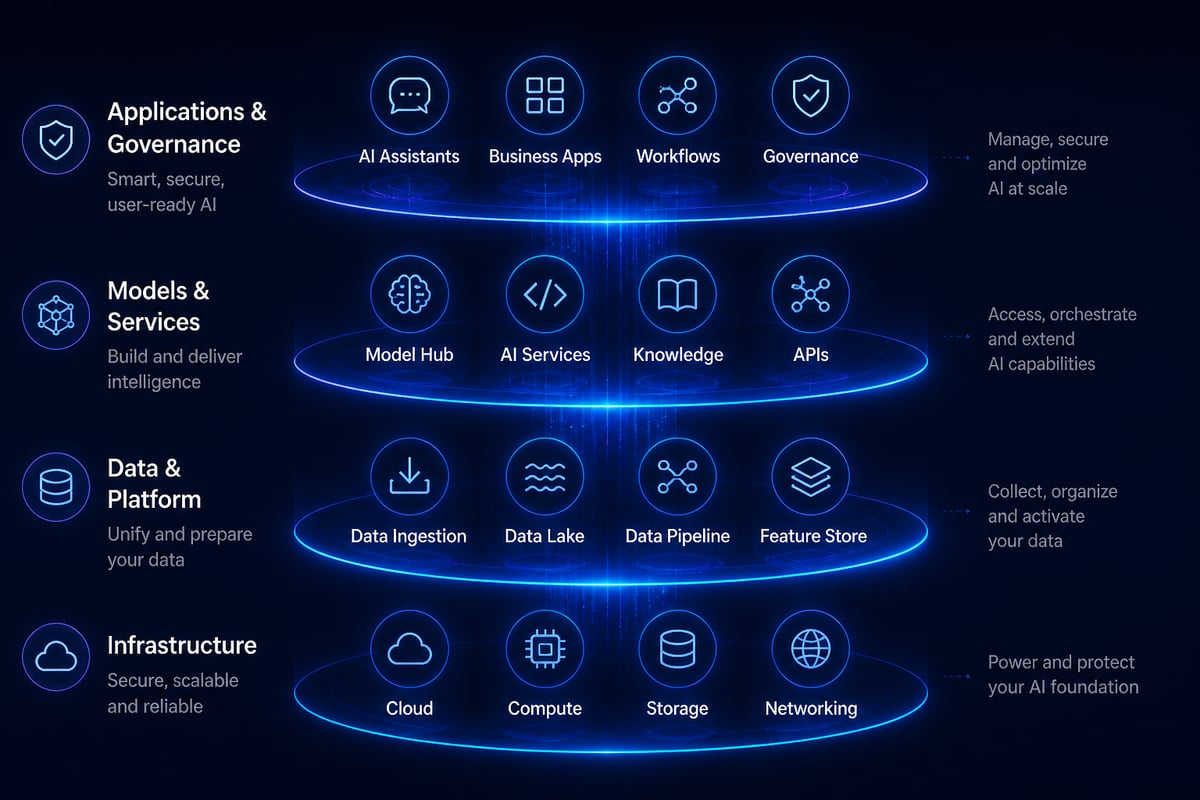
A platform for AI is the combination of infrastructure, models, tooling and governance that lets an organisation build, run and manage AI workloads, rather than a single application. For enterprises, the choice ranges from focused tools that solve one task, such as content or image generation, to cloud foundations that host custom AI at scale. This article compares six options and explains where each fits, with a bias towards organisations adopting Microsoft AI in Switzerland and Europe.
Adoption is moving quickly. According to Eurostat, 19.95% of EU enterprises used AI in 2025, and the figure reached 55.03% among large enterprises. The same source records a rise of 6.47 percentage points compared with 2024. For IT and innovation leaders, the question is no longer whether to adopt AI but which layer to standardise on.
1. Jasper: a platform for AI marketing content
Jasper is a marketing content generation tool built around brand-voice support, which makes it a focused platform for AI-assisted copy rather than a general foundation. It costs approximately £39 per month. Its brand-voice support means a team can encode tone and style once and apply them across campaigns, product pages and email sequences, rather than correcting each draft by hand. This matters most for organisations where several writers, agencies or regional teams contribute to the same brand and drift in tone is a recurring editorial cost.
- Key capabilities: marketing content generation and brand-voice support
- Approximate price: £39/month
- Suits: marketing teams producing branded content at scale, where consistency of tone matters more than model customisation
Eurostat reports that 34.70% of EU enterprises using AI applied it to marketing or sales in 2025, so this is a well-established use case. Jasper works as a standalone application, so data residency and access control need review before it is rolled out across a regulated organisation. A practical first step is to restrict early use to public-facing material, such as blog drafts and ad variants, and keep customer data and unreleased product details out of prompts until the review is complete. Human editing should remain part of the workflow, because generated copy still needs fact-checking and legal sign-off.
Verdict: A strong choice for branded content production, but a tool rather than a foundation.
2. Midjourney: a platform for AI image generation
Midjourney is an AI image generation service whose Basic plan costs approximately £8 per month as of November 2026 and includes commercial usage rights. Its appeal is image quality rather than enterprise integration. Teams typically use it to explore visual directions quickly, producing mood boards, campaign concepts and illustrative artwork in minutes rather than days. Because the Basic plan includes commercial usage rights, outputs can in principle move into published material, which removes one common barrier for small creative teams.
- Key capabilities: high-quality AI image generation, commercial usage rights on the Basic plan
- Approximate price: £8/month (Basic)
- Suits: creative and communications teams that prioritise image quality and need a low-cost entry point for concept visuals
Pricing and plan coverage for tools such as Midjourney and Runway should be checked directly with each provider before budgeting, as plans change frequently. Enterprises should confirm how generated assets are stored and reviewed before they reach customers. In practice that means agreeing who approves an image, how prompts and outputs are archived, and how brand and intellectual property checks are recorded. Without those steps, a low subscription cost can hide a significant review burden once usage spreads beyond a single design team.
Verdict: Excellent for visual output at a low price, with limited fit for governed enterprise workflows.
3. Runway: AI video generation and editing
Runway is an AI video generation and editing service, and its Standard plan costs approximately £12 per month as of November 2026, with 625 monthly credits when billed annually. A free plan includes 125 one-time credits, which allows a team to test it before committing. Because the free credits do not renew, they work best as a structured trial: pick one realistic task, such as a short product teaser or an internal announcement clip, and judge the output against what a conventional edit would cost in time.
- Key capabilities: video generation and editing, credit-based usage
- Approximate price: £12/month (Standard, billed annually); free plan with 125 one-time credits
- Suits: creators and internal communications teams generating and editing video on a small budget
The credit model keeps spend predictable for pilots, though heavier production use will consume credits faster than the entry plan implies. Each generation or edit draws on the monthly allowance, so repeated experimentation with a single clip can exhaust it well before the month ends. Teams moving beyond a pilot should track credits per finished video to forecast realistic cost. As with other creative tools, generated footage needs a review step before it appears in external communications.
Verdict: A practical way to trial AI video, best treated as a creative tool alongside a wider platform.
4. Stellium Consulting Cloud and AI Platforms: Azure foundations for enterprise AI
Cloud and AI Platforms is a service for building secure, scalable AI infrastructure on Microsoft Azure, from compliant landing zones to advanced AI deployments. It is the option on this list that functions as a true enterprise foundation, where the earlier tools function as applications. The service covers enterprise AI capabilities from foundation to execution, so the same engagement can begin with environment design and carry through to production workloads. That continuity avoids the handover gaps that appear when infrastructure, security and AI delivery are split across separate suppliers.
- Key capabilities: secure, scalable AI infrastructure and platforms on Azure; delivery by a Microsoft Solutions Partner; responsible AI built in, including human-in-the-loop validation, privacy safeguards and bias checks
- Suits: mid-to-large organisations in Switzerland and Europe that need AI workloads to sit inside their existing Microsoft estate, with compliance requirements defined up front
- Pricing: scoped to each client; see the Stellium Consulting AI services page for details
Stellium Consulting was selected as Microsoft Partner of the Year in Switzerland, and its named engagements include JTI, a Swiss law firm and a public hospital in Switzerland. For a deeper view of how Azure supports this work, see Stellium’s overview of the Azure AI platform. The mix of clients, spanning a multinational manufacturer, a legal practice and a hospital, reflects the range of data sensitivity that a shared foundation has to accommodate. Redesigning key processes around AI depends on infrastructure that several teams can safely share.
Verdict: The right layer when AI must be integrated, secure and ready to scale across the organisation.
5. Stellium Consulting AI Landing Zone Quick-Start: a 4-week Azure starting point
The AI Landing Zone Quick-Start is a 4-week setup of a compliant, reusable Azure environment ready for AI workloads. It addresses the most common early blocker for enterprise AI, which is the absence of a governed environment in which to run pilots. A fixed four-week window gives IT leaders a clear date by which teams can start building, which is easier to plan around than an open-ended infrastructure programme. The result is a defined starting point that sits within the wider Cloud and AI Platforms service.
- Key capabilities: compliant, reusable Azure environment; defined 4-week setup
- Suits: IT teams that want a governed base in place before multiple business units start AI experiments
- Pricing: available on request via the Stellium Consulting contact page
A reusable landing zone means each new AI project inherits the same security and policy baseline instead of rebuilding it. This reduces review cycles and keeps governance consistent. For example, a finance team and a marketing team can each deploy a pilot into the same environment, with identity, access rules and network controls already agreed, rather than negotiating them separately. Stellium’s thinking on AI governance platforms explains why this matters before scale.
Verdict: A low-risk first step for organisations that need structure before ambition.
6. Microsoft Azure AI: the model and service layer
Microsoft Azure AI provides the model catalogue, development tooling and managed services on which custom AI applications are built. It sits beneath the application layer and above the raw infrastructure, and it connects naturally to the rest of the Microsoft ecosystem that many European enterprises already run. Because identity, security and data services are shared with the wider Azure estate, developers can build on existing access controls rather than introducing a separate stack. That shortens the path from prototype to a service that security and compliance teams are willing to approve.
- Key capabilities: access to AI models, development and deployment services, integration with Microsoft security and identity
- Suits: organisations building custom AI solutions that must integrate with Microsoft 365, Dynamics and Power Platform
- Pricing: consumption-based; confirm current rates with Microsoft or a partner
Safety evaluation is a practical concern here. Stellium’s article on safety metrics for AI models in Azure Foundry shows how model choice can be tested against risk criteria before deployment. Consumption-based pricing also means cost follows usage, so a pilot with a handful of users can be inexpensive while a company-wide rollout needs proper forecasting. Setting budgets and monitoring from the first deployment prevents surprises as an application moves from a trial to daily use.
Verdict: The natural model layer for Microsoft-centred enterprises, most effective on a governed landing zone.
Platforms for AI compared
The table below compares all six options on the attributes that most affect an enterprise decision.
| Option | Type | Approximate price (as of November 2026) | Best use |
|---|---|---|---|
| Jasper | Marketing content tool | £39/month | Branded content at scale |
| Midjourney | Image generation tool | £8/month (Basic) | High-quality visuals |
| Runway | Video generation tool | £12/month (Standard, annual) | Video creation and editing |
| Cloud and AI Platforms | Azure AI foundation service | Scoped per client | Secure, scalable enterprise AI |
| AI Landing Zone Quick-Start | Azure setup service | On request | Compliant environment in 4 weeks |
| Microsoft Azure AI | Model and service layer | Consumption-based | Custom AI on Microsoft |
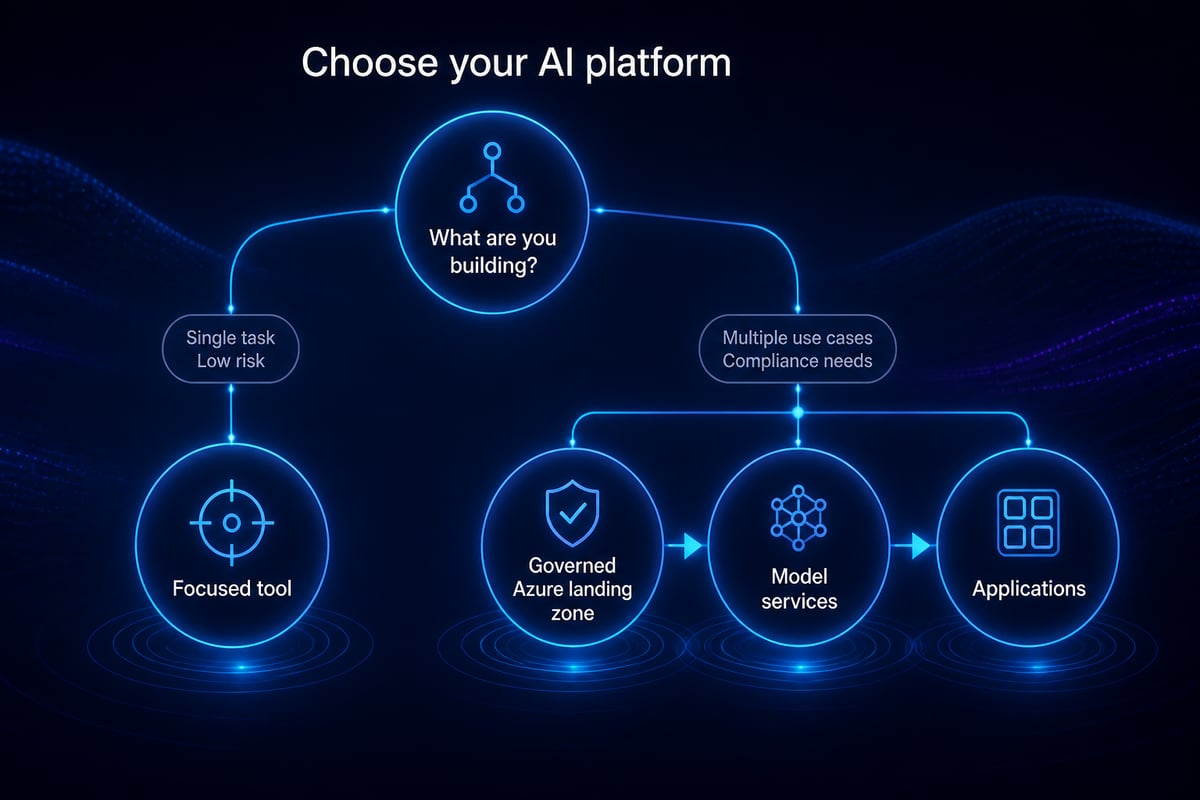
How to choose a platform for AI in an enterprise
Choose by the scale and risk of the use case: focused tools suit single tasks, while shared foundations suit anything touching regulated data or several business units. A sensible sequence has three steps.
- Define the use case and data sensitivity. Marketing copy and customer records carry very different risk.
- Fix the governance baseline first. Identity, data residency and policy should exist before pilots multiply.
- Add tools on top of the foundation. Applications such as Jasper or Runway then sit inside agreed boundaries.
The scale gap is real. Eurostat shows adoption rising with enterprise size, from 17% in small enterprises to 55.03% in large ones, which suggests that foundations matter more as organisations grow. Deloitte’s State of AI in the Enterprise survey found that most organisations reported productivity and efficiency gains, yet only about a third were using AI to deeply transform their business, while a similar share remained at a surface level. Moving beyond the surface generally requires a shared platform, not a collection of separate subscriptions.
Data readiness deserves equal attention. Stellium’s piece on data for AI covers why model quality depends on the condition of the underlying data.

FAQ
What are the AI platforms available now?
Options range from focused applications such as Jasper, Midjourney and Runway to cloud foundations such as Microsoft Azure AI. The right category depends on whether you need a single capability or a governed base for many use cases.
What can generative AI be used for?
Common uses include marketing content, image and video creation, document drafting and business administration. Eurostat reports that 34.70% of EU enterprises using AI applied it to marketing or sales, and 31.05% to business administration or management in 2025.
Is AI considered a platform?
AI itself is a technology, not a platform. A platform for AI is the infrastructure, models, tooling and governance that allow AI to be built and operated reliably across an organisation.
Start by listing your three most valuable AI use cases and marking which touch regulated or customer data, since that single exercise tells you whether a tool or a foundation comes first. If a governed environment is the missing piece, Stellium Consulting’s Cloud and AI Platforms service sets up Azure for AI workloads with responsible AI built in. Our team works hands-on and designs around your business goals rather than a template, so Let’s Talk about where your organisation should begin.