The statement “we are AI” represents far more than a technological declaration. It embodies the fundamental transformation occurring across enterprises worldwide, where artificial intelligence has become inseparable from how organisations operate, innovate, and compete. This integration reflects a paradigm shift from viewing AI as an external tool to recognising it as an intrinsic component of business strategy, employee empowerment, and operational excellence. Understanding that we are AI means acknowledging that modern enterprises cannot separate their identity from the intelligent systems that augment their capabilities.
The Evolution of Enterprise AI Integration
The journey towards accepting that we are AI has progressed through distinct phases. Early adoption focused on isolated automation projects, where AI served specific functions without broader organisational integration. Today’s landscape differs dramatically, with AI embedded throughout entire value chains.
Modern AI integration encompasses:
- Strategic decision-making powered by predictive analytics
- Customer engagement enhanced through intelligent automation
- Operational efficiency driven by machine learning algorithms
- Innovation accelerated by AI-augmented research and development
This evolution demonstrates how AI infrastructure solutions have matured from experimental initiatives to mission-critical systems. Enterprises no longer question whether to adopt AI, but rather how to integrate it most effectively across all organisational layers.
The transformation extends beyond technology deployment. When we are AI, we acknowledge that organisational culture, employee skills, and business processes must evolve alongside technological capabilities. This holistic approach ensures that AI investments deliver measurable returns whilst building sustainable competitive advantages.

Building Trust in AI Systems
Research into trustworthiness in AI-infused decision-making reveals critical factors that determine whether organisations successfully integrate AI. Trust emerges from transparency, consistency, and demonstrated value across multiple use cases.
Establishing trust requires deliberate frameworks that address concerns whilst highlighting benefits. Employees need confidence that AI systems augment rather than replace their expertise. Leadership must demonstrate how AI aligns with organisational values and strategic objectives.
| Trust Factor | Implementation Approach | Measurable Outcome |
|---|---|---|
| Transparency | Clear explanation of AI decision logic | Increased user acceptance rates |
| Reliability | Consistent performance across scenarios | Reduced error rates and exceptions |
| Value Demonstration | Quantifiable productivity improvements | Higher adoption velocity |
| Human Oversight | Defined escalation and review processes | Enhanced decision quality |
Empowering Employees Through AI Augmentation
The concept that we are AI fundamentally centres on employee empowerment. Rather than replacing human capability, successful AI implementation amplifies what employees can achieve. This augmentation creates opportunities for professionals to focus on high-value activities whilst AI handles repetitive, data-intensive tasks.
Research on AI automation and meaningful work emphasises the importance of designing systems that enhance rather than diminish work satisfaction. When implemented thoughtfully, AI elevates employee roles by removing tedious aspects whilst preserving the elements that provide fulfilment and purpose.
Practical Applications Across Functions
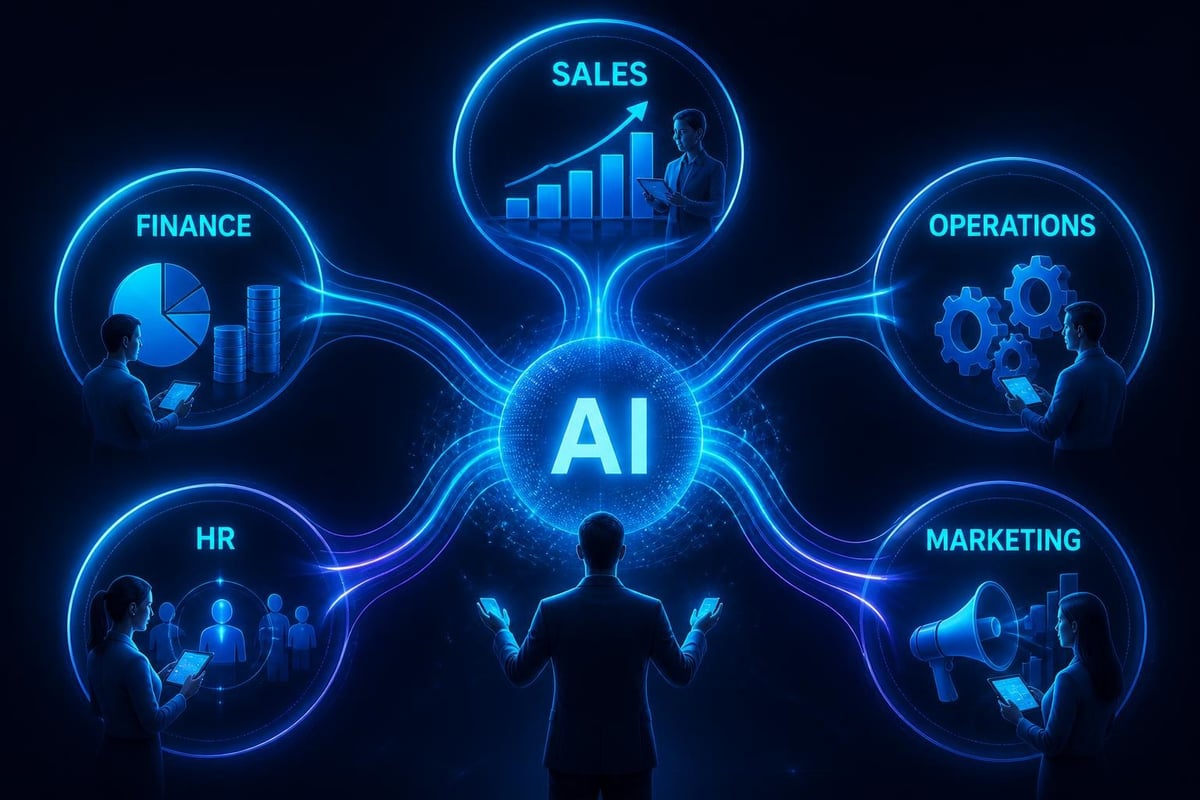
Different departments experience AI augmentation uniquely:
- Sales teams leverage AI-powered insights to identify opportunities and personalise customer interactions
- Finance professionals utilise predictive analytics for forecasting and risk assessment
- Operations managers deploy intelligent automation to optimise workflows and resource allocation
- Human resources applies AI to talent acquisition, development planning, and engagement analysis
- Marketing specialists harness AI for content personalisation and campaign optimisation
These applications demonstrate how AI productivity solutions transform daily workflows. The key lies in selecting tools that complement existing expertise rather than attempting to replicate it.
Modern platforms like Microsoft Copilot exemplify this augmentation philosophy. By integrating directly into familiar applications, these tools reduce friction whilst maximising value delivery. Employees maintain their preferred workflows whilst gaining AI-powered assistance exactly when needed.
Designing Responsible AI Frameworks
Acknowledging that we are AI demands responsibility in how these systems are developed, deployed, and governed. The ten guidelines for responsible AI use provide a foundation for ethical implementation that balances innovation with accountability.
Responsible frameworks address several critical dimensions:
- Data governance ensuring privacy, security, and compliance
- Algorithmic fairness preventing bias and discrimination
- Transparency standards making AI decisions explainable
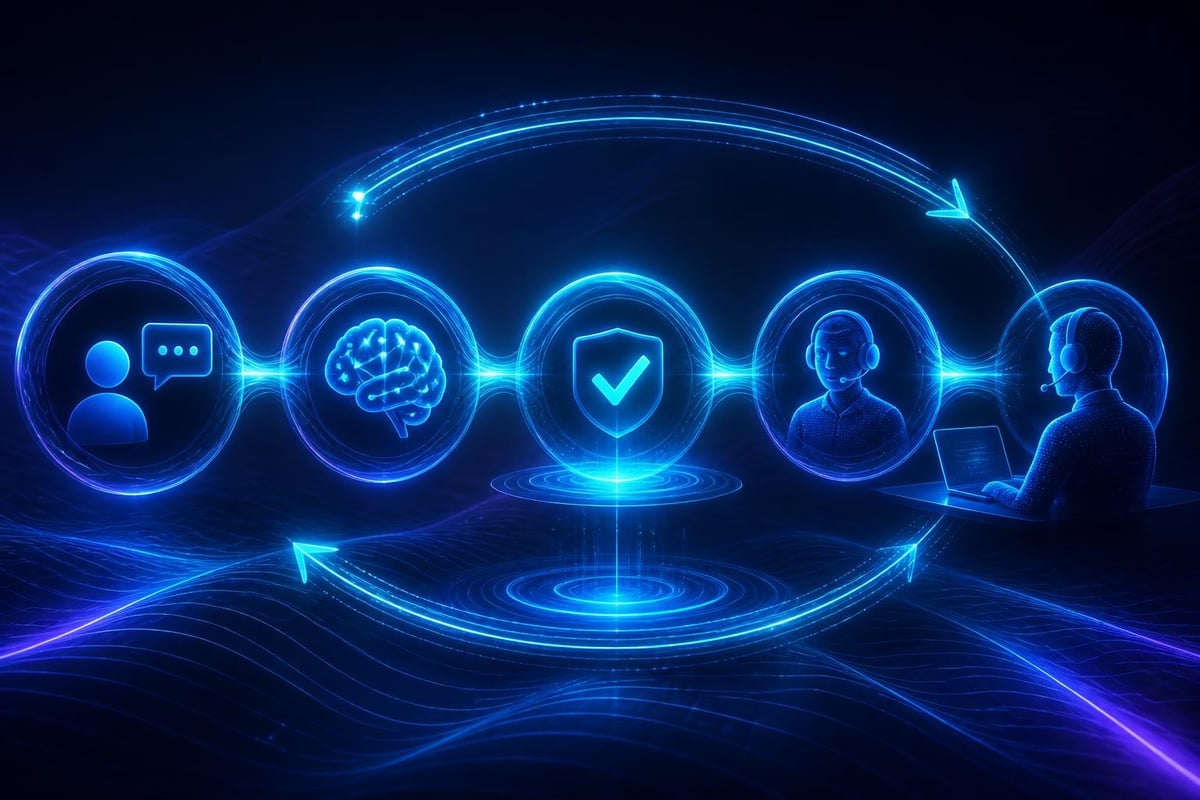
- Human oversight maintaining appropriate control mechanisms
- Continuous monitoring detecting and correcting issues proactively
Educational initiatives like the “We Are AI” course developed by NYU’s Centre for Responsible AI demonstrate the growing emphasis on public understanding and engagement. These programmes equip stakeholders with knowledge to participate meaningfully in AI governance discussions.
Implementing Governance Structures
Effective AI governance requires clear structures that define roles, responsibilities, and decision-making authority. Enterprises must establish committees or councils that oversee AI initiatives, ensuring alignment with organisational values and regulatory requirements.
Key governance components include:
- Executive sponsorship providing strategic direction and resource allocation
- Technical standards defining development and deployment protocols
- Risk assessment frameworks identifying and mitigating potential harms
- Stakeholder engagement mechanisms incorporating diverse perspectives
- Performance metrics measuring both technical and ethical outcomes
These structures ensure that as we are AI, we remain accountable for the systems we create and deploy. Governance transforms from checkbox compliance into strategic advantage when organisations use it to build trust and differentiate their offerings.
Transforming Business Processes With Intelligent Automation
Process transformation represents the most tangible evidence that we are AI. Artificial intelligence automation solutions are reshaping how enterprises handle everything from customer service to supply chain management.
Intelligent automation differs from traditional automation through its ability to handle unstructured data, adapt to changing conditions, and improve through experience. This capability enables organisations to automate complex processes previously requiring human judgement.
| Process Area | Traditional Automation | Intelligent Automation | Business Impact |
|---|---|---|---|
| Customer Service | Rule-based responses | Natural language understanding | 40-60% efficiency gain |
| Document Processing | Template matching | Contextual comprehension | 70-80% time reduction |
| Quality Control | Fixed parameters | Adaptive learning | 30-50% defect reduction |
| Forecasting | Historical patterns | Multi-variable prediction | 20-35% accuracy improvement |
The vision of running AI locally where data resides addresses concerns about data sovereignty and latency. This approach enables enterprises to harness AI benefits whilst maintaining control over sensitive information, particularly relevant for regulated industries.
Building Scalable AI Architectures
Successful process transformation requires robust technical foundations. Organisations must design architectures that support AI workloads whilst integrating seamlessly with existing systems. This technical groundwork determines whether AI initiatives deliver isolated benefits or drive enterprise-wide transformation.
Modern architectures emphasise modularity, allowing organisations to deploy AI capabilities incrementally whilst maintaining flexibility. Cloud-native approaches provide scalability and resilience, ensuring that AI systems can grow alongside business demands.
Strategic AI Implementation Across Industries
Different sectors experience the reality that we are AI through industry-specific applications. Understanding these variations helps enterprises identify opportunities relevant to their context whilst learning from adjacent markets.
Financial services leverage AI for fraud detection, algorithmic trading, and personalised wealth management. Healthcare organisations apply AI to diagnostic support, treatment optimisation, and operational efficiency. Manufacturing enterprises utilise AI for predictive maintenance, quality assurance, and supply chain optimisation.
Telecommunications operations demonstrate how intelligent automation streamlines complex technical environments. These implementations showcase AI’s capacity to manage vast networks whilst improving service reliability and customer experience.
Sector-Specific Considerations
- Regulatory environment shapes what AI applications are permissible and how they must be governed
- Data availability determines which AI techniques can be effectively deployed
- Competitive dynamics influence the urgency and scope of AI adoption
- Talent landscape affects implementation speed and in-house capability development
- Customer expectations drive prioritisation of customer-facing versus internal applications
These factors explain why AI strategy consulting proves valuable. External expertise helps organisations navigate industry-specific challenges whilst avoiding common pitfalls. Strategic guidance ensures that AI investments align with business objectives rather than following technology trends.
The impact of AI in business continues expanding as capabilities mature and costs decline. Enterprises that recognise we are AI position themselves to capture emerging opportunities whilst managing associated risks proactively.
Measuring AI Success and ROI
Quantifying AI value requires metrics that capture both tangible and intangible benefits. Traditional ROI calculations often underestimate AI impact by focusing exclusively on cost reduction whilst overlooking revenue generation, risk mitigation, and capability building.
Comprehensive measurement frameworks include:
- Operational metrics tracking efficiency, accuracy, and throughput improvements
- Financial metrics quantifying cost savings and revenue growth
- Customer metrics assessing satisfaction, retention, and lifetime value
- Employee metrics evaluating productivity, satisfaction, and capability development
- Strategic metrics measuring competitive position and innovation velocity
The 2026 AI trends emphasise outcome-based evaluation rather than technology-centric assessment. This shift reflects maturation from “AI for AI’s sake” towards disciplined focus on business value creation.
Establishing Baseline and Tracking Progress
Successful measurement begins before AI deployment. Organisations must establish clear baselines capturing current performance across relevant dimensions. These baselines enable accurate attribution of improvements to AI initiatives rather than confounding factors.
Tracking should occur at multiple intervals: immediate post-deployment, short-term stabilisation (3-6 months), and long-term value realisation (12-24 months). This temporal perspective reveals how AI benefits evolve as systems mature and users develop proficiency.
| Measurement Phase | Key Focus | Typical Metrics | Action Items |
|---|---|---|---|
| Pre-deployment | Baseline establishment | Current performance levels | Document existing processes |
| Initial deployment | Technical validation | System accuracy and reliability | Address technical issues |
| Early adoption | User acceptance | Adoption rates and satisfaction | Enhance training and support |
| Maturity | Business impact | ROI and strategic outcomes | Scale successful initiatives |
Partnering for AI Excellence
The acknowledgement that we are AI extends to recognising when external expertise accelerates success. Whilst internal teams provide domain knowledge and cultural understanding, partners contribute specialised capabilities and proven methodologies.
Microsoft Solutions Partners offer particular value through their deep platform expertise and access to cutting-edge capabilities. These partnerships enable organisations to leverage enterprise-grade AI tools whilst benefiting from implementation best practices refined across numerous deployments.
Collaboration with specialists in AI and ML technology solutions provides access to talent that may be difficult to recruit or develop internally. This partnership model allows organisations to move quickly whilst building internal capabilities progressively.
Selecting the Right Partner
Effective partnerships require alignment across multiple dimensions:
- Technical capability matching your specific AI requirements and existing technology stack
- Industry experience understanding sector-specific challenges and regulatory requirements
- Delivery methodology compatible with your organisational culture and project preferences
- Knowledge transfer commitment to building internal capabilities alongside delivering solutions
- Long-term vision partnership approach rather than transactional engagement
The detailed course development process for AI education programmes illustrates the rigour required to build effective AI capabilities. Whether through formal training or hands-on implementation, capability development demands structured approaches that balance theoretical understanding with practical application.
Building AI-Ready Organisational Culture
Technology deployment alone cannot fulfil the promise that we are AI. Organisational culture must evolve to embrace experimentation, accept calculated risks, and value continuous learning. This cultural transformation often proves more challenging than technical implementation.
AI-ready cultures exhibit several characteristics:
- Data-driven decision-making replacing intuition with evidence-based approaches
- Collaborative mindsets breaking down silos between technical and business functions
- Learning orientation viewing failures as opportunities for improvement
- Customer centricity focusing AI initiatives on enhancing customer value
- Ethical awareness considering broader implications of AI deployment
Leadership plays a crucial role in cultural evolution. Executives must model desired behaviours, allocate resources to capability building, and celebrate both successes and instructive failures. This top-down commitment signals that AI represents strategic priority rather than peripheral initiative.
Addressing Change Resistance
Resistance to AI adoption stems from legitimate concerns: job security fears, scepticism about promised benefits, discomfort with new tools, and uncertainty about personal capability to adapt. Addressing these concerns requires transparent communication, meaningful involvement, and demonstrated quick wins.
Change management strategies should include:
- Clear articulation of how AI augments rather than replaces human roles
- Involvement of end-users in solution design and deployment planning
- Comprehensive training programmes tailored to different skill levels
- Visible executive support and resource commitment
- Recognition and reward for early adopters and successful implementations
Future-Proofing Through Continuous Evolution
The recognition that we are AI demands acknowledgement that AI itself continues evolving rapidly. Organisations cannot treat AI adoption as a one-time project with a defined endpoint. Instead, they must establish capabilities for continuous evaluation, learning, and adaptation.
Future-proofing strategies include maintaining technological flexibility, investing in employee development, monitoring emerging capabilities, and participating in industry ecosystems. These approaches ensure that organisations can absorb new AI advances without disruptive overhauls.
Business intelligence using AI exemplifies how AI capabilities layer and compound over time. Initial deployments create data foundations and user familiarity that enable more sophisticated applications subsequently. This progressive sophistication rewards organisations that start their AI journey early and commit to sustained investment.
Preparing for Emerging Capabilities
Developments in areas like agentic AI, multimodal systems, and edge computing promise to expand what organisations can achieve. Preparing for these advances requires monitoring technology trends, maintaining architectural flexibility, and cultivating relationships with innovation partners.
Agencies specialising in AI-powered digital solutions demonstrate the breadth of applications possible as AI capabilities mature. From graphic design to application development, AI touches increasingly diverse aspects of business operations. Organisations that build foundational capabilities position themselves to capitalise on these expanding possibilities.
Understanding that we are AI transforms how enterprises approach technology, talent, and transformation. This recognition moves organisations from passive AI adoption to active AI integration, where intelligent systems become fundamental to competitive advantage. Success requires balancing technological capability with responsible governance, employee empowerment with process efficiency, and immediate value with long-term strategic positioning. Whether you’re beginning your AI journey or scaling existing initiatives, Stellium Consulting brings deep expertise in delivering AI-powered solutions that empower employees, enhance processes, and transform enterprises. Our team of Microsoft Solutions Partners stands ready to guide your organisation towards sustainable AI excellence tailored to your unique business context.