
AI workflow automation represents one of the most transformative shifts in enterprise operations today. As organisations face increasing pressure to do more with less whilst maintaining quality and compliance, intelligent automation has emerged as the solution that bridges human expertise with machine efficiency. Unlike traditional automation that simply follows predetermined rules, AI workflow automation adapts, learns, and makes decisions within complex business processes. This evolution marks a fundamental change in how enterprises approach operational excellence, moving from static procedures to dynamic, intelligent systems that continuously improve.
Understanding AI Workflow Automation in the Enterprise Context
AI workflow automation combines artificial intelligence capabilities with traditional process automation to create systems that can handle complex, multi-step procedures with minimal human intervention. These systems leverage machine learning, natural language processing, and decision intelligence to execute tasks that previously required human judgment.
The technology differs fundamentally from robotic process automation (RPA) in several key ways. Whilst RPA executes predefined rules, AI workflow automation interprets context, handles exceptions, and improves over time. According to Deloitte’s 2026 Workflow Automation Outlook report, enterprises are increasingly moving beyond simple task automation towards AI-ready architectures that support end-to-end process transformation.
Core Components of Modern AI Workflow Systems
Every effective AI workflow automation system comprises several integrated elements:
- Intelligent orchestration engines that coordinate tasks across multiple systems and departments
- Decision-making algorithms that evaluate conditions and determine appropriate actions
- Integration layers that connect disparate enterprise applications and data sources
- Monitoring and analytics capabilities that track performance and identify optimisation opportunities
- Governance frameworks that ensure compliance, security, and human oversight
These components work together to create systems that handle everything from simple document processing to complex multi-departmental approval chains. The sophistication lies not in any single component but in how they coordinate to deliver seamless automation.

Implementing AI Workflow Automation: Strategic Considerations
Success in AI workflow automation depends heavily on strategic planning and methodical execution. Organisations that rush implementation without proper groundwork typically encounter resistance, compliance issues, and disappointing returns on investment.
The first consideration involves selecting appropriate processes for automation. Not every workflow benefits equally from AI enhancement. The most suitable candidates share common characteristics: high volume, repetitive patterns, clear decision criteria, and significant time consumption. Custom AI development initiatives should focus on workflows where AI adds genuine value rather than automating for automation’s sake.
Assessment and Prioritisation Framework
| Evaluation Criteria | High Priority | Medium Priority | Low Priority |
|---|---|---|---|
| Transaction Volume | >1000/month | 100-1000/month | <100/month |
| Time Per Task | >30 minutes | 10-30 minutes | <10 minutes |
| Error Rate Impact | Critical | Moderate | Minimal |
| Compliance Requirements | Regulated | Governed | Discretionary |
| ROI Timeline | <6 months | 6-12 months | >12 months |
This framework helps organisations identify where to invest their automation efforts first. High-priority workflows deliver faster returns and build organisational confidence in AI capabilities.
Beyond selection, documenting business processes for AI automation becomes essential. Many enterprises discover their processes exist primarily in employees’ heads rather than in documented procedures. Creating AI-ready documentation requires capturing not just steps but decision logic, exception handling, and data dependencies.
Real-World Applications Across Business Functions
AI workflow automation delivers measurable value across virtually every enterprise function. Understanding these applications helps organisations envision possibilities within their own operations.
Finance and Accounting Workflows
Finance departments leverage AI workflow automation for invoice processing, expense management, and financial close procedures. Modern systems extract data from invoices using computer vision, match purchases against orders, identify discrepancies, and route exceptions to appropriate personnel. This automation reduces processing time from days to hours whilst improving accuracy rates beyond 99%.
Monthly close procedures particularly benefit from intelligent automation. Systems coordinate tasks across departments, monitor completion status, identify bottlenecks, and escalate delays automatically. What once required extensive manual coordination now proceeds with minimal intervention.
Human Resources and Talent Management
HR workflows encompass recruitment, onboarding, performance management, and employee service delivery. AI workflow automation transforms these processes by handling repetitive administrative tasks whilst preserving the human touch where it matters most.
Recruitment workflows can screen CVs, schedule interviews, conduct initial assessments, and maintain candidate communications automatically. AI solutions for employees enhance the experience for both recruiters and candidates by reducing delays and improving transparency.
- Candidate sourcing and initial screening
- Interview coordination and scheduling
- Assessment administration and scoring
- Offer generation and approval routing
- Onboarding task orchestration
- Equipment and access provisioning
Each step flows seamlessly into the next, with AI handling routine decisions and escalating complex situations to human judgment.
Customer Service and Support Operations
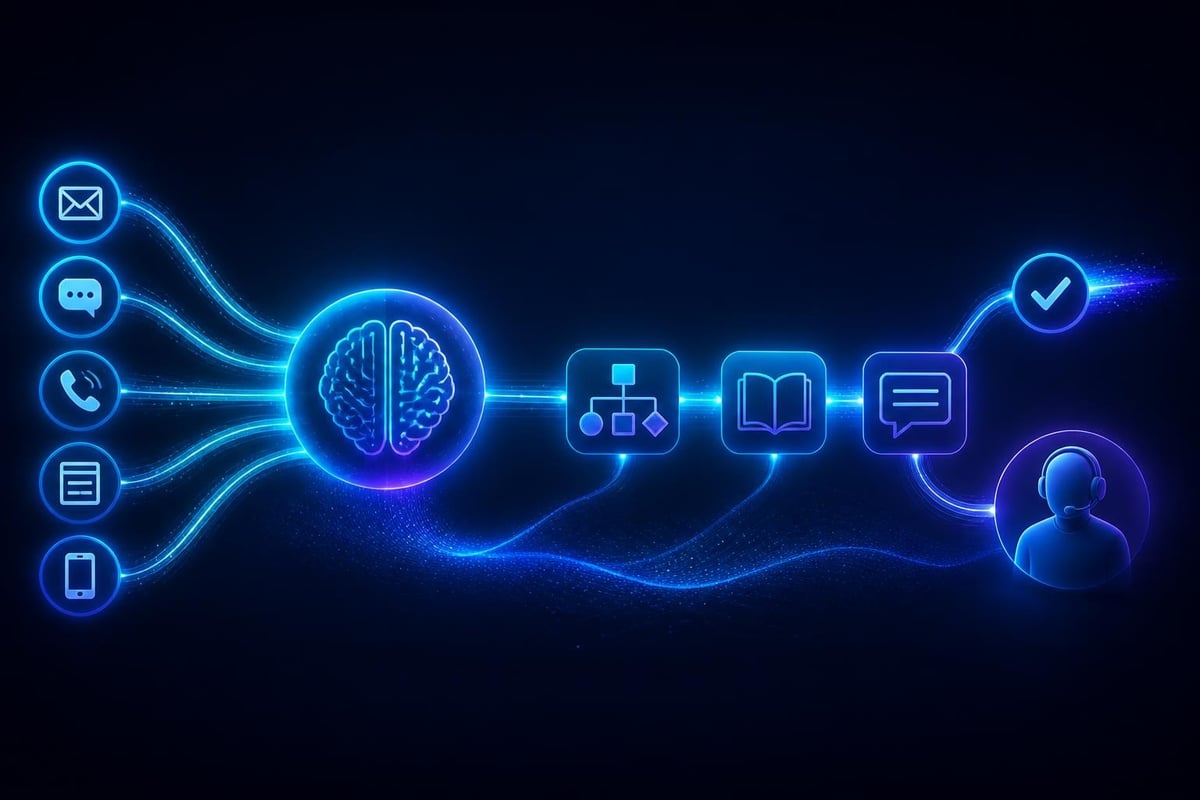
Customer service represents perhaps the most visible application of AI workflow automation. Intelligent systems now handle inquiry routing, knowledge base searches, ticket classification, and response generation with impressive accuracy.
The technology excels at triaging incoming requests, identifying urgent issues, gathering preliminary information, and connecting customers with appropriate resources. This approach dramatically reduces resolution times whilst freeing support staff to focus on complex problems requiring empathy and creative problem-solving.
Technical Architecture and Integration Patterns
Building robust AI workflow automation requires careful attention to technical architecture. The most successful implementations share common architectural patterns that ensure scalability, reliability, and maintainability.
Event-Driven Architecture Fundamentals
Modern AI workflow systems typically adopt event-driven architectures that respond to triggers across the enterprise ecosystem. When a customer submits an order, uploads a document, or requests service, these events initiate appropriate workflows automatically.
This approach offers several advantages:
- Loose coupling between systems reduces dependencies and simplifies changes
- Real-time responsiveness ensures workflows begin immediately when conditions are met
- Scalability allows systems to handle varying workload volumes efficiently
- Resilience prevents failures in one component from cascading throughout the system
Integration with existing enterprise systems requires thoughtful planning. AI system integration projects must address authentication, data synchronisation, error handling, and version compatibility across multiple platforms.
Data Flow and Governance Considerations
AI workflow automation depends entirely on data quality and accessibility. Systems require clear definitions of what data they can access, how they should use it, and what governance controls apply. Documenting data access requirements becomes essential for production readiness.
Key data governance elements include:
- Field-level access controls that restrict sensitive information appropriately
- Audit trails that track how data flows through automated processes
- Data quality rules that prevent workflows from acting on unreliable information
- Retention policies that ensure compliance with regulatory requirements
- Privacy controls that protect personal and confidential data
These considerations directly impact both the effectiveness and safety of AI workflow automation implementations.
Measuring Success and Optimising Performance
Implementing AI workflow automation represents just the beginning. Continuous measurement and optimisation determine whether these systems deliver sustained value or gradually decline in effectiveness.
Establishing Meaningful Metrics
Different stakeholders require different metrics to evaluate AI workflow automation success. Operations teams focus on efficiency gains, finance departments examine cost reduction, whilst business leaders assess strategic impact.
| Metric Category | Example Measurements | Typical Targets |
|---|---|---|
| Efficiency | Processing time reduction | 60-80% improvement |
| Quality | Error rate decrease | <1% error rate |
| Cost | Labour hours saved | 40-60% reduction |
| Experience | Customer satisfaction | +15-25 point increase |
| Strategic | Process capacity increase | 2-3x throughput |
Regular monitoring against these metrics reveals whether AI workflow automation delivers expected benefits. According to Deloitte’s State of AI in the Enterprise research, organisations moving AI projects into production report significantly higher satisfaction when they establish clear success metrics from the outset.
Continuous Improvement Processes
AI workflow automation systems should improve over time through systematic refinement. This improvement happens through multiple mechanisms: algorithm training on new data, process redesign based on bottleneck analysis, and capability expansion as confidence grows.
Successful organisations establish regular review cycles that examine:
- Exception handling patterns to identify opportunities for automation expansion
- User feedback on workflow effectiveness and pain points
- Performance trends across different scenarios and conditions
- New technology capabilities that could enhance existing workflows
- Changing business requirements that necessitate workflow adjustments
This continuous improvement approach ensures AI workflow automation remains aligned with evolving business needs rather than becoming rigid and outdated.

Addressing Common Implementation Challenges
Despite its potential, AI workflow automation presents significant challenges that organisations must navigate carefully. Understanding these obstacles in advance enables better planning and risk mitigation.
Change Management and User Adoption
Technical excellence means little if employees resist or circumvent automated workflows. Successful adoption requires addressing concerns about job security, providing adequate training, and demonstrating clear benefits to those affected by changes.
Effective change management strategies include involving end users in design decisions, running pilot programmes that prove value before broad rollout, and celebrating early wins that build momentum. Organisations that treat AI workflow automation as purely a technology initiative typically struggle with adoption regardless of technical quality.
Balancing Automation with Human Oversight
Complete automation rarely proves appropriate even for highly structured workflows. Determining the right balance between machine autonomy and human oversight requires nuanced judgment.
The concept of human-in-the-loop design addresses this challenge by identifying decision points where human review adds value. These touchpoints might involve:
- High-stakes decisions with significant financial or reputational impact
- Edge cases that fall outside normal operating parameters
- Ethical considerations requiring human judgment and empathy
- Learning opportunities where human feedback improves AI models
- Compliance requirements mandating human review or approval
Research on agent workflow frameworks highlights the importance of clear protocols for human-AI collaboration, particularly in complex multi-agent systems.
Documentation and Knowledge Management
Comprehensive documentation separates sustainable AI workflow automation from fragile systems that collapse when key personnel leave. Proper documentation serves multiple audiences and purposes.
Creating Maintainable Workflow Documentation
Effective workflow documentation captures not just what systems do but why they operate that way. This includes business rationale, technical implementation details, exception handling procedures, and maintenance requirements.
Best practices for documenting AI workflows emphasise several critical elements:
- Purpose statements that explain workflow objectives and success criteria
- Role definitions that clarify who owns, operates, and monitors each workflow
- Prompt templates that standardise how AI components receive instructions
- Quality checkpoints that verify workflow outputs meet requirements
- Risk controls that prevent errors from causing significant harm
- Performance metrics that enable ongoing assessment
This documentation proves invaluable during audits, troubleshooting, and knowledge transfer situations.
Industry-Specific Applications and Use Cases
Whilst core principles remain consistent, AI workflow automation manifests differently across industries based on sector-specific requirements and constraints.
Healthcare and Life Sciences
Healthcare organisations implement AI workflow automation for patient scheduling, insurance verification, clinical documentation, and care coordination. These workflows must meet stringent privacy regulations whilst maintaining accuracy that directly impacts patient outcomes.
Radiology departments exemplify this application. AI systems automatically route imaging studies, flag urgent findings, match current scans with historical images, and generate preliminary reports. Radiologists then review and finalise these reports, combining AI efficiency with human expertise.
Manufacturing and Supply Chain
Manufacturing workflows benefit from AI automation in quality control, predictive maintenance, inventory management, and production scheduling. Modern systems analyse sensor data, predict equipment failures, automatically order replacement parts, and adjust production schedules to minimise downtime.
Supply chain orchestration represents another high-value application. AI workflow automation coordinates supplier communications, tracks shipments, predicts delays, identifies alternative routing options, and updates stakeholders automatically throughout the process.
Financial Services and Banking
Banks and financial institutions deploy AI workflow automation extensively for loan processing, fraud detection, regulatory reporting, and customer onboarding. These workflows must balance speed with rigorous compliance requirements.
Loan origination workflows particularly demonstrate AI workflow automation’s value. Systems gather documentation, verify information across multiple sources, assess credit risk, identify missing requirements, communicate with applicants, and prepare approval packages. Processing times drop from weeks to days whilst maintaining or improving decision quality.
Real-world AI workflow automation examples across these industries demonstrate measurable outcomes including cost reductions of 40-70%, cycle time improvements of 50-80%, and accuracy rates exceeding 95%.
Security and Compliance Frameworks
Security and compliance represent non-negotiable requirements for enterprise AI workflow automation. Systems handling sensitive data or regulated processes must incorporate robust controls from inception.
Building Secure Automation Systems
Security considerations permeate every aspect of AI workflow automation architecture. Access controls determine who can modify workflows, audit logs track all system actions, encryption protects data in transit and at rest, and anomaly detection identifies suspicious patterns.
Particular attention must address:
- Authentication and authorisation mechanisms that verify user and system identities
- Data segregation that prevents workflows from accessing inappropriate information
- Vulnerability management that keeps all components patched and current
- Incident response procedures that activate when security events occur
- Penetration testing that validates security control effectiveness
AI infrastructure solutions must incorporate these security principles throughout their design rather than adding them as afterthoughts.
Regulatory Compliance Management
Different industries face varying regulatory requirements that AI workflow automation must respect. Financial services workflows must comply with anti-money laundering rules, healthcare systems must protect patient privacy, and public sector automation must ensure transparency and fairness.
Compliance-focused workflow design includes automated audit trail generation, segregation of duties enforcement, retention policy implementation, and regulatory reporting automation. These controls ensure workflows operate within legal and ethical boundaries whilst providing evidence of compliance during audits.
Future Directions and Emerging Trends
AI workflow automation continues evolving rapidly as new technologies emerge and adoption patterns mature. Understanding these trends helps organisations prepare for what comes next.
Agentic AI and Autonomous Workflows
The next generation of AI workflow automation incorporates agentic AI that can plan multi-step procedures, adapt to changing conditions, and coordinate with other AI agents autonomously. Research on AI-powered automation for scientific discovery demonstrates how these systems might handle entire complex workflows from hypothesis generation through validation.
This evolution raises important questions about oversight, accountability, and control. As workflows become more autonomous, organisations must establish clear boundaries around decision authority and ensure humans remain appropriately involved.
Integration with Emerging Technologies
AI workflow automation increasingly integrates with other emerging technologies including blockchain for immutable audit trails, quantum computing for complex optimisation problems, and edge computing for real-time processing at data sources.
The convergence creates new possibilities but also new complexity. Organisations must balance innovation with practicality, adopting new capabilities when they solve real problems rather than chasing technological novelty.
Building Organisational Capabilities
Long-term success with AI workflow automation requires developing organisational capabilities beyond individual implementations. These capabilities span technical skills, process design expertise, and cultural readiness.
Developing Internal Expertise
Whilst external partners provide valuable support, organisations benefit from cultivating internal AI workflow automation expertise. This includes training business analysts to identify automation opportunities, developing technical staff who can maintain and enhance workflows, and building leadership understanding of AI capabilities and limitations.
AI adoption best practices emphasise starting with education and capability building before large-scale deployment. Organisations that invest in their people alongside technology achieve better outcomes than those focusing exclusively on tools.
Creating a Centre of Excellence
Many successful enterprises establish AI centres of excellence that coordinate automation efforts across business units. These centres develop standards, share best practices, maintain common platforms, and provide expertise to project teams.
Benefits of this centralised approach include:
- Avoiding redundant development of similar workflows across departments
- Maintaining consistent governance and security standards
- Accelerating implementation through reusable components
- Building deeper expertise through focused investment
- Ensuring knowledge transfer and documentation continuity
The centre of excellence model works particularly well in large organisations where multiple departments pursue AI workflow automation independently.
AI workflow automation has matured from experimental technology to enterprise necessity, delivering measurable improvements in efficiency, quality, and strategic capability. Success requires balancing technical excellence with change management, security with usability, and automation with appropriate human oversight. As a Microsoft Solutions Partner specialising in AI-powered solutions, Stellium Consulting helps enterprises navigate this complexity, designing and implementing workflow automation that empowers employees, enhances processes, and transforms organisations through modern AI capabilities.