
Enterprises seeking competitive advantage in 2026 increasingly recognise that off-the-shelf software cannot address their unique operational challenges and strategic objectives. Custom AI development emerges as the strategic imperative for organisations requiring solutions precisely aligned with their specific workflows, data ecosystems, and business models. Unlike generic AI tools, bespoke systems integrate seamlessly with existing infrastructure whilst delivering capabilities designed exclusively for an organisation’s requirements. This approach empowers businesses to harness artificial intelligence in ways that standardised products simply cannot replicate, driving innovation whilst maintaining complete control over functionality, security, and performance.
Understanding Custom AI Development Fundamentals
Custom AI development represents the process of designing, building, and deploying artificial intelligence systems tailored specifically to an organisation’s unique requirements. This differs fundamentally from implementing pre-built AI solutions or software-as-a-service platforms.
The bespoke approach allows enterprises to address precisely their operational challenges, competitive positioning, and strategic goals. Rather than adapting business processes to fit generic software capabilities, custom AI development creates technology that conforms to how organisations actually operate.
Why Enterprises Choose Bespoke AI Solutions
Several compelling factors drive organisations towards custom AI development rather than commercial alternatives:
- Proprietary data utilisation: Leveraging unique datasets that provide competitive advantages
- Specific workflow integration: Seamless alignment with established business processes
- Compliance requirements: Meeting industry-specific regulatory standards and governance frameworks
- Intellectual property protection: Maintaining complete ownership of algorithms and training methodologies
- Scalability control: Building systems that expand precisely as business needs evolve
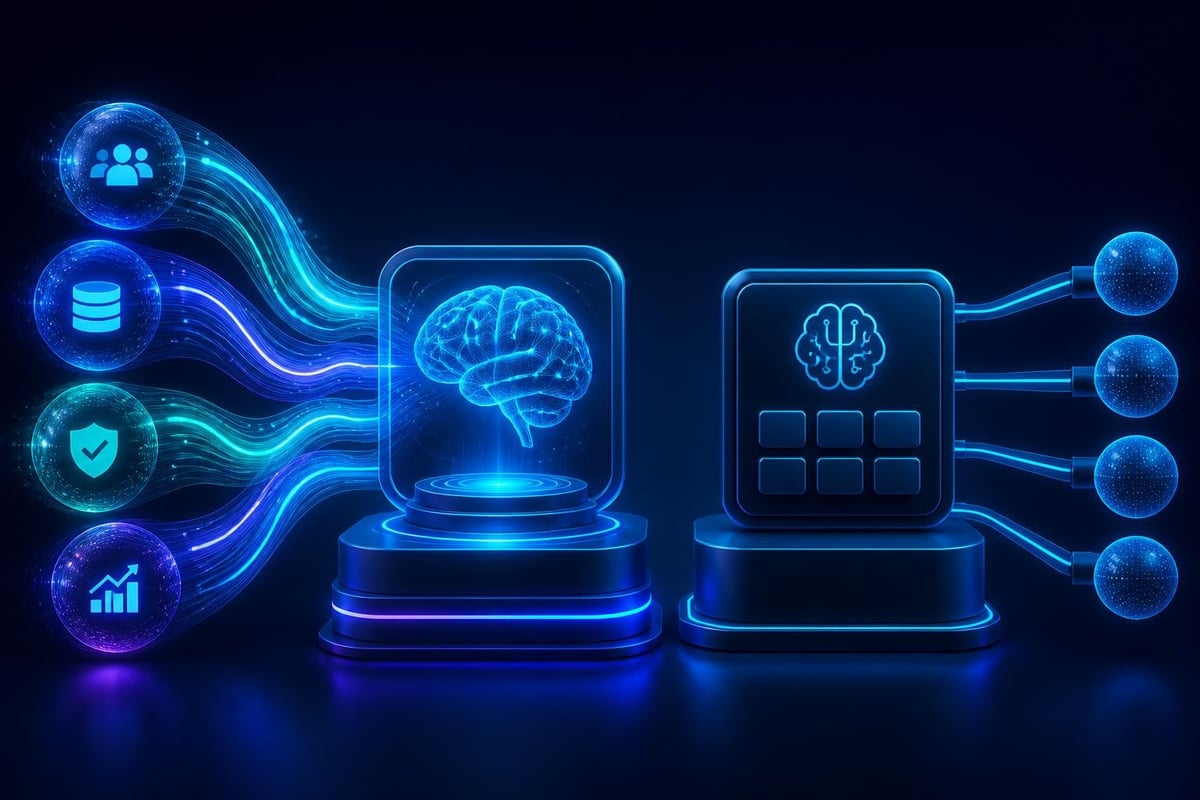
These considerations become particularly critical for enterprises operating in regulated industries or those possessing valuable proprietary information. The AI infrastructure solution framework provides foundations upon which bespoke systems can be constructed efficiently.
Strategic Planning for Custom AI Development
Successful custom AI development begins long before any code is written. Strategic planning establishes the foundation upon which effective solutions are built.
Defining Business Objectives and Success Metrics
Clarity regarding what the AI system must accomplish drives every subsequent decision. Enterprises should articulate specific, measurable objectives rather than vague aspirations.
| Objective Type | Example | Success Metric |
|---|---|---|
| Operational Efficiency | Automate document processing | 75% reduction in processing time |
| Revenue Growth | Personalised recommendation engine | 20% increase in conversion rates |
| Risk Mitigation | Fraud detection system | 90% accuracy with <2% false positives |
| Customer Experience | Intelligent support chatbot | 80% query resolution without escalation |
These objectives inform architectural decisions, technology selections, and resource allocation throughout the development lifecycle. AI strategy consulting helps organisations articulate these goals effectively.
Conducting Feasibility Assessments
Not every business challenge requires or benefits from custom AI development. Rigorous feasibility assessment prevents costly missteps.
Technical feasibility examines whether available data possesses sufficient quality, quantity, and relevance to train effective models. Financial feasibility analyses whether expected benefits justify development and operational costs. Organisational feasibility evaluates whether the enterprise possesses or can acquire necessary talent and change management capabilities.
This assessment phase typically reveals whether artificial intelligence automation solutions warrant custom development or whether existing tools suffice.
The Custom AI Development Process
Understanding the custom AI development process helps enterprises anticipate resource requirements, timelines, and decision points throughout implementation.
Discovery and Requirements Gathering
This foundational phase establishes what the system must accomplish and under what constraints it must operate.
- Stakeholder interviews: Engaging users, managers, and technical teams to understand needs
- Process mapping: Documenting current workflows and identifying improvement opportunities
- Data inventory: Cataloguing available data sources, formats, and quality levels
- Constraint identification: Defining technical, regulatory, and budgetary limitations
- Success criteria definition: Establishing measurable outcomes that constitute success
Thorough discovery prevents scope creep and ensures development efforts focus on genuine business value. Many organisations find that AI adoption best practices emphasise investing adequate time in this phase.
Architecture Design and Technology Selection
With requirements clearly defined, attention shifts to designing system architecture and selecting appropriate technologies.
Model selection depends on the specific problem type. Predictive analytics, natural language processing, computer vision, and recommendation systems each demand different approaches. The choice between supervised, unsupervised, or reinforcement learning fundamentally shapes development trajectories.
Infrastructure decisions determine where models will be trained and deployed. Cloud platforms offer scalability and managed services, whilst on-premises infrastructure provides maximum control and data sovereignty. Hybrid approaches balance these considerations.
Integration planning ensures the custom AI system connects effectively with existing enterprise applications, databases, and workflows. Artificial intelligence integration services address these critical connectivity requirements.

Data Preparation and Model Development
Quality data preparation determines model effectiveness more than any other factor. This labour-intensive phase consumes considerable development time.
Data cleaning removes errors, inconsistencies, and duplicates that degrade model performance. Feature engineering transforms raw data into representations that models can effectively utilise. Data augmentation artificially expands training datasets when insufficient examples exist.
Model development proceeds iteratively. Initial models establish baseline performance. Subsequent iterations refine architectures, adjust hyperparameters, and incorporate additional features. This experimentation continues until models meet predefined success criteria.
Throughout development, rigorous version control tracks experiments, enabling teams to reproduce results and understand what approaches proved effective.
Implementation and Deployment Considerations
Transitioning from development environments to production systems introduces distinct challenges requiring careful planning.
Testing and Validation Frameworks
Comprehensive testing ensures custom AI systems perform reliably under real-world conditions.
- Unit testing: Verifying individual components function correctly
- Integration testing: Confirming system components work together seamlessly
- Performance testing: Validating response times and throughput under expected loads
- Accuracy testing: Measuring model predictions against held-out validation datasets
- User acceptance testing: Confirming the system meets stakeholder expectations
Validation extends beyond technical metrics. Bias testing ensures models don’t perpetuate unfair discrimination. Robustness testing confirms systems handle edge cases and unexpected inputs gracefully.
Deployment Strategies and Change Management
Deployment methodologies balance risk mitigation against speed to value. Phased rollouts introduce systems gradually, enabling teams to identify and address issues before full deployment. Parallel running operates new and legacy systems simultaneously, building confidence whilst providing fallback options.
Change management proves equally critical. Users require training on new capabilities and workflows. Documentation must be comprehensive yet accessible. Support mechanisms need establishment before launch.
Enterprise AI adoption succeeds when technical excellence combines with thoughtful organisational preparation.
Governance, Maintenance, and Evolution
Custom AI development doesn’t conclude at deployment. Ongoing governance and maintenance ensure sustained value delivery.
Establishing AI Governance Frameworks
Robust governance addresses ethical, legal, and operational considerations throughout the AI lifecycle.
| Governance Area | Key Considerations |
|---|---|
| Data Privacy | Compliance with GDPR, handling personal information, data retention policies |
| Model Transparency | Explainability requirements, audit trails, decision documentation |
| Bias and Fairness | Regular bias assessments, fairness metrics, remediation procedures |
| Security | Access controls, adversarial robustness, vulnerability management |
| Performance Monitoring | Accuracy tracking, drift detection, retraining triggers |
These frameworks establish accountability, define decision-making processes, and ensure AI systems remain aligned with organisational values and regulatory obligations.
Continuous Improvement and Model Retraining
AI models degrade over time as real-world conditions evolve. Concept drift occurs when the statistical properties of prediction targets change. Data drift happens when input data characteristics shift from training distributions.
Monitoring systems detect these degradations, triggering retraining workflows. Continuous improvement processes incorporate user feedback, address edge cases, and expand capabilities based on evolving requirements.
AI managed services provide ongoing optimisation expertise when internal teams lack capacity for continuous enhancement.

Cost Considerations and ROI Analysis
Understanding financial implications helps enterprises make informed decisions about custom AI development investments.
Development Cost Components
Custom AI development encompasses diverse cost categories:
Personnel expenses typically dominate budgets. Data scientists, machine learning engineers, software developers, and project managers contribute specialised expertise. Depending on project complexity, teams might range from three to fifteen professionals working over several months.
Infrastructure costs include cloud computing resources for training and deployment, data storage, and development tools. Training complex models on large datasets can consume substantial compute resources.
Data acquisition and preparation frequently require significant investment, particularly when existing data proves insufficient or inadequate for training purposes.
Third-party services such as specialised platforms, pre-trained models, or consulting expertise supplement internal capabilities.
Research on enterprise custom AI development architecture provides frameworks for estimating these investments accurately.
Calculating Return on Investment
ROI calculations compare development and operational costs against quantifiable benefits. Benefits manifest in various forms:
- Direct cost savings: Reduced labour costs, decreased error rates, lower operational expenses
- Revenue enhancement: Improved conversion rates, better customer retention, new product capabilities
- Risk reduction: Fewer compliance violations, decreased fraud losses, enhanced security
- Competitive advantage: Unique capabilities competitors cannot easily replicate
Realistic ROI projections account for implementation timelines, adoption curves, and ongoing maintenance costs. Most custom AI development projects target 18-36 month payback periods, though strategic initiatives may justify longer horizons.
Selecting Development Partners and Approaches
Enterprises face fundamental choices regarding how to execute custom AI development initiatives.
Build Versus Partner Decisions
Internal development provides maximum control and builds organisational capabilities. However, it requires recruiting specialised talent and accepting longer development timelines whilst teams gain experience.
External partnerships accelerate delivery through established expertise and proven methodologies. Microsoft Solutions Partners bring deep platform knowledge alongside AI development capabilities, particularly valuable for organisations invested in Microsoft ecosystems.
Hybrid approaches combine internal domain expertise with external technical capabilities, balancing control with efficiency.
Evaluating Development Partner Capabilities
When engaging external partners, several evaluation criteria prove essential:
- Domain experience: Demonstrated success in relevant industries and use cases
- Technical expertise: Proficiency with appropriate technologies and methodologies
- Delivery methodology: Structured approaches ensuring predictable outcomes
- Cultural alignment: Compatible working styles and communication preferences
- Support capabilities: Ongoing maintenance and enhancement services
Examining case studies of custom AI development projects reveals how different approaches yield results across various contexts.
Integration with Microsoft Technologies
Enterprises invested in Microsoft ecosystems benefit from custom AI development approaches leveraging these platforms effectively.
Azure AI Platform Advantages
Azure provides comprehensive infrastructure for custom AI development. Azure Machine Learning offers managed environments for training, deploying, and managing models at scale. Cognitive Services provide pre-built AI capabilities that can be incorporated into custom solutions.
Azure’s integration with Microsoft 365, Dynamics 365, and Power Platform enables custom AI systems to enhance productivity tools employees already use. Understanding Azure AI platform capabilities informs architectural decisions.
Power Platform Low-Code Integration
Power Platform enables rapid development of interfaces and workflows connecting custom AI models to business processes. Power Apps creates custom applications consuming AI predictions. Power Automate orchestrates workflows incorporating AI decision-making. Power BI visualises AI-generated insights.
This low-code approach democratises AI utilisation, enabling business users to leverage sophisticated models without requiring deep technical expertise. The combination of custom AI development with Power Platform creates accessible, powerful solutions.
Addressing Common Implementation Challenges
Understanding typical obstacles enables proactive mitigation strategies.
Data Quality and Availability Issues
Insufficient or poor-quality data represents the most frequent impediment to successful custom AI development. Data sparsity occurs when too few examples exist for effective training. Label quality problems arise when training data annotations contain errors or inconsistencies.
Mitigation approaches include synthetic data generation, transfer learning from related domains, active learning to prioritise labelling efforts, and data acquisition partnerships.
Skills Gaps and Talent Acquisition
The specialised expertise required for custom AI development remains scarce and expensive. Recruiting challenges delay projects whilst undermining quality.
Solutions encompass upskilling existing technical staff, engaging experienced consultants during critical phases, partnering with specialists for knowledge transfer, and leveraging managed services for ongoing operations.
Integration Complexity
Connecting custom AI systems with legacy infrastructure often proves more challenging than anticipated. Incompatible data formats, outdated APIs, and architectural constraints create obstacles.
Successful integration requires thorough discovery of existing systems, designing flexible interfaces, implementing robust error handling, and planning phased rollouts that minimise disruption.
Future-Proofing Custom AI Investments
Rapid AI advancement demands approaches ensuring solutions remain relevant and valuable over time.
Architectural Flexibility and Modularity
Modular architectures separate data processing, model training, inference, and application layers. This separation enables component upgrades without complete system rebuilds.
API-first designs ensure AI capabilities can be consumed by multiple applications and platforms. Model versioning allows safe experimentation with improved algorithms whilst maintaining production stability.
Staying Current with AI Advancements
The AI landscape evolves rapidly. Foundation models, multimodal AI, and emerging techniques continuously reshape possibilities.
Continuous learning through conferences, research monitoring, and experimentation keeps teams current. Technology partnerships with platform providers ensure access to latest capabilities. Flexible roadmaps accommodate emerging opportunities whilst maintaining focus on business value.
Organisations pursuing AI and Microsoft strategies benefit from Microsoft’s substantial AI investments and regular platform enhancements.
Custom AI development represents a strategic investment enabling enterprises to address unique challenges with precision and competitive differentiation. Success demands clear objectives, rigorous planning, skilled execution, and ongoing commitment to governance and improvement. Whether building internal capabilities or partnering with specialists, organisations must balance technical excellence with business pragmatism. Stellium Consulting brings Microsoft Solutions Partner expertise to guide enterprises through every phase of custom AI development, from initial strategy through deployment and continuous optimisation, transforming AI ambitions into measurable business outcomes.