
The convergence of machine learning and business intelligence represents one of the most significant technological shifts in modern enterprise operations. While traditional business intelligence platforms have long provided retrospective insights through reporting and visualisation, the integration of machine learning capabilities has fundamentally transformed these systems into predictive powerhouses. Organisations that successfully harness this combination gain unprecedented visibility into their operations, customer behaviour, and market dynamics, enabling proactive decision-making rather than reactive responses.
The Evolution of Business Intelligence Through Machine Learning
Traditional business intelligence systems relied heavily on human-defined rules, static queries, and predetermined reports. Analysts would spend considerable time extracting data, creating dashboards, and interpreting historical trends. This approach, whilst valuable, created significant limitations in scale, speed, and predictive capability.
Machine learning has revolutionised this landscape by introducing automated pattern recognition, predictive analytics, and adaptive learning systems that continuously improve without explicit programming. These capabilities transform business intelligence from a backward-looking tool into a forward-thinking strategic asset.
Key Advantages of Integration
- Automated anomaly detection that identifies unusual patterns in real-time
- Predictive forecasting that anticipates trends before they materialise
- Natural language processing for conversational analytics queries
- Personalised insights tailored to individual user roles and responsibilities
- Continuous learning from new data without manual reconfiguration
The impact extends across every business function. Sales teams receive predictions about which leads are most likely to convert, finance departments detect fraudulent transactions automatically, and operations managers optimise supply chains through demand forecasting.

Strategic Applications Across Enterprise Functions
Machine learning and business intelligence create value differently across various organisational departments. Understanding these specific applications helps enterprises prioritise implementation efforts and maximise return on investment.
Sales and Revenue Optimisation
Modern sales organisations leverage machine learning-enhanced business intelligence to identify high-value opportunities and allocate resources efficiently. Predictive lead scoring algorithms analyse thousands of variables-from email engagement patterns to company firmographics-to rank prospects by conversion probability. This enables sales teams to focus their efforts where they’ll generate the greatest impact.
Revenue forecasting has similarly transformed. Rather than relying on sales representatives’ subjective pipeline assessments, machine learning models analyse historical win rates, deal progression velocity, and external market factors to produce accurate quarterly predictions. These insights allow CFOs to make informed decisions about hiring, expansion, and investment timing.
| Application Area | Traditional BI Approach | Machine Learning Enhancement |
|---|---|---|
| Lead Prioritisation | Manual scoring based on fixed criteria | Dynamic scoring with 50+ variables and continuous learning |
| Revenue Forecasting | Spreadsheet projections from sales input | Algorithmic predictions with confidence intervals |
| Churn Prediction | Periodic reviews of account health | Real-time risk scoring and automated alerts |
| Pricing Optimisation | Annual reviews and competitor analysis | Dynamic pricing based on demand, inventory, and market conditions |
Operational Excellence and Process Improvement
Manufacturing and service organisations apply machine learning and business intelligence to optimise production schedules, reduce downtime, and improve quality control. Predictive maintenance systems analyse sensor data from equipment to forecast failures before they occur, preventing costly unplanned outages.
Supply chain operations benefit enormously from machine learning-driven demand forecasting. These systems consider seasonal patterns, promotional calendars, economic indicators, and even weather forecasts to predict inventory requirements with remarkable accuracy. The result is reduced carrying costs, fewer stockouts, and improved customer satisfaction.
Quality assurance processes become more efficient through computer vision and statistical anomaly detection. Rather than relying solely on human inspectors or random sampling, machine learning models can examine every product for defects, identifying issues that might escape manual inspection whilst simultaneously learning to recognise new defect patterns.
Implementation Framework for Enterprise Success
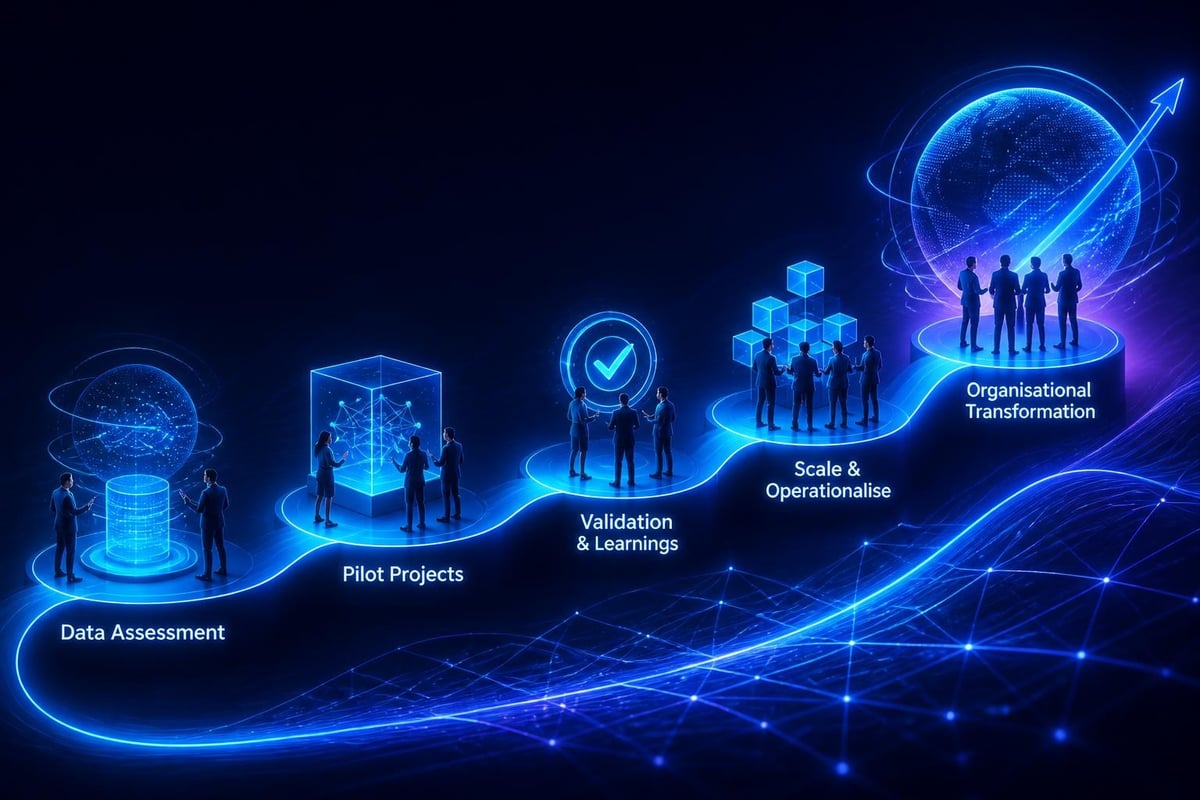
Deploying machine learning and business intelligence solutions requires thoughtful planning and phased execution. Organisations that rush implementation often struggle with data quality issues, user adoption challenges, and misaligned expectations.
Phase One: Foundation Building
Begin by assessing your current data infrastructure and governance practices. Machine learning models are only as good as the data they consume, making data quality improvement a critical first step.
- Audit existing data sources to identify completeness, accuracy, and accessibility
- Establish data governance policies that define ownership, quality standards, and security protocols
- Implement data integration platforms that consolidate information from disparate systems
- Create a data dictionary that standardises terminology across the organisation
- Train staff on data literacy fundamentals to build organisational capability
Many enterprises discover that addressing these foundational elements delivers immediate value even before machine learning implementation begins. Clean, accessible data improves traditional business intelligence reporting and creates a solid platform for advanced analytics.
Phase Two: Use Case Selection and Pilot Projects
Rather than attempting organisation-wide transformation simultaneously, identify specific use cases where machine learning and business intelligence can demonstrate clear value quickly.
Ideal pilot characteristics include:
- Well-defined success metrics that are measurable and meaningful
- Availability of historical data spanning at least 12-24 months
- Executive sponsorship and dedicated resources
- Manageable scope that can be completed within 90-120 days
- Potential for significant business impact if successful
Customer churn prediction, demand forecasting, and fraud detection represent excellent initial use cases because they address common pain points, leverage readily available data, and produce tangible financial benefits.
Technical Architecture and Platform Considerations
Selecting the appropriate technology stack for machine learning and business intelligence initiatives requires balancing capability, complexity, and cost. The Microsoft ecosystem offers particularly compelling options for enterprises already invested in Azure, Power BI, and Microsoft 365.
Cloud-Native Solutions
Azure Machine Learning provides comprehensive tools for building, training, and deploying machine learning models at scale. Integration with Azure Synapse Analytics enables seamless connection between data warehousing and machine learning workflows, whilst Power BI serves as the presentation layer for insights and predictions.
This integrated approach offers several advantages:
- Unified security and identity management through Azure Active Directory
- Simplified compliance with enterprise data governance requirements
- Native integration reducing development time and technical complexity
- Scalable infrastructure that grows with organisational needs
Organisations can begin with automated machine learning (AutoML) capabilities that require minimal data science expertise, then progressively adopt more sophisticated approaches as internal capabilities mature.
Hybrid and On-Premises Options
Some enterprises face regulatory constraints or latency requirements that necessitate hybrid architectures. Modern platforms accommodate these needs through edge computing capabilities and hybrid cloud connectivity.
Azure Stack enables deployment of consistent Azure services in on-premises environments, whilst Azure Arc extends management and governance across hybrid infrastructure. This flexibility ensures that machine learning and business intelligence solutions can be deployed wherever data resides and regulatory requirements dictate.
Data Quality and Model Governance
The most sophisticated machine learning algorithms cannot compensate for poor-quality input data. Organisations must establish rigorous data quality processes and model governance frameworks to ensure reliable, trustworthy insights.
Establishing Data Quality Standards
Different data elements require different quality thresholds based on their criticality to business processes and machine learning models. Financial transaction data demands near-perfect accuracy, whilst certain demographic attributes might tolerate moderate incompleteness.
Create a tiered classification system that prioritises improvement efforts:
| Data Tier | Quality Target | Validation Frequency | Example Data Types |
|---|---|---|---|
| Critical | 99.9% accuracy | Real-time | Financial transactions, inventory counts, customer identifiers |
| Important | 95% accuracy | Daily | Product attributes, customer demographics, supplier information |
| Supporting | 85% accuracy | Weekly | Marketing campaign details, secondary contact information |
Implement automated data quality monitoring that alerts stakeholders when metrics fall below acceptable thresholds. These systems should identify both sudden degradation (suggesting system failures) and gradual drift (indicating process erosion).
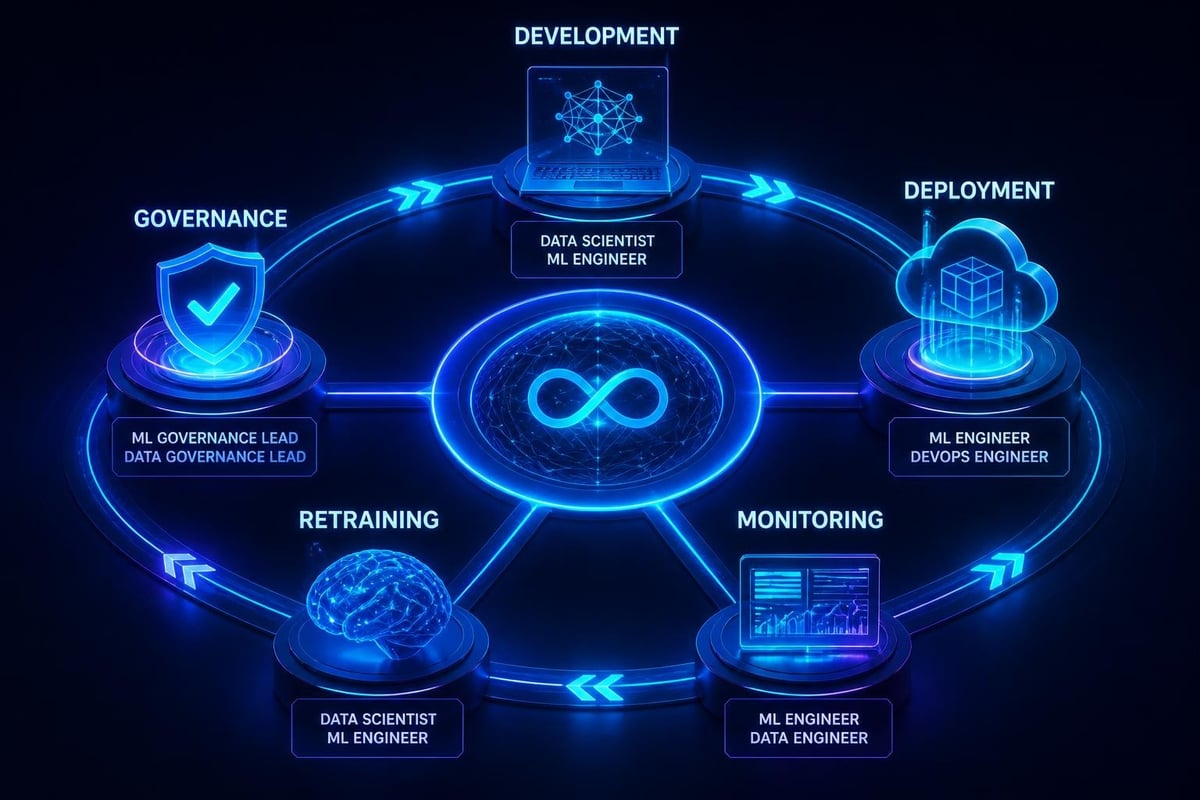
Model Performance Monitoring
Machine learning models can degrade over time as business conditions change and historical training data becomes less representative of current realities. Continuous monitoring ensures models remain accurate and valuable.
Track these key performance indicators:
- Prediction accuracy compared to actual outcomes
- Data drift measuring changes in input variable distributions
- Concept drift identifying shifts in the relationships between variables
- Prediction volume and latency ensuring system performance
- Model confidence scores highlighting predictions with high uncertainty
Establish automatic retraining schedules and trigger-based retraining when performance degradation exceeds predefined thresholds. This proactive approach maintains model reliability without requiring constant manual intervention.
Change Management and Organisational Adoption
Technical excellence alone does not guarantee success with machine learning and business intelligence initiatives. Organisations must address the human dimension of transformation, helping employees understand, trust, and effectively utilise these new capabilities.
Building AI Literacy Across the Organisation
Many employees feel intimidated by machine learning and artificial intelligence, fearing job displacement or struggling to understand how these systems produce their recommendations. Transparent communication and education programmes address these concerns whilst building capability.
Develop role-specific training that demonstrates practical applications rather than theoretical concepts. Sales representatives don’t need to understand neural network architecture, but they do need to know how to interpret lead scores and act on predictive insights. Finance analysts benefit from understanding confidence intervals and model limitations when using forecasts for budgeting decisions.
Creating Feedback Loops
Users often possess contextual knowledge that machine learning models lack. Establishing mechanisms for employees to provide feedback on predictions, flag incorrect recommendations, and suggest improvements creates a collaborative relationship between human expertise and machine learning capabilities.
This feedback serves dual purposes. Immediately, it helps refine models and improve accuracy. Longer term, it builds employee confidence and investment in the technology, transforming potential sceptics into advocates.
Security, Privacy, and Ethical Considerations
Machine learning and business intelligence systems process vast quantities of sensitive organisational and customer data. Robust security measures, privacy protections, and ethical guidelines are essential components of responsible implementation.
Data Protection and Access Control
Implement fine-grained access controls that limit data visibility to authorised users based on their roles and responsibilities. Attribute-based access control (ABAC) provides more nuanced permissions than traditional role-based systems, enabling dynamic policies that consider user attributes, data sensitivity, and environmental context.
Encryption both at rest and in transit protects data from unauthorised access. Modern platforms offer customer-managed encryption keys, providing additional control for organisations with stringent security requirements.
Addressing Algorithmic Bias
Machine learning models can perpetuate or amplify biases present in training data, leading to unfair outcomes. Regular bias audits examine model predictions across different demographic groups, identifying disparate impacts that require correction.
Mitigation strategies include:
- Diverse training datasets that represent all relevant populations
- Fairness constraints incorporated into model training
- Human review of high-stakes predictions
- Transparency in model features and decision logic
- Regular audits by independent parties
Organisations should document their approach to fairness and establish clear accountability for monitoring and addressing bias issues as they arise.
Measuring Return on Investment
Executives rightfully demand evidence that machine learning and business intelligence investments deliver tangible business value. Establishing clear metrics before implementation enables objective assessment of success.
Quantifiable Impact Categories
Financial returns manifest in multiple ways, from revenue increases to cost reductions. Track both direct and indirect benefits to capture the full impact.
Revenue impact:
- Increased conversion rates from improved lead prioritisation
- Higher average order values through recommendation engines
- Reduced customer churn from proactive retention efforts
- New revenue streams enabled by personalised offerings
Cost reduction:
- Decreased operational expenses through process optimisation
- Lower inventory carrying costs from accurate demand forecasting
- Reduced waste from quality improvements
- Minimised downtime through predictive maintenance
Time-to-Value Optimisation
Quick wins build momentum and justify continued investment. Structure implementation roadmaps to deliver measurable benefits within the first 90-120 days whilst laying groundwork for more transformative long-term capabilities.
Early successes might include automated reporting that saves analyst hours, anomaly detection that prevents fraud losses, or demand forecasting that reduces emergency procurement costs. These tangible improvements demonstrate value whilst the organisation develops more sophisticated applications.
Integration with Existing Enterprise Systems
Machine learning and business intelligence solutions deliver maximum value when seamlessly integrated with the systems employees use daily. Isolated analytics platforms that require context switching and manual data transfer struggle with adoption and limit impact.
Microsoft Ecosystem Advantages
Organisations using Microsoft 365 can embed Power BI dashboards directly within Teams, SharePoint, and Excel. This contextual integration ensures insights appear where decisions are made, rather than requiring users to visit separate applications.
Azure Logic Apps and Power Automate enable workflow automation that triggers actions based on machine learning predictions. When a churn prediction model identifies an at-risk customer, automated workflows can create support tickets, notify account managers, and initiate retention campaigns without manual intervention.
API-First Architecture
For organisations with heterogeneous technology environments, API-first design principles enable flexible integration. Modern machine learning platforms expose prediction capabilities through REST APIs that can be consumed by any application capable of making HTTP requests.
This approach allows gradual enhancement of existing systems rather than wholesale replacement. A legacy CRM system might lack native machine learning capabilities but can still benefit from predictive lead scoring by consuming predictions from an external service.
Future Trends Shaping the Landscape
The convergence of machine learning and business intelligence continues to evolve rapidly. Organisations planning long-term strategies should consider emerging capabilities that will shape the next generation of analytics platforms.
Generative AI and Natural Language Interfaces
Large language models are transforming how business users interact with data and analytics. Rather than constructing complex queries or navigating dashboard hierarchies, users can ask questions in natural language and receive contextually relevant answers.
“Which products are trending downward in the Midlands region this quarter?” might generate visualisations, statistical analysis, and predictive insights automatically. This democratisation of analytics enables decision-makers at all levels to access sophisticated insights without specialised training.
Autonomous Analytics Systems
Emerging platforms move beyond providing insights to autonomously executing decisions within predefined parameters. An inventory management system might automatically adjust reorder points based on demand forecasts, whilst a marketing platform optimises campaign spending across channels without human intervention.
These systems still require human oversight for strategic direction and exception handling, but they eliminate routine decision-making that previously consumed significant management time. The result is faster responses to market conditions and freed capacity for higher-value strategic thinking.
Edge Analytics and Real-Time Processing
Latency-sensitive applications increasingly require analytics processing at the edge rather than centralised cloud environments. Manufacturing facilities use edge computing for real-time quality control, whilst retail stores process video analytics locally for inventory management and customer behaviour analysis.
Machine learning and business intelligence architectures must accommodate distributed processing whilst maintaining centralised governance, model management, and performance monitoring.
Machine learning and business intelligence have evolved from separate disciplines into a unified capability that transforms how enterprises operate, compete, and grow. Organisations that successfully implement these technologies gain significant competitive advantages through faster decision-making, more accurate predictions, and optimised operations across every business function. Stellium Consulting helps enterprises navigate this transformation through comprehensive AI-powered solutions that integrate seamlessly with Microsoft platforms, ensuring your organisation maximises the value of its data whilst empowering employees with intelligent tools and insights. Our expertise as a Microsoft Solutions Partner positions us to guide your journey from initial assessment through full-scale deployment and ongoing optimisation.