
The enterprise landscape in 2026 demands rapid innovation, yet traditional software development cycles often struggle to keep pace with business requirements. A low code AI platform emerges as the solution that bridges this gap, enabling organisations to harness artificial intelligence capabilities without requiring extensive programming expertise. These platforms democratise AI development, allowing business users and citizen developers to create intelligent applications whilst empowering professional developers to focus on complex challenges. For enterprises seeking competitive advantage, understanding how to leverage these platforms has become essential to digital transformation success.
Understanding the Low Code AI Platform Revolution
A low code development platform fundamentally changes how organisations approach application creation by replacing traditional hand-coding with visual interfaces, pre-built components, and drag-and-drop functionality. When combined with AI capabilities, these platforms unlock unprecedented potential for business innovation.
The integration of artificial intelligence into low-code environments represents a paradigm shift in enterprise technology adoption. Modern low code AI platform solutions incorporate machine learning models, natural language processing, and predictive analytics as ready-to-use building blocks. This approach eliminates the traditional barriers that prevented organisations from implementing AI at scale.
Key Components of Modern Low Code AI Platforms
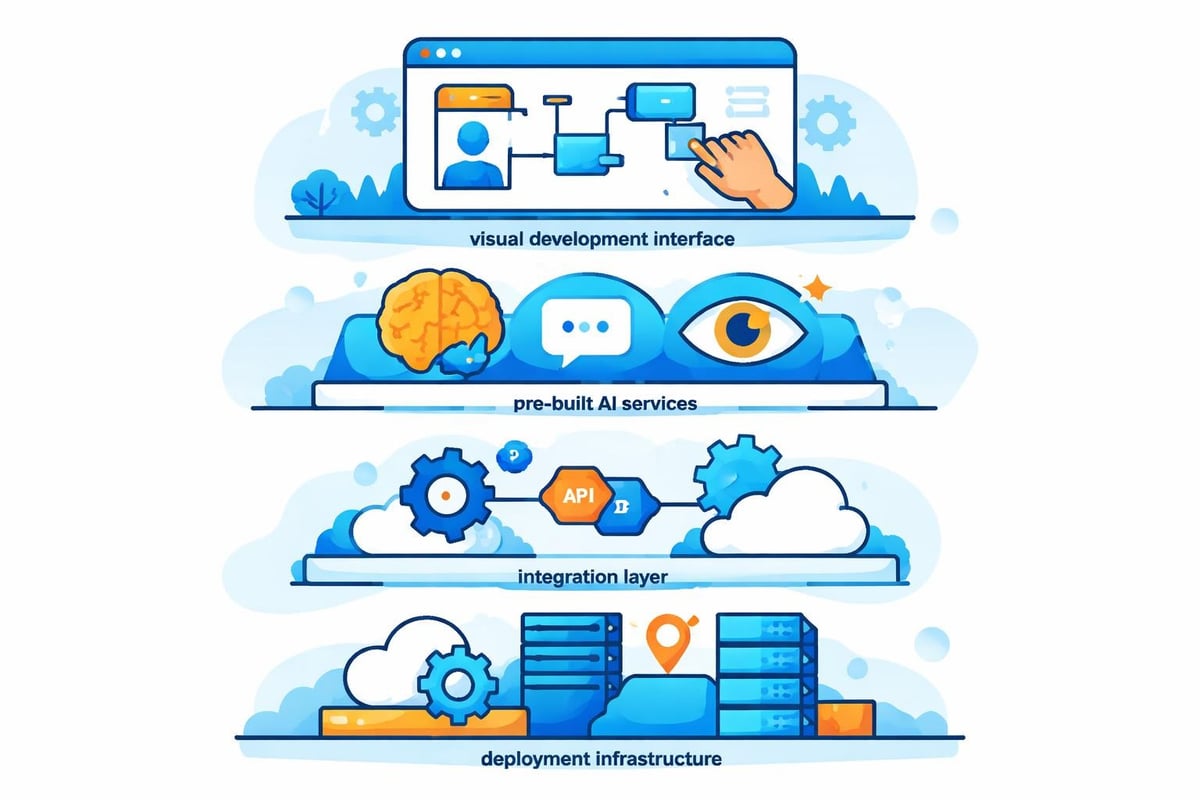
Visual Development Interfaces form the foundation of these platforms, allowing users to design workflows and applications through intuitive graphical environments. These interfaces translate visual designs into functional code automatically, reducing development time from months to weeks or even days.
Pre-Built AI Models and Services provide immediate access to sophisticated capabilities:
- Natural language processing for document analysis and chatbot development
- Computer vision for image recognition and quality control
- Predictive analytics for forecasting and trend identification
- Recommendation engines for personalised customer experiences
- Sentiment analysis for customer feedback interpretation
Integration Capabilities ensure that low code AI platforms connect seamlessly with existing enterprise systems. Modern platforms offer native connectors to databases, cloud services, legacy applications, and third-party APIs, creating a unified technology ecosystem.
Business Value and Strategic Advantages
The adoption of a low code AI platform delivers measurable benefits across multiple dimensions of enterprise operations. Understanding these advantages helps organisations justify investment and prioritise implementation strategies.
Accelerated Time to Market
Traditional AI development projects often require six to twelve months from conception to deployment. Low code platforms compress this timeline dramatically, with many solutions reaching production in four to eight weeks. This acceleration stems from reusable components, automated testing, and simplified deployment processes.
Research indicates that AI-enhanced low-code platforms can reduce development effort by up to 70% compared to conventional approaches. This efficiency gain translates directly into competitive advantage, allowing organisations to respond quickly to market opportunities.
Cost Reduction and Resource Optimisation
The financial implications of low code AI platform adoption extend beyond reduced development hours. Organisations experience lower total cost of ownership through:
| Cost Category | Traditional Approach | Low Code Platform | Savings |
|---|---|---|---|
| Developer Salaries | £150,000 annually | £90,000 annually | 40% |
| Training Expenses | £25,000 per project | £8,000 per project | 68% |
| Maintenance Costs | £40,000 annually | £15,000 annually | 62% |
| Infrastructure | £30,000 annually | £12,000 annually | 60% |
These savings compound over time, creating substantial financial benefits whilst maintaining or improving solution quality. Organisations redirect saved resources towards innovation and strategic initiatives rather than routine development tasks.
Democratisation of AI Capabilities
Perhaps the most transformative aspect of a low code AI platform is its ability to empower non-technical staff. Business analysts, process owners, and domain experts can now build intelligent applications without extensive programming knowledge. This democratisation accelerates innovation by placing development power in the hands of those who best understand business challenges.
Implementation Strategies for Enterprise Success
Deploying a low code AI platform requires thoughtful planning and execution. Successful organisations follow structured approaches that balance ambition with pragmatism.
Assessment and Platform Selection
Begin by evaluating your organisation’s specific requirements across multiple criteria:
- Business Objectives: Define clear goals for AI implementation, whether improving customer service, optimising operations, or enhancing decision-making capabilities.
- Technical Environment: Assess existing infrastructure, security requirements, and integration needs to ensure platform compatibility.
- Skill Levels: Evaluate the technical capabilities of intended users, from citizen developers to professional programmers.
- Scalability Needs: Consider both current requirements and anticipated growth over the next three to five years.
- Vendor Ecosystem: Examine available support, training resources, and community engagement around potential platforms.
Platforms like Microsoft Power Fx demonstrate how low-code languages can integrate seamlessly with AI capabilities whilst maintaining enterprise-grade security and governance. Such solutions prove particularly valuable for organisations already invested in the Microsoft ecosystem.
Governance and Best Practices
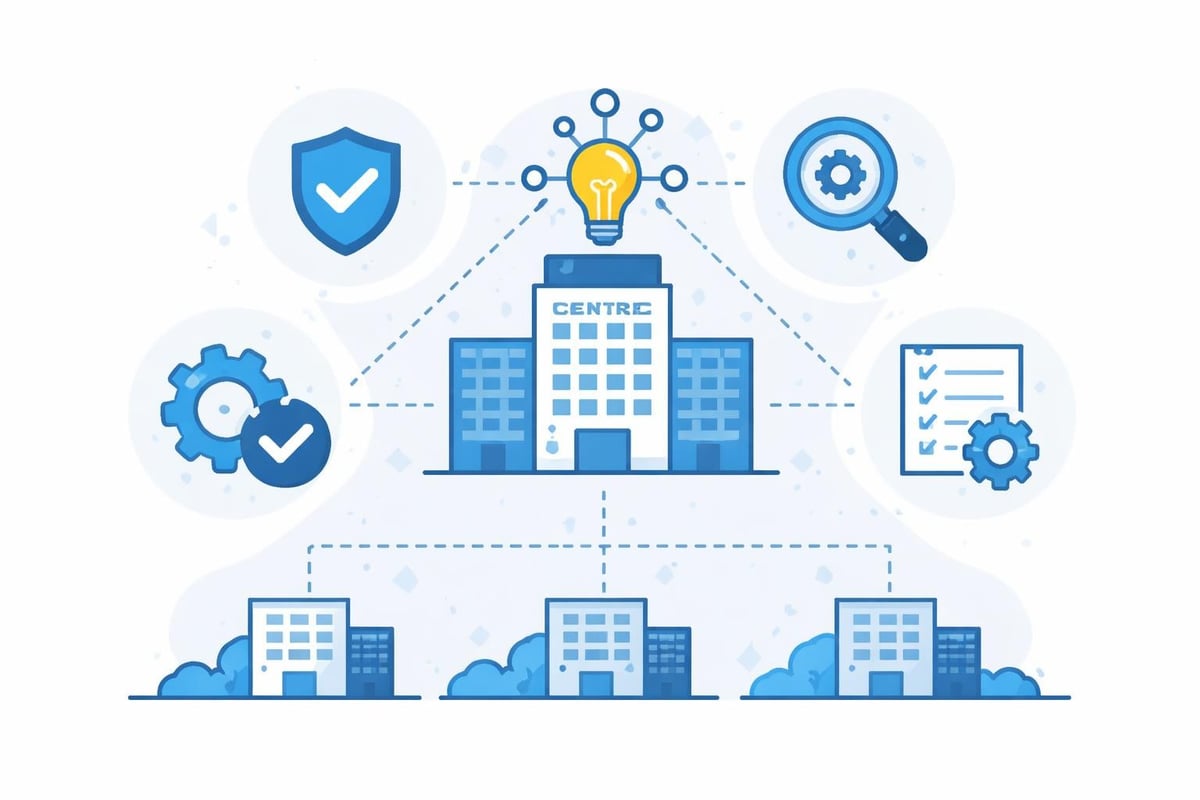
Establishing governance frameworks prevents the chaos that can emerge from democratised development. Effective governance balances empowerment with control through:
- Centre of Excellence: Create a dedicated team that sets standards, provides guidance, and shares best practices across the organisation.
- Security Protocols: Implement role-based access controls, data protection measures, and compliance monitoring to maintain enterprise security.
- Quality Assurance: Define testing requirements, performance benchmarks, and review processes for applications before production deployment.
- Documentation Standards: Require clear documentation of AI models, data sources, and business logic to ensure maintainability.
Real-World Applications and Use Cases
A low code AI platform enables diverse applications across industries and business functions. Understanding practical implementations helps organisations identify opportunities within their own operations.
Customer Experience Enhancement
Modern customer service demands personalised, intelligent interactions at scale. Low code AI platforms enable rapid development of:
Intelligent Chatbots that understand natural language queries, access customer data, and resolve issues without human intervention. These solutions integrate with existing CRM systems whilst continuously learning from interactions to improve response quality.
Predictive Customer Service applications that identify potential issues before customers experience problems. By analysing usage patterns, transaction histories, and behavioural signals, these systems trigger proactive support interventions.
Personalisation Engines that tailor content, recommendations, and offers based on individual customer preferences and predicted needs. Platforms like Kissflow demonstrate how AI-driven low-code tools accelerate such development whilst maintaining accessibility for business teams.
Operational Excellence and Process Automation
Enterprises achieve significant efficiency gains by applying low code AI platforms to internal operations:
- Automated document processing that extracts data from invoices, contracts, and forms with high accuracy
- Quality control systems using computer vision to identify defects in manufacturing processes
- Predictive maintenance applications that forecast equipment failures and schedule interventions
- Resource allocation optimisers that balance workloads across teams and facilities
- Compliance monitoring tools that flag potential regulatory violations in real-time
Advanced Analytics and Decision Support
Transforming data into actionable insights represents a critical competitive advantage. Low code AI platforms democratise advanced analytics through:
| Application Type | Business Impact | Implementation Complexity |
|---|---|---|
| Sales Forecasting | 15-25% accuracy improvement | Low |
| Inventory Optimisation | 20-30% reduction in carrying costs | Medium |
| Risk Assessment | 40-50% faster decision-making | Medium |
| Fraud Detection | 60-70% reduction in false positives | High |
| Customer Churn Prediction | 25-35% improvement in retention | Low |
These applications leverage pre-built machine learning models whilst allowing customisation for specific business contexts. The low code approach enables rapid iteration and continuous improvement based on real-world performance.
Integration with Enterprise Ecosystems
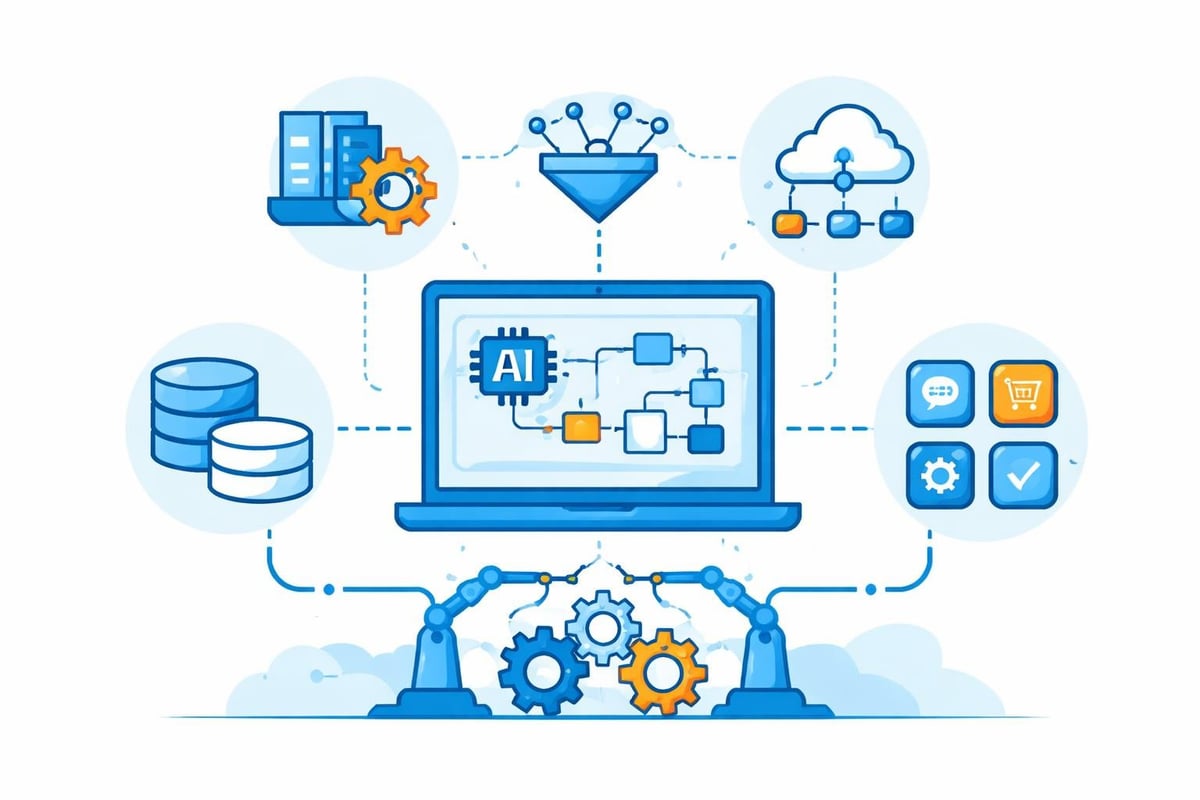
The true power of a low code AI platform emerges when it connects seamlessly with existing enterprise systems and external services. Modern platforms excel at creating unified technology ecosystems.
Connecting Legacy and Modern Systems
Most enterprises operate hybrid environments combining legacy applications with cloud-native solutions. Low code AI platforms serve as integration layers that:
- Extract value from legacy databases and applications through modern APIs and connectors
- Enhance existing systems with AI capabilities without requiring complete replacements
- Create unified interfaces that present data from multiple sources in coherent applications
- Modernise workflows incrementally whilst maintaining business continuity
Research on federated learning platforms illustrates how low-code approaches can simplify complex AI deployments across distributed systems, maintaining data privacy whilst enabling collaborative model development.
Automation and Workflow Orchestration
Connecting disparate systems enables powerful automation scenarios. Low code AI platforms facilitate:
Intelligent Workflow Automation that routes tasks based on content analysis, priority scoring, and resource availability. These workflows adapt dynamically as business conditions change, optimising processes in real-time.
Cross-System Orchestration that coordinates activities across multiple applications, ensuring data consistency and process integrity. Tools similar to Zapier demonstrate how low-code platforms can automate complex multi-step workflows across diverse applications.
Event-Driven Architectures that respond instantly to business events, triggering appropriate actions across integrated systems. This approach reduces latency and improves responsiveness to customer needs and market changes.
Emerging Trends and Future Directions
The landscape of low code AI platforms continues evolving rapidly, with several trends shaping the future of enterprise development.
Agentic AI and Autonomous Systems
The emergence of agentic AI represents the next frontier in low code development. Recent developments like OutSystems’ Agent Workbench demonstrate how enterprises can develop and manage autonomous AI agents that perform complex tasks with minimal human supervision.
These systems combine:
- Goal-oriented behaviour that pursues objectives through multi-step reasoning
- Environmental awareness that adapts to changing conditions and constraints
- Tool utilisation that leverages various APIs and services to accomplish tasks
- Learning capabilities that improve performance through experience
Industry-Specific Solutions
Low code AI platforms increasingly offer pre-configured solutions for specific industries:
Healthcare: Patient monitoring systems, diagnostic assistants, and treatment recommendation engines that comply with regulatory requirements whilst accelerating deployment.
Financial Services: Risk assessment tools, fraud detection systems, and customer onboarding automation that meet stringent security and compliance standards.
Manufacturing: Quality control systems, predictive maintenance applications, and supply chain optimisation tools that integrate with industrial IoT devices.
Retail: Inventory management, demand forecasting, and personalised marketing platforms that respond to rapidly changing consumer preferences.
Research on low-code IoT platforms showcases how specialised tools can accelerate development in specific domains whilst maintaining flexibility for customisation.
Skills Development and Organisational Change
Successfully adopting a low code AI platform requires more than technology deployment. Organisations must develop new capabilities and adapt existing processes.
Training and Enablement Programmes
Effective training addresses multiple audience levels:
- Executive Awareness: Help leadership understand strategic implications, governance requirements, and investment priorities for low code AI initiatives.
- Citizen Developer Enablement: Provide business users with foundational skills in visual development, AI concepts, and best practices.
- Professional Developer Upskilling: Equip IT staff with platform-specific expertise, advanced customisation techniques, and integration patterns.
- Business Analyst Transformation: Train analysts to bridge business requirements and technical implementation using low code tools.
- Change Champion Development: Create internal advocates who drive adoption, share knowledge, and support colleagues through transformation.
Cultural Transformation
Technology alone cannot drive success. Organisations must foster cultures that embrace:
Experimentation and Learning where failures provide valuable insights rather than career setbacks. Low code platforms reduce the cost of experimentation, making iterative innovation practical.
Collaboration Across Boundaries that breaks down silos between IT and business functions. The shared language of visual development facilitates productive dialogue between technical and non-technical stakeholders.
Continuous Improvement mindsets that view applications as evolving assets rather than fixed deliverables. The ease of modification in low code environments supports ongoing refinement based on user feedback.
Security and Compliance Considerations
Whilst low code AI platforms accelerate development, they must maintain rigorous security and compliance standards. Enterprise-grade platforms incorporate robust controls across multiple dimensions.
Data Protection and Privacy
Modern platforms implement comprehensive data protection through:
- Encryption at rest and in transit protecting sensitive information throughout its lifecycle
- Granular access controls ensuring users access only appropriate data based on roles and responsibilities
- Audit logging creating complete records of data access, modifications, and AI model predictions
- Data residency options allowing organisations to control where data is stored and processed
- Privacy-preserving AI techniques that enable model training without exposing individual records
Regulatory Compliance
Different industries face varying compliance requirements. A robust low code AI platform supports:
| Regulation | Key Requirements | Platform Capabilities |
|---|---|---|
| GDPR | Data subject rights, consent management | Automated data deletion, consent tracking |
| HIPAA | Healthcare data protection | Encrypted storage, access controls, audit trails |
| SOC 2 | Security controls, availability | Continuous monitoring, disaster recovery |
| ISO 27001 | Information security management | Risk assessment tools, security policies |
Organisations must verify that chosen platforms provide necessary compliance features and documentation to support regulatory audits and certifications.
Measuring Success and ROI
Quantifying the value delivered by a low code AI platform helps justify continued investment and guides optimisation efforts. Successful organisations track both operational and strategic metrics.
Operational Metrics
Track immediate impacts on development efficiency and application performance:
- Development velocity: Number of applications delivered per quarter
- Time to deployment: Average days from concept to production
- Resource utilisation: Developer hours required per application
- Platform adoption: Number of active users across business functions
- Application performance: Response times, uptime, and user satisfaction scores
Business Impact Metrics
Measure how low code AI applications drive business outcomes:
- Cost savings: Reduced operational expenses through automation and efficiency gains
- Revenue impact: Increased sales, improved conversion rates, or new revenue streams
- Customer satisfaction: Net Promoter Score improvements attributable to AI-enhanced experiences
- Process improvements: Cycle time reductions, error rate decreases, or quality enhancements
- Innovation metrics: New capabilities launched, markets entered, or services introduced
Establishing baseline measurements before implementation enables clear demonstration of platform value over time. Regular reporting maintains visibility and supports ongoing investment decisions.
Low code AI platforms represent a fundamental shift in how enterprises approach technology innovation, combining the power of artificial intelligence with the accessibility of visual development environments. By accelerating development, reducing costs, and democratising AI capabilities, these platforms enable organisations to respond rapidly to market demands whilst empowering employees across all functions. As a Microsoft Solutions Partner specialising in AI-powered enterprise solutions, Stellium Consulting helps organisations navigate the complexities of low code AI adoption, from platform selection and governance framework design through implementation and skills development. Contact our team to discover how the right low code AI platform can transform your organisation’s digital capabilities and accelerate your journey towards intelligent automation.