
Artificial Intelligence is transforming business at a speed few could have imagined. Leaders today face a stark choice: adapt rapidly or risk being left behind.
This guide reveals how the frontier firm model is redefining success in 2026. You will discover what sets these organisations apart, from core principles to new ways of working.
We will explore the journey of adopting AI at scale, transforming operations, and learning from industry pioneers. If you are ready to lead with agility, growth, and innovation, this roadmap will help you become a frontier firm.
Understanding the Frontier Firm: Definition and Core Principles
Adapting to the rapid pace of AI means understanding what sets a frontier firm apart from the rest. At its core, a frontier firm is an organisation that uses AI and digital agents to enable scalable innovation, agility, and sustainable growth. These businesses embrace a future where technology and human expertise combine for maximum impact.
Frontier firms are not just early adopters, they are pioneers who rethink how work gets done. By placing AI at the heart of operations, they create new value streams and competitive advantages that traditional models cannot match. To see a practical breakdown of what defines a frontier firm, explore Becoming a Frontier Firm.

What Is a Frontier Firm?
A frontier firm operates with an AI-first mindset, integrating digital agents throughout every business function. This approach enables:
- Seamless human-agent collaboration as standard practice.
- Data-driven decision-making at every organisational level.
- Continuous upskilling and a culture of learning.
- Prioritisation of trust, security, and responsible AI.
These elements ensure the frontier firm maintains a constant edge in innovation and operational efficiency. Such firms see AI as a partner, not just a tool, allowing employees to focus on high-value, strategic tasks.
Glossary: Essential Terms for the Frontier Firm Era
To navigate this new landscape, leaders should become familiar with several core terms:
- Intelligence resources: Tools and systems that provide actionable insights using AI.
- Digital labour: The use of AI agents to automate and augment human work.
- Agent boss: A role or system overseeing both human and digital agents.
- Work chart: A visual map of tasks and responsibilities, replacing traditional org charts.
- Human-agent ratio: The balance between human staff and AI agents within teams.
Understanding these terms is crucial for any organisation aiming to become a frontier firm.
How Frontier Firms Differ from Traditional Organisations
The frontier firm departs from conventional business structures. Instead of rigid functional hierarchies, these organisations adopt flexible, job-centric workflows powered by digital agents.
| Aspect | Traditional Firm | Frontier Firm |
|---|---|---|
| Structure | Departmental silos | Agile work charts |
| Decision-making | Top-down | Data-driven, decentralised |
| Role of AI | Support tool | Core collaborator |
| Workforce model | Human-centric | Human-agent teams |
This shift enables frontier firms to innovate faster and respond rapidly to market changes.
Impact and Value Creation: Data-Driven Outcomes
Embracing the frontier firm model has measurable benefits. According to IDC, 68% of organisations now use AI, but frontier firms achieve returns three times higher than slower adopters.
These firms accelerate innovation cycles, deliver superior customer experiences, and boost operational efficiency. For instance, Microsoft’s Work Trend Index found that 71% of frontier firms are thriving, compared to 39% globally.
The Frontier Firm Paradigm: A New Business Era
The rise of the frontier firm signals a shift as significant as the internet or industrial revolutions. Businesses that adopt this model are redefining what it means to compete and lead in the digital age.
As more companies make the transition, the frontier firm becomes the blueprint for future-ready, resilient organisations.
The Journey to Becoming a Frontier Firm: Phases and Milestones
The journey to becoming a frontier firm is a dynamic, multi-phase process that redefines how businesses operate and innovate. As AI adoption accelerates, organisations must rethink their strategies and embrace new ways of working. Understanding these phases helps leaders navigate the rapid changes and position their companies for sustained growth. For a comprehensive overview of the frontier firm model and its business impact, see Frontier Firms in 2026 insights.
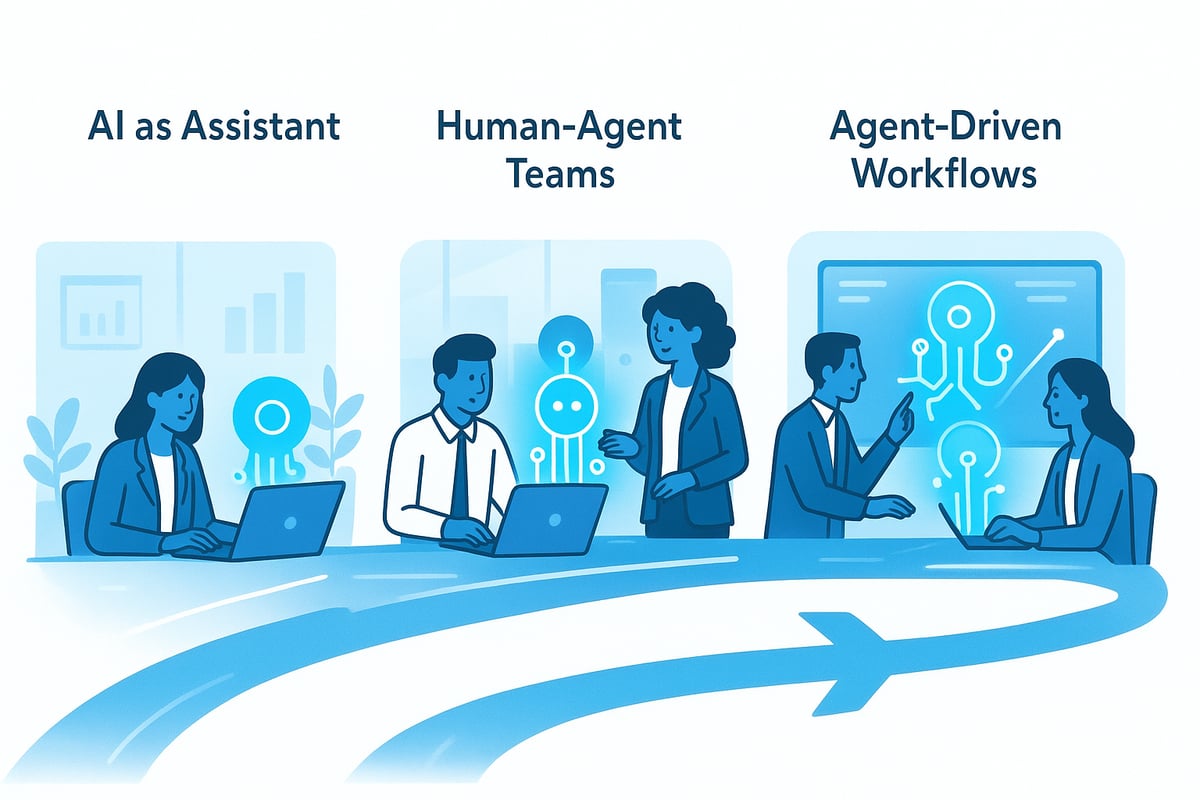
Phase 1: AI as Assistant
In the initial phase of the frontier firm journey, AI acts as a powerful assistant, removing repetitive and time-consuming tasks from employees’ workloads. This transformation allows staff to focus on higher-value activities and strategic thinking.
Organisations typically see AI tools automating functions such as email management, report generation, and scheduling. Employees benefit from increased productivity and reduced manual effort, creating space for creativity and problem-solving.
- 82% of leaders are confident that digital labour will expand capacity within 12–18 months.
- AI as assistant supports teams across departments, laying the groundwork for deeper integration.
By adopting this approach, the frontier firm begins to unlock the potential of digital labour, making efficiency gains accessible to all.
Phase 2: Human-Agent Teams
The second phase sees digital agents moving from mere assistants to genuine colleagues within teams. Here, the frontier firm empowers employees to direct AI agents in completing specific tasks, effectively scaling individual and team impact.
Human-agent collaboration becomes central, with staff leveraging agents for research, analysis, and strategy development. For example, researcher agents can assemble go-to-market strategies, freeing up time for innovation and decision-making.
- 53% of leaders report that productivity must increase to stay competitive.
- However, 80% feel constrained by lack of time or energy.
- Human-agent teams bridge this gap, amplifying output without overburdening staff.
This phase marks a cultural shift, as the frontier firm integrates digital agents into everyday workflows.
Phase 3: Agent-Driven Workflows
In phase three, the frontier firm leverages AI agents to autonomously manage entire business processes. Humans set the strategic direction, while agents execute tasks and handle routine decisions.
The human-agent ratio emerges as a critical metric, helping organisations balance oversight with efficiency. For instance, supply chain agents can manage logistics from start to finish, only involving humans when exceptions arise or judgement is required.
- Agent-driven workflows result in faster response times and improved accuracy.
- Employees focus on high-impact activities, such as optimisation and innovation.
This phase reflects a mature integration of digital agents, where the frontier firm achieves scalable, agile operations.
Navigating Multiple Phases Simultaneously
Most organisations do not progress through these phases in a linear fashion. Instead, they often operate in multiple phases at once, adapting to the unique needs of each function. Effective change management and clear leadership are essential as the frontier firm navigates this complexity.
For example, a company like Dow may use AI agents for logistics automation while simultaneously upskilling teams for new, strategic roles. Statistics show that 24% of leaders have deployed AI organisation-wide, while only 12% remain in pilot mode.
Leaders must guide transformation, foster a growth mindset, and ensure the frontier firm remains agile across all departments.
Core Traits of Frontier Firms: What Sets Leaders Apart
The frontier firm stands apart by embracing a bold approach to AI, making it the engine of transformation and competitive advantage. What exactly distinguishes a frontier firm from its traditional counterparts? Four defining traits set these leaders ahead: enterprise-wide AI, seamless human-agent collaboration, relentless upskilling, and an unwavering commitment to trust and security.
Each trait builds on the others, forming a dynamic model for long-term growth and innovation. Let us explore what it truly means to be a frontier firm in 2026.

AI at Scale Across the Enterprise
A frontier firm deploys AI not just in isolated projects but across at least seven business functions. This scale of adoption transforms every area, from customer service and marketing to IT, product development, and cybersecurity.
Leaders in this space report that over 70% of their operations benefit from AI integration. For example, Levi Strauss & Co. reduced project timelines from a year to a single day by leveraging Copilot, demonstrating the potential for radical acceleration.
The journey to becoming a frontier firm is underpinned by a commitment to scale, as detailed in Enterprise AI transformation strategies. This resource outlines how organisations can strategically expand AI across multiple domains for maximum impact.
By embedding AI deeply, a frontier firm ensures agility, responsiveness, and a foundation for continuous innovation.
Human-Agent Collaboration and New Organisational Structures
The frontier firm ushers in a new era of human-agent collaboration. Digital agents are no longer just tools but vital team members, seamlessly integrated into daily workflows.
New roles emerge, such as the agent boss, who manages and coordinates both human and digital talent. Traditional department-based hierarchies give way to work charts focused on tasks and outcomes, boosting efficiency and oversight.
A key metric for the frontier firm is the human-agent ratio, which helps leaders optimise both productivity and control. For instance, Wells Fargo introduced an agent that supports 35,000 bankers, cutting search times from 10 minutes to just 30 seconds.
These changes empower employees to focus on higher-value work while agents handle routine or data-heavy tasks, establishing the frontier firm as a model of operational excellence.
Ubiquitous Innovation and Upskilling
For a frontier firm, innovation is not occasional or confined to a lab. It is a continuous, organisation-wide process, fuelled by ongoing upskilling and a culture that prizes experimentation.
Nearly half of leaders prioritise AI-specific upskilling, while 95% of frontier firms are hiring for new roles such as AI trainers, data specialists, and agent specialists. Bayer’s R&D team, for example, saves six hours per week per researcher thanks to AI agents.
This relentless focus on learning ensures that the frontier firm stays ahead of the technology curve and adapts rapidly to new challenges. The result is a workforce that is agile, highly skilled, and ready to leverage AI for breakthrough outcomes.
Trust, Security, and Responsible AI
Trust is the cornerstone of every frontier firm. As digital agents take on more responsibility, robust governance, compliance, and real-time observability become non-negotiable.
Enterprise-grade security measures are embedded at every level, ensuring that AI systems operate transparently and ethically. Microsoft partners, for example, are integrating governance and real-time monitoring into their AI solutions, setting a new standard for responsible innovation.
By prioritising trust and security, the frontier firm builds confidence with customers, employees, and regulators. This commitment not only protects the organisation but also enables sustainable, responsible growth in an increasingly complex digital landscape.
Organisational Transformation: Strategies for Adopting the Frontier Firm Model
Transforming into a frontier firm requires a clear strategy that bridges vision, technology, and people. Leaders must align business and IT, rethink talent, foster innovation, embed trust, and measure progress. The following strategies outline how organisations can adopt the frontier firm model and unlock the full potential of AI-driven change.

Aligning Business and IT for AI Integration
Success as a frontier firm begins with breaking down silos between business and IT functions. Collaboration ensures that digital agents and AI solutions are fully integrated, not isolated experiments. Data quality and accessibility become critical, as does navigating governance and regulatory requirements.
For example, ABB demonstrates how aligning business goals with IT capabilities can transform industrial operations. Their use of Azure AI-powered insights enables faster, more accurate decision-making. For a broader look at organisational transformation through AI, see AI and the future of business.
Key steps include:
- Foster cross-functional teams to accelerate AI adoption
- Prioritise secure, accessible data infrastructure
- Engage compliance experts early in the process
Collaboration at every level accelerates the transition to a frontier firm.
Rethinking Talent and Workforce Strategies
Becoming a frontier firm means reimagining workforce structures. Digital labour enables organisations to retain top talent while optimising team size. Leaders must prioritise upskilling, ensuring employees can work effectively with AI agents.
A compelling example is ICG, a startup that leverages AI for simulations and research, increasing margins by 20 percent. Upskilling and reskilling become essential, with 45 percent of leaders focused on expanding capacity through digital agents.
Practical actions:
- Launch company-wide AI training programmes
- Redefine roles to include agent oversight
- Use digital agents to free time for strategic work
These shifts position the frontier firm to attract and retain the workforce of the future.
Fostering a Culture of Innovation and Experimentation
Frontier firms thrive on a culture of innovation. Empowering employees to build and deploy AI solutions encourages experimentation and rapid scaling of successful initiatives. Everyone, from front-line staff to executives, contributes ideas and tests new approaches.
Land O’Lakes illustrates this mindset by embedding AI across agricultural workflows, optimising supply chains and improving decision-making speed. Organisations should encourage piloting new tools and reward creative problem-solving.
Best practices:
- Create internal sandboxes for AI experimentation
- Recognise and share successful use cases company-wide
- Provide incentives for innovative thinking
A culture of experimentation is a hallmark of every frontier firm.
Embedding Trust, Security, and Compliance
Trust is non-negotiable for any frontier firm. Robust governance, real-time monitoring, and compliance controls must be embedded in every layer of AI adoption. Transparency builds confidence with both customers and employees.
Accenture offers a strong example, using an AI agent to automate collections while maintaining rigorous compliance. Automated governance ensures responsible AI and reduces risk.
Core elements:
- Implement end-to-end monitoring of AI systems
- Maintain clear documentation and audit trails
- Regularly review policies for evolving regulations
By embedding trust, the frontier firm strengthens its reputation and resilience.
Measuring Impact and Scaling Success
Measurement is vital for the frontier firm journey. Leaders must set clear KPIs for AI adoption, productivity gains, and customer experience improvements. Regularly tracking progress allows for rapid course correction and scaling of effective solutions.
Dow’s implementation of AI-driven logistics is a powerful case, forecasting millions in annual savings. Frontier firms report four times better results in brand differentiation, efficiency, growth, and customer experience compared to slower adopters.
A summary table of core metrics:
| Metric | Frontier Firm Benchmark | Traditional Firm Benchmark |
|---|---|---|
| AI Adoption (Functions) | 7+ | 1–2 |
| Productivity Gains | 3–4x | 1x |
| Customer Experience | 4x improvement | Baseline |
| Innovation Cycle Speed | Rapid | Slow |
Consistent measurement ensures that the frontier firm model delivers lasting value and sustainable growth.
Industry Case Studies: Frontier Firms in Action
The frontier firm model is no longer a theoretical concept. Across industries, leading organisations are demonstrating how AI, digital agents, and new ways of working deliver tangible business impact. Below, we explore how the frontier firm is redefining value creation in enterprise, services, life sciences, retail, and startups.
Enterprise and Manufacturing
Frontier firms in enterprise and manufacturing have rapidly accelerated project delivery and operational efficiency. Levi Strauss & Co. leveraged Copilot and Copilot+ PCs to cut project timelines from a year to just one day. This transformation showcases how the frontier firm model, powered by AI, can fundamentally reshape value chains.
Dow, a global leader in chemicals, implemented AI agents to streamline shipping, boost accuracy, and achieve multi-million pound savings within the first year. ABB utilised Azure AI insights to transform industrial operations, enabling predictive maintenance and smarter resource allocation. According to Microsoft’s 2025 Work Trend Index Report, these outcomes typify the competitive edge of the frontier firm.
Financial Services and Professional Services
In financial services, the frontier firm is closing the productivity gap with digital agents. Wells Fargo deployed an AI agent supporting 35,000 bankers, resulting in 75 percent of searches now handled by AI and reducing response times from 10 minutes to 30 seconds. This shift enables staff to focus on higher-value client interactions.
Accenture, a leader in professional services, automated its collections process with an AI agent, driving efficiency and improving the bottom line. These examples highlight how the frontier firm model can deliver scalable gains and greater compliance in highly regulated sectors.
Life Sciences and Agriculture
Life sciences and agriculture are rapidly embracing the frontier firm approach to speed up research and optimise operations. Bayer’s Crop Science R&D teams use AI agents to save researchers up to six hours weekly, accelerating discovery and product development.
Land O’Lakes, a major agricultural cooperative, integrates AI into supply chain workflows, enabling faster, data-driven decisions. The frontier firm in these sectors is not only boosting productivity but also fostering new ways to tackle complex global challenges.
Retail and Customer Experience
Retailers and service providers adopting the frontier firm model are seeing improved customer insight and engagement. Estée Lauder Companies rely on an AI agent to consolidate consumer data, delivering instant, actionable intelligence to marketing and sales teams.
Holland America Line has introduced an AI concierge, managing thousands of guest conversations each week. This digital agent enhances guest experiences and frees human staff for personalised service, embodying the frontier firm ethos of human-agent collaboration.
Startups and Small Enterprises
The frontier firm is not limited to large enterprises. Startups like ICG, with just five employees, use AI for simulations, research, and market analysis, increasing margins by 20 percent. Another example is a solo founder operating an AI-powered staffing firm, on track for £2 million in annual revenue without a CFO.
These cases show the frontier firm model delivers scale and agility, allowing small teams to compete with established players. As highlighted in How Agentic AI Is Redefining The Intelligent Enterprise, agentic AI is lowering barriers for innovation across the business landscape.
Every sector is discovering that becoming a frontier firm is a catalyst for innovation, operational excellence, and new growth opportunities.
Actionable Roadmap: Steps to Becoming a Frontier Firm in 2026
To become a frontier firm in 2026, leaders must follow a structured path that aligns vision, technology, people, and process. The roadmap below breaks this transformation into six actionable steps, each grounded in the latest research and best practices. By following these steps, organisations can close the digital gap and unlock sustainable growth.
Step 1: Assess Current AI Maturity and Set Vision
Begin your frontier firm journey by evaluating where your organisation stands with AI adoption. Map out the current digital infrastructure, data readiness, and the prevailing culture around AI. Identify operational bottlenecks, capacity gaps, and areas where automation could deliver immediate results.
Engage leadership teams to define a bold, shared vision for how AI will drive business value. This vision should be informed by 7 AI trends shaping 2026 to ensure relevance and competitiveness. Clear objectives help align teams and resources for the transformation ahead.
Step 2: Build Strong Foundations—Data, Security, and Governance
A frontier firm requires robust foundations. Prioritise data quality by ensuring information is accurate, accessible, and integrated across business functions. Invest in secure data pipelines and platforms that enable seamless AI deployment.
Establish governance frameworks to address regulatory compliance, ethical AI, and risk management. Build trust by making security and transparency non-negotiable. Responsible AI practices and real-time observability should be embedded from day one, safeguarding both operations and reputation.
Step 3: Scale AI Across Business Functions
To become a frontier firm, expand AI adoption beyond pilots or isolated projects. Target high-impact functions such as customer service, marketing, or supply chain for early wins. Leverage insights from reports like Global AI Adoption in 2025 to benchmark progress and identify industry best practices.
Deploy digital agents for both repetitive and knowledge-intensive tasks. Monitor outcomes closely, iterating based on feedback and performance data. Scaling AI across multiple domains accelerates value creation and competitive advantage.
Step 4: Upskill Workforce and Foster Collaboration
A frontier firm thrives on human-agent collaboration. Launch comprehensive AI literacy and upskilling programmes for all employees, ensuring everyone understands how to work alongside digital agents. Redefine roles to include agent management, data stewardship, and AI oversight.
Encourage cross-functional teams, blending business and IT expertise. This collaborative approach accelerates problem-solving and innovation, preparing your workforce to adapt as technology evolves.
Step 5: Embed Innovation and Measure Impact
Continuous innovation is essential for any frontier firm. Empower employees to experiment with new AI solutions, providing tools and resources to build, test, and deploy pilots. Create feedback loops to scale successful initiatives across the organisation.
Set clear KPIs for productivity, growth, and customer experience. Use data-driven insights to refine strategies and demonstrate tangible business impact. Measurement ensures ongoing alignment with strategic goals and supports long-term value creation.
Step 6: Partner for Success and Accelerate Transformation
Collaboration is a hallmark of the frontier firm model. Engage with technology partners, consultants, and industry peers to access expertise and accelerate adoption. External partnerships can bridge capability gaps and bring new perspectives to your transformation journey.
Share best practices, learn from others, and stay agile in your approach. Strategic alliances, like those with Microsoft and other innovators, can significantly speed up enterprise transformation with trusted, scalable AI solutions.
As we’ve explored, embracing the Frontier Firm model is all about harnessing AI and human collaboration to drive agility, innovation, and growth. If you’re ready to start your transformation and put these strategies into action, we can help you map the right path forward. Whether you’re looking to empower your teams, optimise business processes, or reimagine your organisation with cutting edge AI, our experts are here to guide you every step of the way. Let’s work together to unlock your next phase of growth. Get Started today.