
In 2026, Copilot stands at the forefront of enterprise AI transformation, promising remarkable gains for organisations willing to embrace change. Yet, despite its potential, many leaders find that true copilot adoption remains out of reach.
Why do so many pilot projects stall, and what separates the few achieving real results? This essential guide will demystify the copilot adoption process, offering proven strategies, common pitfalls, and practical steps for sustainable success.
We will explore the current landscape, governance and security essentials, step-by-step rollout strategies, change management, ROI measurement, and future accelerators. Equip yourself with a clear roadmap for Copilot success.
The Current State of Copilot Adoption in 2026
In 2026, copilot adoption is at a pivotal stage for organisations worldwide. Enterprises are navigating rapid change, driven by both curiosity and competitive necessity. Understanding the true state of copilot adoption is essential for leaders aiming to move beyond pilot projects and deliver real business value.

Enterprise Adoption Trends and Statistics
Copilot adoption has surged across the enterprise landscape. By 2026, 70% of Fortune 500 companies have initiated some level of copilot adoption, but most remain in pilot or phased rollout stages. This broad yet shallow adoption is highlighted by Microsoft’s “seat-add and expansion” strategy, where many licences are purchased before true enterprise-wide deployment begins.
Industry leaders such as Barclays and UBS have completed large-scale deployments, particularly in financial services and technology. Early adopters also include legal, finance, and research departments, with life sciences firms leveraging Copilot for research acceleration. According to recent statistics, nearly half of IT leaders express concerns about managing Copilot security and access risks.
This trend is reflected in the UK government’s pilot, which engaged 20,000 users and reported an average of 26 minutes saved per employee per day. The momentum is clear, but the depth of Copilot adoption remains limited for most enterprises.
What “Adoption” Really Means in 2026
It is crucial to distinguish between buying Copilot licences and achieving genuine Copilot adoption. Microsoft’s investor communications confirm that most clients are still in the early adoption phase, not full deployment. Pilots and staged rollouts are now standard practice, with organisations focusing on governance and risk management before expanding further.
Adoption is often led by IT, legal, or compliance teams, rather than business-wide initiatives. This cautious approach is shaped by regulatory scrutiny from the EU, UK, and US courts. For example, a Dutch government review highlighted transparency and retention gaps, signalling the need for robust oversight.
In some cases, fear of missing out (FOMO) drives organisations to pursue copilot adoption even when the return on investment is unclear. Leaders are learning that real success comes from measured, well-governed rollouts rather than rapid, unchecked expansion.
Key Drivers and Industry Patterns
Financial services, technology, and life sciences are setting the pace for copilot adoption as they respond to competitive and compliance pressures. Early measurable gains include a 32% increase in task completion speed and a 20% boost in accuracy for Microsoft’s own legal department. Common use cases span RFP drafting, meeting insights, data automation, project reporting, and the deployment of custom Copilot agents.
Business functions such as sales, service, and finance are increasingly included as Copilot expands its core offering. The global ecosystem, with over 430 million Microsoft 365 commercial seats, provides a copilot-ready environment for scaling adoption. Cross-departmental pilots are emerging as a best practice, ensuring Copilot delivers business relevance beyond IT.
Regulatory compliance and data governance continue to shape the pace of copilot adoption. Organisations are prioritising pilots in departments with well-structured content and clear governance. As adoption accelerates, collaboration between IT, legal, compliance, and business units is becoming essential for sustainable success.
Overcoming Barriers: Governance, Security, and Compliance
Navigating the barriers to successful copilot adoption requires more than just technical implementation. Enterprises must address data governance, security vulnerabilities, and compliance requirements to ensure Copilot delivers value without introducing new risks. Let us examine how leading organisations are tackling these essential challenges.

Data Governance and Oversharing Risks
One of the most significant hurdles for copilot adoption is the risk of data oversharing. Copilot accesses a wide range of business data across SharePoint, Teams, OneDrive, and Exchange, which increases the potential for both internal and external data exposure.
Legal, compliance, and security teams are voicing concerns about unintentional information leaks. For many organisations, governance remains the single biggest roadblock to scaling copilot adoption. Before expanding access, enterprises prioritise data remediation efforts and implement strict access controls.
For example, US courts now consider Copilot prompts and responses as discoverable content, adding complexity to eDiscovery processes. Regulatory reviews, such as the Dutch government’s, have flagged transparency and retention gaps that could expose organisations to additional scrutiny.
Critical controls include:
- Sensitivity labels to restrict access to confidential content
- Limited content discovery for high-risk groups
- Advanced management tools for ongoing governance
Microsoft has responded by enhancing governance features, including SharePoint Advanced Management and Restricted Search capabilities. For a comprehensive overview of governance frameworks and controls essential for secure Copilot adoption, refer to the Copilot Control System and Governance guide.
Security Threats and Vulnerabilities
Security concerns are central to the copilot adoption conversation. The 2025 Echoleak vulnerability showed how sensitive email data could be silently exfiltrated via Copilot. Although Microsoft responded swiftly with patches, each new AI integration brings fresh risks.
These risks often prompt enterprises to delay or limit their Copilot adoption until robust safeguards are in place. Proactive monitoring, regular security audits, and incident response protocols are now baseline requirements.
Integration with existing cybersecurity frameworks is vital. Financial services and healthcare sectors, for instance, demand additional validation before any Copilot deployment. This ensures that sensitive data is protected according to industry standards.
Ongoing training for IT staff and end users is equally important. As AI-specific threats evolve, so must the knowledge and preparedness of everyone involved in copilot adoption. A layered security approach is becoming the norm, with continuous improvement at its core.
Compliance, eDiscovery, and Regulatory Pressures
Copilot adoption in regulated industries faces heightened scrutiny from EU, UK, and US authorities. Regulators are examining how Copilot handles data retention, transparency, and discoverability, raising the bar for compliance.
Retention and discoverability of Copilot prompts, responses, and related training data introduce new layers of complexity. To address these, Microsoft has introduced dedicated retention controls, easing some eDiscovery concerns for legal and compliance teams.
Legal departments often lead copilot adoption pilots to ensure compliance from the very beginning. Industry-specific regulations, such as GDPR, HIPAA, and FCA, require tailored governance models for Copilot. For example, life sciences firms leverage Copilot for research acceleration but enforce strict data access controls to meet regulatory obligations.
Cross-functional collaboration is key. IT, legal, compliance, and business units must work together to develop policies that align with both operational needs and regulatory demands. By maintaining flexible governance frameworks, organisations can adapt to future regulatory changes and ensure that copilot adoption remains both sustainable and compliant.
Step-by-Step Roadmap to Copilot Adoption Success
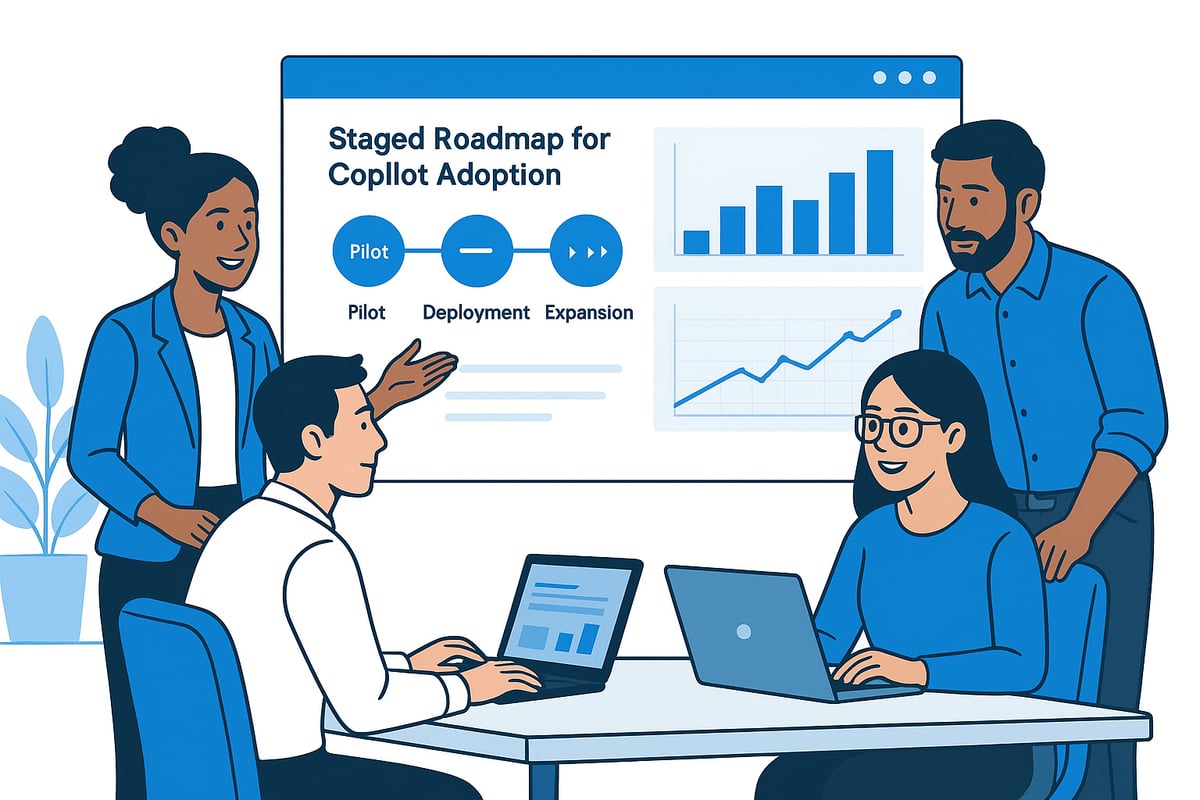
Embarking on a successful copilot adoption journey requires a structured approach, clear planning, and close alignment with business goals. By following a step-by-step roadmap, organisations can move from cautious pilots to enterprise-wide transformation. Each phase builds on the last, ensuring that copilot adoption delivers measurable value and long-term sustainability.
Step 1: Assess Organisational Readiness
Begin your copilot adoption by evaluating your organisation’s current digital maturity and AI readiness. Identify business objectives, key stakeholders, and the metrics that will define success. Conduct a thorough audit of existing data governance, security, and compliance frameworks to highlight strengths and address gaps.
Map out high-value use cases for Copilot adoption, prioritising departments where digital content is clean, well-structured, and ready for automation. Benchmark your starting position against industry peers and Microsoft’s recommended blueprint for Copilot adoption.
Involve legal and compliance teams early to ensure all regulatory and governance considerations are addressed from the outset. Use readiness assessments to inform a phased rollout plan, ensuring each stage is built on a strong foundation.
Step 2: Prepare Data and Governance Foundations
Preparing robust data and governance foundations is essential for secure copilot adoption. Begin with data discovery and remediation, ensuring only clean, accessible, and relevant content is available for pilot groups. Apply sensitivity labels, access controls, and restricted search capabilities to safeguard sensitive information.
Align your data management practices with regulatory requirements, leveraging Microsoft tools such as SharePoint Advanced Management and Purview for governance automation. Remove unnecessary or outdated content from pilot groups to minimise risk and streamline adoption.
Establish ongoing data hygiene and governance review processes, with legal and compliance teams actively involved in policy development. A strong governance foundation supports the scalability and security required for effective copilot adoption.
Step 3: Design and Launch Targeted Pilots
Designing targeted pilots is a critical stage in copilot adoption. Define clear, tangible business use cases that align with organisational priorities. Select cross-departmental pilot groups, including business functions like sales, HR, and operations—not just IT.
Provide tailored hands-on training and resources to ensure pilot participants understand how to leverage Copilot effectively. Set predefined KPIs, such as productivity, accuracy, and user satisfaction, to measure pilot outcomes.
For practical guidance on structuring pilots and overcoming common deployment challenges, see Deploying Copilot in Enterprise. Limit pilots to well-governed content, collect feedback and iterate on pilot design as needed, ensuring each lesson learned contributes to broader copilot adoption success.
Step 4: Build Stakeholder Engagement and Change Management
Stakeholder engagement is vital to successful copilot adoption. Involve business leaders, end users, and IT teams from the outset to foster buy-in and shared vision. Clearly communicate the benefits, expected outcomes, and realistic timelines for adoption.
Address concerns about potential productivity dips during the transition. Provide ongoing training, support, and knowledge sharing to help users adapt to new workflows. Establish champions and super users in each department to drive engagement and offer peer support.
Monitor adoption sentiment closely. Proactively address resistance or misconceptions, and celebrate early wins to build momentum. Continuous enablement programmes will reinforce skills and confidence throughout the copilot adoption journey.
Step 5: Measure, Optimise, and Scale
Measurement and optimisation are the keys to sustainable copilot adoption. Track adoption metrics, user feedback, and return on investment continuously. Use real-world data to refine use cases, resolve emerging governance or security challenges, and inform decisions on scaling deployment.
Share success stories and lessons learned across the organisation to encourage broader participation. For example, the UK government pilot reported 26 minutes saved per user per day, providing compelling evidence for expansion.
Implement iterative improvement cycles, preparing for future Copilot updates and new feature releases. By embedding measurement and optimisation into every phase, your copilot adoption will remain agile, resilient, and aligned with evolving business needs.
Change Management and User Enablement for Lasting Adoption
Change management is the linchpin for sustainable copilot adoption. Technology alone does not guarantee lasting results. Organisations must focus on people, process, and the cultural shift that AI brings. Successful Copilot adoption relies on proactive enablement, open dialogue, and a clear vision for how Copilot transforms daily work.

Building a Culture of AI Adoption
Embracing copilot adoption requires a mindset shift across the organisation. Leaders should encourage experimentation through low-risk pilots and sandbox environments. When leadership visibly supports AI initiatives, employees feel empowered to explore new ways of working.
Open communication is essential. Discuss both the challenges and the benefits of copilot adoption, and set realistic timelines for measurable impact. Recognising and rewarding early adopters helps to build momentum. In life sciences, for example, a culture of continuous improvement has driven copilot adoption to accelerate research innovation.
Address workforce concerns by positioning AI as a tool for augmentation, not replacement. When staff see Copilot adoption as an opportunity to enhance their roles, resistance gives way to curiosity and engagement.
Training, Support, and Continuous Learning
Ongoing enablement is vital for Copilot adoption. Copilot changes established workflows, so tailored learning paths are necessary for different departments. Combine instructor-led sessions, digital resources, and peer learning for maximum impact.
A Copilot centre of excellence can centralise best practices and support materials. Microsoft’s legal department, for example, achieved a 32 per cent increase in task speed through continuous enablement. As Copilot’s features evolve, regularly update training materials and encourage staff feedback.
For in-depth strategies on maximising value from Copilot adoption, see Optimising Copilot for Maximum Efficiency. Adapt support resources as needs change, ensuring every team has the confidence to use Copilot effectively.
Managing Productivity Dips and Setting Realistic Expectations
During early copilot adoption, productivity may dip as users adjust to new workflows. It is important to set clear, achievable targets for adoption and improvement. Communicate that transformation is a journey, not an overnight leap.
Avoid overpromising immediate results. For example, remind teams that AI will not instantly deliver dramatic performance boosts. Offer extra support during the transition and celebrate incremental achievements. Monitor progress closely, address misconceptions, and reset expectations when needed.
By supporting users through the adjustment period, organisations can build trust and secure long-term buy-in for Copilot adoption.
Cross-Departmental Collaboration and Stakeholder Alignment
Copilot adoption succeeds when all business units are involved from the start. Include HR, sales, marketing, operations, and IT in planning to align use cases with each department’s goals and challenges.
Regular cross-functional meetings help share insights and coordinate efforts. Successful copilot adoption pilots often involve business users from several departments, not just IT. Address department-specific governance and compliance requirements to ensure relevance and safety.
A shared vision for AI transformation, supported by tailored Copilot agents, maximises impact. By fostering collaboration, organisations unlock the full potential of copilot adoption and drive meaningful change.
Measuring ROI and Future Accelerators for Copilot Adoption
Understanding the return on investment is central to any successful copilot adoption strategy. Measuring tangible business value, addressing the hype, and leveraging future accelerators are vital for maximising results as organisations scale their Copilot adoption journey.
Quantifying Business Value and ROI
To justify copilot adoption at scale, organisations need clear, measurable outcomes. The most common metrics include productivity gains, time savings, accuracy improvements, and user satisfaction. Early adopters, such as the UK government, have reported 26 minutes saved per user per day, while Microsoft’s legal department achieved a 32 per cent increase in task speed and a 20 per cent accuracy boost.
A focused approach to copilot adoption involves setting baseline KPIs, benchmarking against industry standards, and tracking improvements over time. Consider the following simplified table:
| Use Case | Productivity Gain | Time Saved | Accuracy Boost |
|---|---|---|---|
| Legal (Contracts) | 32 percent | 26 min/day | 20 percent |
| Research (Life Sci.) | 28 percent | 18 min/day | 17 percent |
| Sales (RFP Drafting) | 25 percent | 15 min/day | 15 percent |
These benchmarks help quantify ROI for pilot groups and support business cases for wider copilot adoption. For developer productivity, GitHub Copilot usage data statistics offer additional insights into adoption rates and impact across technology teams.
Cost savings are another critical metric, factoring in reduced manual effort, error reduction, and process automation. Presenting these results to executives builds confidence in continued investment and expansion.
Overcoming the ROI vs. FOMO Dilemma
Many organisations initiate copilot adoption to avoid missing out, rather than based on proven business value. This fear of missing out can lead to rushed decisions, unclear objectives, and wasted investment. It is essential to balance innovation with evidence.
Pilot results should guide the copilot adoption journey. Use real-world data to support expansion, rather than relying on hype or vendor promises. Setting achievable targets and sharing transparent results helps manage executive expectations and addresses scepticism.
A phased approach, starting with high-value use cases and iterating based on actual outcomes, ensures that copilot adoption is grounded in measurable success. Avoid overpromising—AI will not transform productivity overnight. Instead, celebrate incremental wins and use them to build momentum for broader deployment.
Adoption Accelerators: Technology, Licensing, and Ecosystem
Several accelerators are influencing copilot adoption across industries. Microsoft’s decision to bundle Copilot for sales, service, and finance at no extra cost from October 2025 is driving adoption in business functions beyond IT. The integration with over 430 million Microsoft 365 seats means a vast user base is ready for Copilot adoption with minimal friction.
The introduction of advanced governance features, such as SharePoint Advanced Management and Restricted Search, is removing key barriers for security-conscious sectors. For a deeper dive into these controls, organisations can explore Copilot Admin Controls for Enterprises to understand how to manage adoption at scale.
The broader partner ecosystem, including third-party tools and consulting expertise, is also accelerating adoption. New licensing models and continuous feature releases from Microsoft ensure that even cautious organisations are compelled to keep pace with industry standards and innovations.
Preparing for the Future: Scaling and Innovating with Copilot
As pilot programmes transition to enterprise-wide deployment, success depends on scalable governance, robust support, and a commitment to continuous improvement. Regulatory requirements will evolve, so flexibility in governance models is crucial for sustained copilot adoption.
Early adopters are already using Copilot agents for specialised tasks, such as HR policy chat or research automation. Building in-house expertise ensures organisations can manage Copilot as a strategic asset rather than just another tool.
Staying agile and investing in skills development will position your organisation to lead as copilot adoption becomes an enterprise norm. Prepare for rapid innovation, and encourage a culture ready for the next wave of AI-powered transformation.
As you’ve seen, achieving lasting Copilot adoption in 2026 takes more than just technology—it’s about empowering your people, building strong governance foundations, and aligning every step with your business goals. If you’re ready to move from cautious pilots to real results and want expert support along the way, we’re here to help. Let’s work together to shape a secure, future-proof AI strategy tailored to your organisation’s needs.
Get Started
Whether you’re just beginning or looking to scale, Stellium Consulting can guide you every step of the way.