
Consulting AI means hiring external specialists to help your organisation choose, build, govern and scale AI use cases, with the aim of turning experiments into measured business results. For an enterprise adopting Microsoft AI tools in a regulated sector, a good engagement delivers a prioritised roadmap, a working implementation, compliance guardrails and trained staff, and a poor one delivers slide decks. This guide explains what to expect at each stage, how pricing works and which questions separate credible partners from the rest.
What does an AI consultant actually do?
An AI consultant helps an organisation decide where AI will create value, builds or oversees the solutions that deliver it, and sets up the governance and training needed to keep them working. The scope differs by provider, but most enterprise work falls into four areas:
- Strategy and prioritisation: identifying use cases, estimating value and ranking them by feasibility and risk.
- Data and platform readiness: assessing data quality, access controls, architecture and the choice of services, for example on Azure.
- Implementation: building, integrating and testing solutions inside existing applications and processes.
- Adoption and governance: training employees, defining oversight, and monitoring performance after launch.
The labels vary. You will see "AI consultancy", "machine learning consulting", "data science advisory" and "AI implementation partner" used for overlapping services. What matters is not the label but whether the provider will carry work through to production, or stop at recommendations.
For leaders weighing the Microsoft route, the useful distinction is between advice that stays tool-neutral and delivery that is native to the platform you already own. A partner that works inside the Microsoft ecosystem can reuse your existing identity, security and compliance controls instead of introducing a parallel stack.
Why are enterprises investing in consulting AI now?
Enterprises are investing because adoption is accelerating, regulation is arriving and internal teams rarely have the capacity to handle both at once. The OECD reports that adoption among firms across OECD countries with available data rose steadily over 2023 to 2025, reaching 20.2% in 2025. Adoption is higher in knowledge-heavy sectors such as ICT and professional and scientific services.
Those figures matter for a second reason. When peers in your sector are moving, the question shifts from whether to adopt to how to do so without creating risk. Regulated organisations face particular pressure, since a pilot that touches patient records, policyholder data or citizen information must meet privacy and audit expectations from the first day.
Switzerland and the wider European market add a regional dimension. Local data residency expectations, multilingual workforces and sector regulators all shape what a sensible deployment looks like. Stellium Consulting has written about AI adoption in Switzerland, which is a useful starting point for understanding how those conditions affect planning.
What happens in a typical AI consulting engagement?
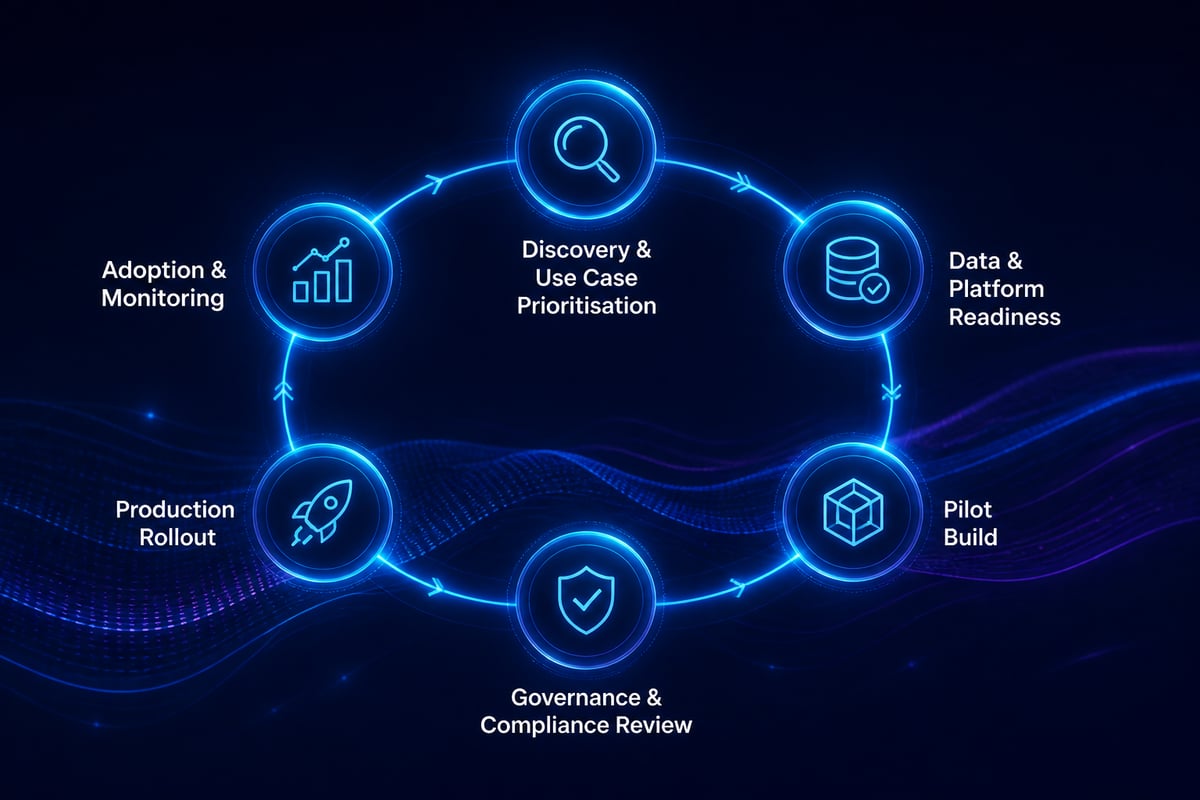
A typical engagement moves through five phases, each with a defined output, and you should expect to see something tangible at the end of every one. The durations depend on scope and data readiness, so ask any provider to state its assumptions rather than accepting a generic timeline.
- Discovery. The consultant interviews stakeholders, maps current processes and gathers candidate use cases. The output is a long list with owners and business context.
- Prioritisation. Use cases are scored on value, feasibility, data availability and regulatory exposure. The output is a short list and a justified sequence.
- Design and pilot. A selected use case is designed with the people who will use it, then built in a controlled environment. The output is a working pilot with agreed success measures.
- Governance and hardening. Security review, privacy assessment, bias checks and human oversight rules are applied. The output is a documented control framework.
- Rollout and adoption. The solution is integrated into live systems, staff are trained, and performance is tracked against the original measures.
The phase that most often decides success is the pilot. A pilot with no agreed measure of success becomes a permanent experiment, so insist on baseline figures, target outcomes and a decision point before any build begins.
How does consulting AI differ from buying an AI product?
Consulting AI adapts technology to your processes, whereas buying a product asks your processes to adapt to the technology. Neither approach is superior in every case, and many enterprises use both.
| Factor | Buying a packaged product | Engaging an AI consultancy |
|---|---|---|
| Fit with your processes | Generic, configured within limits | Designed around your goals and data |
| Speed to first use | Fast for standard needs | Slower to start, faster to relevant value |
| Integration effort | Often left to your IT team | Usually included in scope |
| Governance support | Vendor documentation | Tailored controls and oversight design |
| Ongoing change | Depends on vendor roadmap | Shaped by your priorities |
For common needs such as meeting summaries or document search, a packaged capability may be sufficient. For work that touches proprietary data, sector rules or specialised workflows, a designed solution tends to justify the added effort. Stellium Consulting describes its approach as built around each client's business goals rather than a template, which is the question worth testing with any provider: can they show how a past solution was shaped by a client's specific context?
How much does AI consulting cost?
AI consulting costs vary widely, and no honest provider can quote a reliable figure without understanding your scope, data and integration needs. Rates and totals differ by region, seniority and engagement model, so treat any published average with caution and ask for a scoped proposal instead.
Most providers use one of three pricing structures:
- Time and materials: you pay for consultant days. This suits exploratory work but offers little cost certainty.
- Fixed scope: a set price for defined deliverables, such as a readiness assessment or a pilot. This gives predictability if the scope is genuinely clear.
- Outcome-linked or retained: fees tied partly to milestones or delivered through a continuing relationship, common for multi-phase programmes.
The cost drivers are consistent across providers: the number and complexity of integrations, the condition of your data, the level of compliance review required, and how much training and change support you need. Regulated sectors typically spend more on governance than on model work, and that is appropriate rather than wasteful.
To compare proposals fairly, ask each provider to list what is excluded as well as what is included. Licences, cloud consumption, internal staff time and post-launch support are the items most often left out of a headline price. For Stellium Consulting's pricing, contact the team through its contact page, since figures depend on scope.
What should regulated organisations check first?
Regulated organisations should check legal exposure and data handling before any technical design starts, because retrofitting controls is slower and costlier than building them in. The EU AI Act sets the framework, and its dates are already in motion. According to the European Commission AI Act Service Desk, prohibitions and AI-literacy provisions became applicable on 2 February 2025, and governance and general-purpose AI model obligations on 2 August 2025.
The same timeline states that transparency requirements and enforcement for applicable rules begin on 2 August 2026, with high-risk AI obligations phasing in through 2 August 2028. Those dates are ahead of organisations now, so planning for them early is sensible.
Before you engage a consultant, prepare answers to these questions:
- Which of your planned use cases could be classed as high-risk, for example in credit, insurance pricing, employment or clinical settings?
- Where will data be processed and stored, and who can access it?
- Who reviews AI outputs before they affect a customer, patient or citizen?
- How will you evidence AI literacy among staff who use these tools?
A capable consultant will ask these questions of you in the first meeting. If a provider treats compliance as a later phase, that is a warning sign.
Which questions should you ask before you sign?
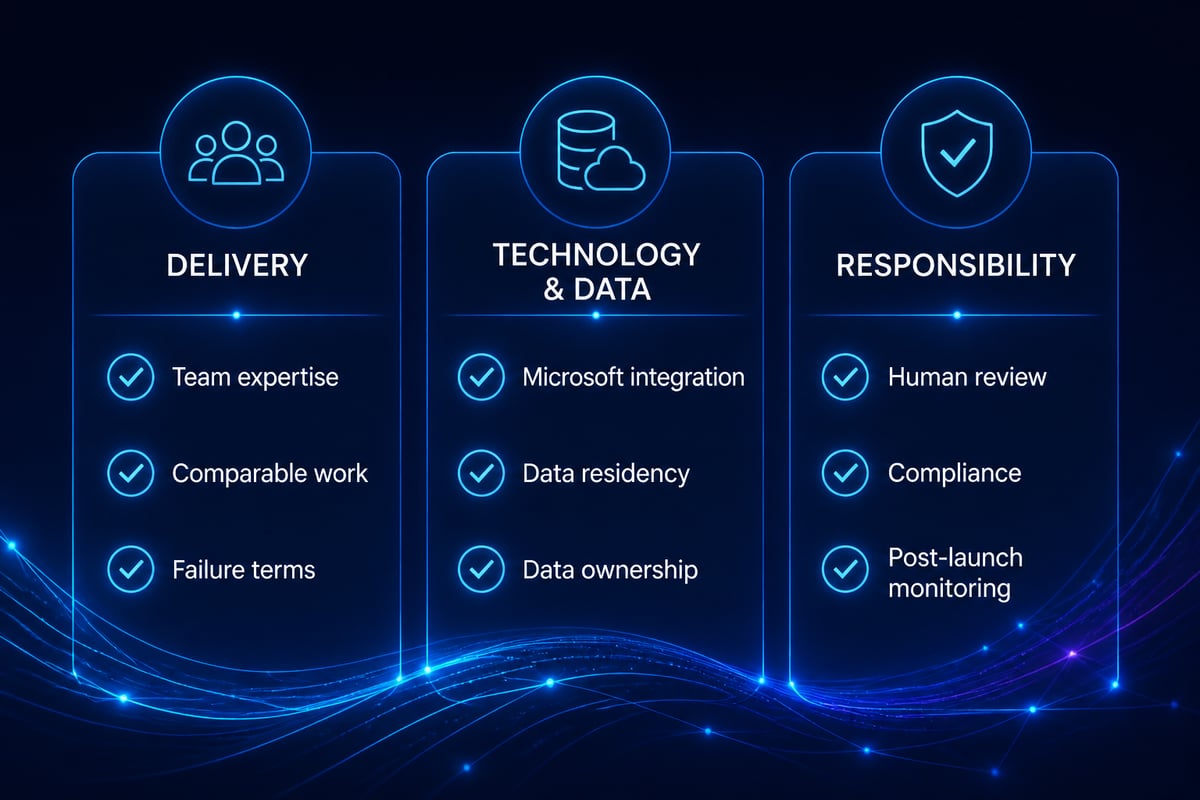
The most useful questions test evidence, accountability and fit rather than technical vocabulary. Put these to every shortlisted provider and compare the answers side by side.
Questions about delivery
- Who will do the work, and will the people presenting the proposal be the ones delivering it?
- Can you show a comparable engagement in a regulated sector, and what measurable result did it produce?
- What happens if the pilot does not meet its agreed measures?
Questions about technology and data
- How does your solution use our existing Microsoft licences, identity and security controls?
- Where is our data processed, and is it ever used to train a shared model?
- What do we own at the end: code, prompts, configurations and documentation?
Questions about responsibility
- How do you build in human review, privacy safeguards and bias checks?
- How will you support our compliance with the AI Act's obligations that apply to us?
- Who monitors the solution after launch, and at what cost?
Pay attention to how specific the answers are. Providers with real delivery experience describe constraints, trade-offs and past corrections. Providers without it describe benefits.
Why does a native Microsoft approach matter for enterprise AI?
A native Microsoft approach matters because it lets AI inherit the identity, permissions, compliance and monitoring controls your organisation already runs. Enterprises that use Microsoft 365 and Azure can build on those foundations instead of adding separate infrastructure that needs its own security review.
In practice this affects three things. First, access: solutions respect existing user permissions, so an employee only sees what they are already entitled to see. Second, integration: AI capabilities can sit inside the applications people use daily, which supports adoption. Third, scalability: a pilot built on the same platform as production avoids a rebuild when it succeeds.
Stellium Consulting is a Microsoft Solutions Partner and has been named Microsoft Partner of the Year, Switzerland. Its AI solutions are built natively on the Microsoft ecosystem, which it describes as secure, integrated and ready to scale. For teams moving from copilots to more autonomous workflows, its piece on becoming a Frontier Firm sets out how that progression can look, and its note on Azure AI Foundry highlights tracks platform developments relevant to build decisions.
For enterprises ready to move from prototypes to production-grade use cases, Advanced AI Implementation covers co-designed AI use cases built on Azure and enterprise data and integrated into applications and processes.
How do you measure whether the engagement worked?
You measure success against the baseline and targets agreed before the build, and a credible provider will help you set them in the first weeks. Without that baseline, improvement is an impression rather than a result.
Choose a small set of measures that match the use case:
- Process measures: time per task, error rates, cycle times, rework.
- Adoption measures: active users, frequency of use, share of eligible staff trained.
- Quality and risk measures: share of outputs corrected in human review, privacy incidents, bias findings.
- Financial measures: cost to serve, avoided effort, revenue influenced, with assumptions stated openly.
Human review data deserves particular attention. If reviewers correct a high share of outputs, the solution is not ready to scale, however good the demonstration looked. If they correct very few, check whether reviewers are genuinely checking or simply approving. Responsible AI practice treats human-in-the-loop validation as an operating control, not a launch formality, and Stellium Consulting builds it into every solution alongside privacy safeguards and bias checks.
Agree a review cadence as well. A quarterly checkpoint that compares live performance with the original case helps you decide whether to expand, adjust or retire a use case.
How do you prepare your organisation before engaging a consultant?
You prepare by clarifying business goals, naming an accountable owner and checking the state of your data, because these three factors shape the engagement more than any technology choice. Teams that arrive with them settled spend their consulting budget on delivery instead of orientation.
Work through this short sequence:
- Name the problems, not the tools. List the processes where delay, error or manual effort cost you most.
- Appoint a business owner. A named leader who owns the outcome, not only an IT sponsor.
- Inventory your data. Know where relevant data sits, who owns it and what restrictions apply.
- Involve compliance early. Legal, risk and data protection staff should see use case candidates before design begins.
- Plan for people. Decide how employees will be trained and how their feedback reaches the project team.
The people dimension is often where value is won or lost. Stellium Consulting's perspective on AI and the employee experience and its article on improving processes with AI both address how adoption and workflow design connect to results.

What does a good AI consulting partner look like?
A good partner combines delivery capability, sector awareness and a stated approach to responsibility, and it shows these through specifics rather than claims. Use this list as a final filter once you have a shortlist:
- Hands-on delivery by a team you meet before signing, rather than a hand-off to unseen staff.
- Named, verifiable client work in sectors comparable to yours. Stellium Consulting's named engagements include JTI, a Swiss law firm and a public hospital in Switzerland.
- Responsible AI practices described in operational terms: who reviews, what is logged, how bias is checked.
- A scoped proposal that lists exclusions, assumptions and decision points.
- Knowledge of the regulatory timeline and willingness to document how the solution supports your obligations.
- A plan for knowledge transfer so your team can operate and extend the solution.
The strongest signal is often behavioural. Partners who challenge your assumptions, narrow an over-ambitious scope and tell you when a use case is not worth pursuing are usually the ones who will deliver measurable results.
FAQ
What is the 30% rule of AI?
There is no single agreed definition of a 30% rule of AI. The phrase usually refers to an informal guideline, for example that AI might handle roughly 30% of a task while humans retain judgement over the rest, and it has no regulatory or technical standing. Treat any such figure as a planning heuristic and set targets from your own baseline measures.
Can I get an AI job with no experience?
Entry routes exist, particularly in roles that combine AI tools with domain knowledge such as operations, compliance, analytics or project coordination. Employers generally look for evidence of applied skills, so building small, documented projects and learning the platforms organisations already use, such as Microsoft's, helps more than general enthusiasm. Technical specialist roles typically still require a background in data, software or statistics.
How long does an AI consulting engagement take?
Duration depends on scope, data readiness and the level of compliance review. A discovery and prioritisation phase is usually shorter than a pilot, and a production rollout takes longer again. Ask each provider to state its timeline assumptions in writing, and treat vague schedules as a risk.
Your next step is to write a one-page brief that names two or three business problems, the data involved and the person who will own the result, then use it to request scoped proposals. If you are building on Microsoft, Stellium Consulting can help you turn that brief into a governed, working solution through hands-on delivery, including Advanced AI Implementation on Azure. When you are ready to test your plan against real constraints, Stellium Consulting is the place to start: let's talk about which use case should come first.