
Companion AI is software that holds ongoing, personalised conversations with a user, remembers past exchanges and adopts a consistent personality, so that it feels like a relationship rather than a series of isolated queries. Unlike a task-focused assistant, its purpose is sustained interaction, whether for conversation, coaching, support or entertainment. For IT and innovation leaders in regulated sectors, the technology raises practical questions about data protection, oversight and appropriate use, as well as opportunities for employee-facing and customer-facing services.
What is companion AI?
A companion AI is a conversational system designed around continuity, personality and emotional tone, not around completing a single transaction. You may also see it called an AI companion, AI friend or social chatbot.
Three traits separate it from a standard enterprise assistant:
- Persistent memory: it retains details from earlier conversations and refers back to them.
- A defined persona: it speaks in a consistent voice, with a name, tone and sometimes a backstory.
- Relational intent: it is built to maintain engagement over weeks or months, not to resolve a ticket and close.
Consumer products such as Replika, Character.AI, Nomi and Pi popularised the category. Their use is widespread among younger people: Common Sense Media's July 2025 risk assessment, reported by the Youth AI Safety Institute, found that most teens had used AI companions and that a large share used them regularly.
How does an AI companion work?
An AI companion works by combining a large language model with a memory layer, a persona definition and a set of safety rules that shape every reply. Each component does a distinct job.
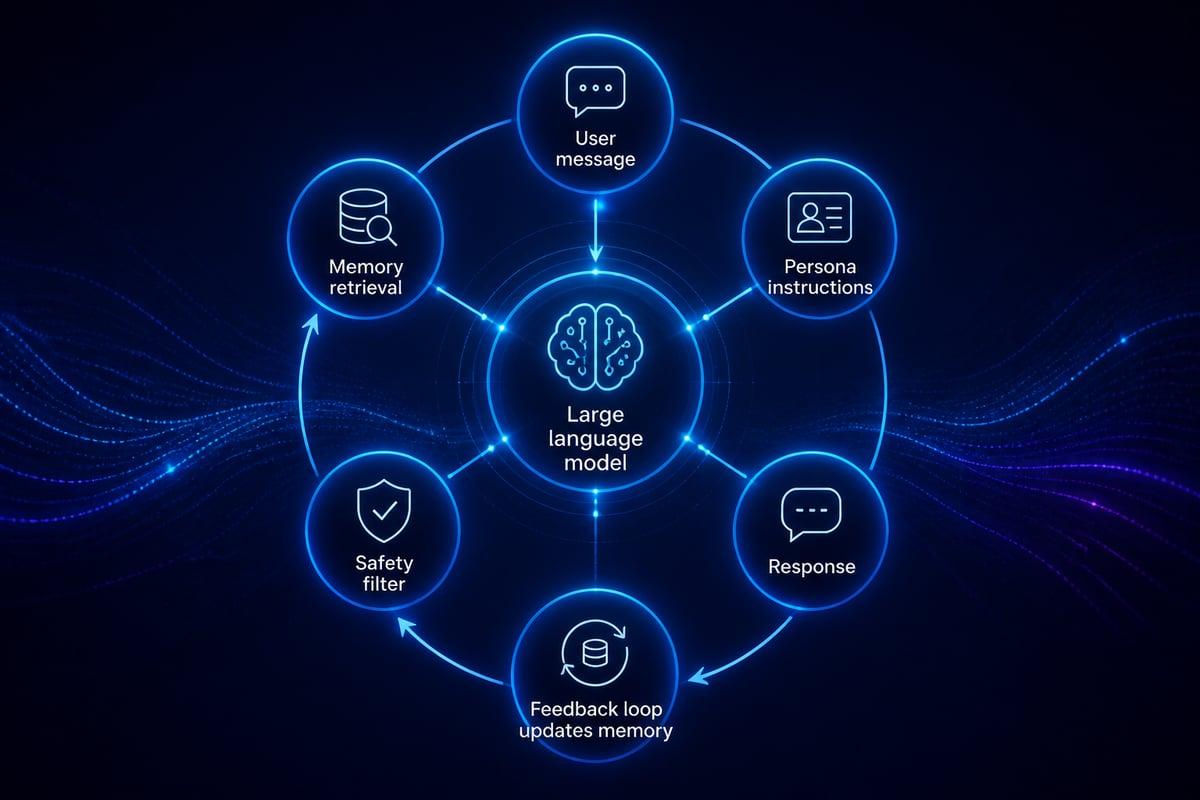
The language model
The language model generates the text. It predicts fluent, contextually appropriate replies based on the conversation so far. On its own it has no lasting knowledge of the user, which is why the other layers matter.
Memory
Memory is what makes a companion feel continuous. Systems typically store summaries, key facts and preferences in a database, then retrieve the relevant items and insert them into the prompt before the model responds. This is why a companion can mention a colleague's name or a project from last week.
Persona and instructions
A hidden set of instructions defines the character's tone, boundaries and behaviour. In an enterprise setting, this layer is where brand voice, tone guidelines and prohibited topics are encoded.
Safety and moderation
Filters screen both what the user sends and what the model returns. Well-designed systems also detect signs of distress and route the user towards human help, rather than continuing to converse.
What are the main types of companion AI?
Companion AI falls into four broad types, distinguished by purpose and audience. The categories overlap, but the distinction helps when deciding what is suitable for a workplace.
| Type | Primary purpose | Typical audience |
|---|---|---|
| Social companions | Friendship, conversation | Consumers |
| Role-play and character apps | Entertainment, storytelling | Consumers |
| Wellbeing and coaching companions | Reflection, habit support | Consumers, employers |
| Professional or workplace companions | Guidance, onboarding, knowledge support | Employees, customers |
The first two types dominate app stores. The last two are where enterprise interest is growing, because the same relational design can support onboarding, learning, patient information or customer guidance when it is grounded in verified organisational data.
What do people use companion AI for?
People use companion AI for conversation, emotional support, practice and entertainment. A 2024 survey of regular companion-chatbot users, published as the Chatbot Companionship study, identified several distinct user profiles, which shows that motivations vary considerably.
Common uses include:
- Casual conversation when no one else is available.
- Rehearsal, such as practising a difficult conversation or a language.
- Reflection, for example journaling with prompts and responses.
- Creative play, including interactive fiction.
- Routine support, such as reminders and daily check-ins.
For organisations, the more relevant question is which of these patterns translate into legitimate business value. Rehearsal and reflection map onto coaching and training. Routine support maps onto onboarding and internal help.
What are the risks and limitations?
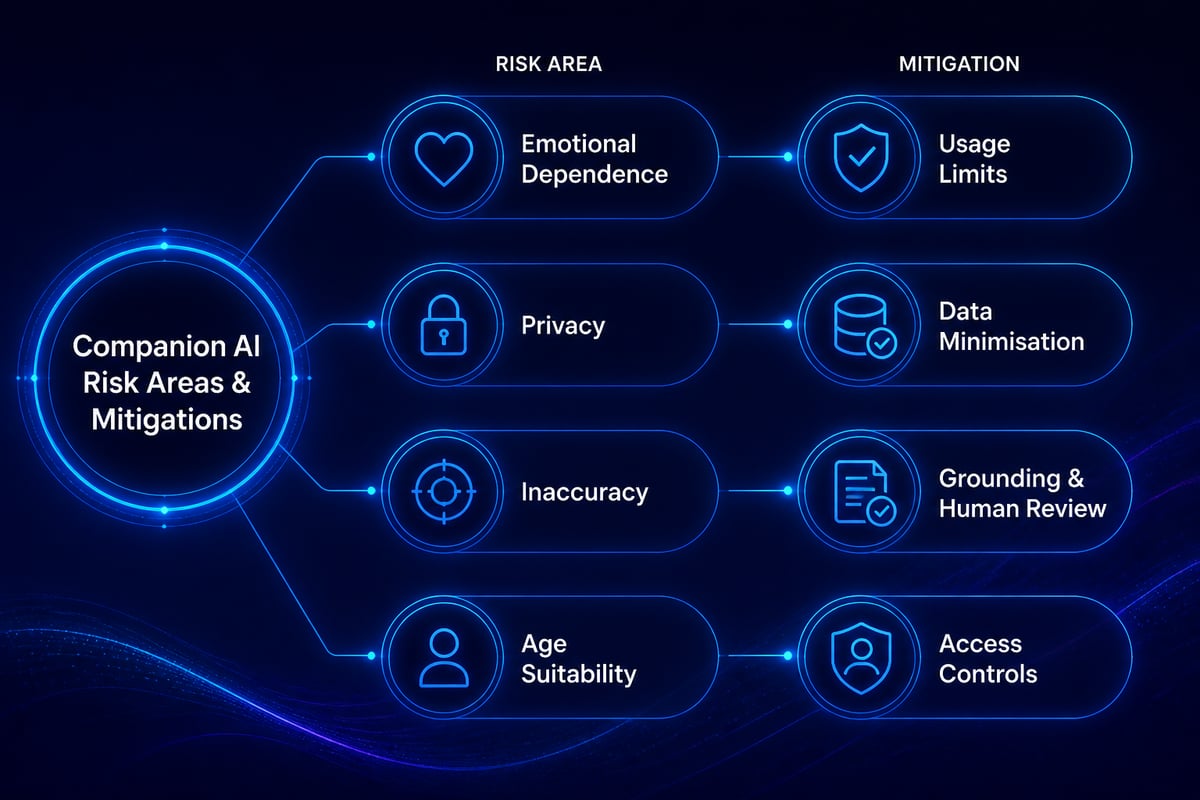
The main risks are over-reliance, privacy exposure, inaccurate output and unsuitable use by vulnerable users. These deserve careful attention before any deployment.
Emotional dependence. The Chatbot Companionship study found a small but statistically significant correlation between longer chatbot sessions and loneliness. Correlation does not establish cause, but it signals that heavy use warrants monitoring.
Privacy. Companions invite disclosure. Pennsylvania's Office of Mental Health and Substance Abuse Services advises users not to share sensitive personal or financial information with AI companions, to set usage limits, and not to treat them as a replacement for treatment. The same logic applies to employees entering confidential data into unmanaged consumer tools.
Accuracy. A fluent reply is not a verified reply. Models can state incorrect information with confidence, which is unacceptable in pharma, finance, insurance or public services unless outputs are grounded and validated.
Age suitability. Common Sense Media recommended that people under 18 not use social AI companions. Any customer-facing deployment must consider age assurance and appropriate design.
How does a companion AI differ from a chatbot or copilot?
A companion AI differs from a chatbot or copilot mainly in intent: it aims to sustain a relationship, whereas a chatbot answers questions and a copilot helps complete tasks within an application. The boundaries are blurring, though.
- Chatbot: scripted or model-driven, session-based, resolves a defined query.
- Copilot: embedded in a tool such as a productivity suite, acts on documents, email and data you already own.
- Companion: persistent, personality-driven, oriented towards ongoing interaction.
For a Microsoft-centred organisation, this distinction matters. A copilot grounded in your Microsoft 365 data inherits existing permissions and compliance controls. A consumer companion app sits outside them. The relevant design lesson from companions, namely memory and tone, can be applied inside a governed environment without adopting the consumer product.
Why does companion AI matter for enterprises?
Companion AI matters for enterprises because the relational design patterns behind it, memory, personalisation and tone, make internal and customer-facing AI more useful and more likely to be adopted. Adoption is often the harder problem. Stellium Consulting's analysis of AI implementation challenges shows how often projects stall on people and process rather than technology.
Practical enterprise applications include:
- Onboarding guides that remember where a new starter left off and adapt explanations to their role.
- Learning coaches that support practice and reflection between formal training sessions.
- Knowledge companions that answer questions from approved internal sources and cite them.
- Patient or citizen information assistants in healthcare and public services, with clear escalation to staff.
Organisations that treat such tools as part of a wider operating model, rather than isolated experiments, tend to progress further. This is a theme in Stellium Consulting's discussion of frontier firms in 2026, where human and AI collaboration is built into how work is organised.

How should regulated organisations approach governance?
Regulated organisations should approach governance by defining purpose, data boundaries, oversight and exit criteria before any companion-style tool reaches users. The following steps provide a workable sequence.
- Define the purpose. State what the companion is for and, just as importantly, what it must not do.
- Classify the data. Decide which information the system may see, store and remember, and apply retention limits to memory.
- Ground the responses. Connect the system to verified internal sources so that answers can be traced.
- Keep humans in the loop. Route sensitive, high-impact or uncertain cases to a qualified person.
- Test for bias and harm. Evaluate outputs across user groups and scenarios, including distress and misuse.
- Set usage guardrails. Introduce session limits, clear disclosure that the user is speaking to AI, and easy escalation to human help.
- Monitor and review. Track usage, feedback and incidents, and adjust or withdraw the tool as needed.
European organisations also need to account for the EU AI Act's transparency expectations and GDPR obligations on personal data, and Swiss organisations should consider the revised Federal Act on Data Protection. Legal and compliance teams should be involved from the outset, not at launch.
Should you build, buy or adapt a companion AI?
Most enterprises should adapt capabilities within their existing Microsoft environment before building from scratch or buying a consumer product. The right choice depends on data sensitivity, integration needs and the level of control required.
| Option | Strengths | Considerations |
|---|---|---|
| Consumer companion app | Fast to try | Data leaves your control; limited governance |
| Build from scratch | Full control | High effort; requires safety and memory engineering |
| Adapt within the Microsoft ecosystem | Inherits identity, permissions and compliance; integrates with existing data | Needs thoughtful design of persona, memory and oversight |
A native approach also reduces integration friction. Stellium Consulting, a Microsoft Solutions Partner, builds AI solutions natively on the Microsoft ecosystem, with responsible AI practices such as human-in-the-loop validation, privacy safeguards and bias checks built into every solution. Its work with organisations including JTI, a Swiss law firm and a public hospital in Switzerland reflects the sectors where these controls matter most.
How do you evaluate a companion AI before rollout?
You evaluate a companion AI by testing it against realistic scenarios, measuring both usefulness and harm, and confirming that governance holds under pressure. A short pilot with defined success criteria is more informative than a broad launch.
Consider these questions during evaluation:
- Does the system stay within its stated purpose when users push it off topic?
- Does it disclose clearly that it is AI?
- What exactly does it remember, for how long, and who can inspect or delete that memory?
- How does it behave when a user expresses distress or asks for advice outside its remit?
- Can every factual answer be traced to an approved source?
- Do employees actually return to it, and does it save measurable time or improve outcomes?
Measure results against business goals, such as faster onboarding, reduced support load or higher training completion, rather than engagement alone. A companion that keeps people talking is not necessarily one that serves the organisation.
What does the future of companion AI look like?
The future of companion AI points towards more capable memory, voice interaction and deeper integration into everyday work tools, alongside tighter regulation. As models improve, the line between a copilot and a companion will continue to narrow.
For leaders, the sensible position is neither enthusiasm nor avoidance. Companion AI demonstrates that people respond to technology that remembers them and speaks in a consistent voice. It also demonstrates what happens when such design is applied without boundaries. The task is to take the useful patterns, apply them within governed systems, and keep a person accountable for outcomes.
Start by listing two or three employee or customer journeys where continuity and personalisation would genuinely help, then note the data each would touch and the oversight it would need. If you would like support turning that list into a secure, Microsoft-native solution with responsible AI built in, Stellium Consulting is ready to help, so let's talk about which use cases suit your organisation and how to deliver them safely.