
Imagine a future where your business operations flow effortlessly, guided by intelligent systems that anticipate needs and automate complex decisions. This is the vision behind AI orchestration in 2026. As organisations seek to stay ahead, AI orchestration emerges as the key to integrating, managing, and scaling intelligent automation across the enterprise.
In this guide, we’ll define AI orchestration, explore how it works, reveal its benefits, and offer a practical roadmap for implementation. Discover real-world examples and trends shaping the future, and unlock the potential of intelligent automation for your organisation.
What is AI Orchestration?
AI orchestration is the strategic coordination and management of multiple AI models, agents, tools, and workflows across an organisation. Rather than focusing on a single task, AI orchestration brings together diverse elements, ensuring they work in harmony to deliver seamless, intelligent automation.
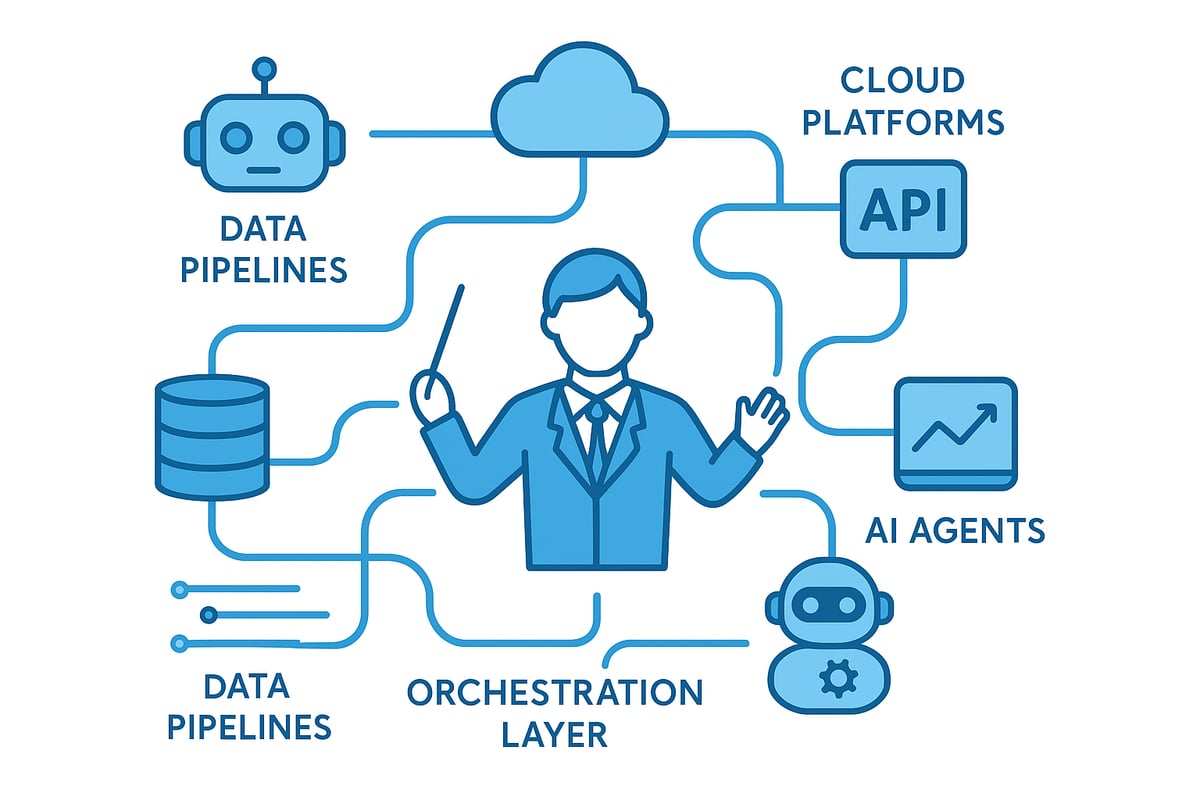
Unlike standalone AI agents, which handle specific tasks in isolation, AI orchestration acts as the conductor for the entire system. It integrates various agents, data sources, and business applications, enabling them to communicate, collaborate, and deliver outcomes that a single agent could never achieve on its own.
At its core, AI orchestration relies on three fundamental elements: integration, automation, and management. Integration connects disparate AI tools and data pipelines, automation streamlines complex workflows, and management oversees the lifecycle of models and processes. These elements ensure that organisations can scale their AI efforts efficiently and reliably.
The key components of AI orchestration include:
- Data pipelines: Move, clean, and prepare data for AI models.
- APIs: Connect AI agents and business systems to enable real-time information exchange.
- Cloud platforms: Provide the scalability and flexibility required for modern AI workloads.
- Orchestration layers: Oversee workflow scheduling, error handling, and resource allocation.
To illustrate, consider a city’s traffic management system. Individual traffic lights act as AI agents, each controlling flow at a specific junction. Ai orchestration is like the central system that monitors all traffic lights, adjusting their timing based on live data to optimise the entire city’s traffic flow.
In practice, enterprises leverage AI orchestration to unify customer service operations. For example, chatbots, analytics engines, and robotic process automation (RPA) tools are connected through a central orchestration layer. This ensures customer queries are routed, answered, and analysed efficiently, providing a seamless experience.
The adoption of AI orchestration is accelerating rapidly. According to an IBM report, over 60% of enterprises plan to invest in orchestration platforms by 2026. This trend is driven by the need to break down silos, automate manual integrations, and achieve scalable, enterprise-wide AI. Market research projects that the AI orchestration market is set to reach $30.23 billion by 2030, underlining the immense value organisations are placing on unified automation and governance.
Organisations face significant challenges without AI orchestration. Siloed systems, manual data transfers, and fragmented processes limit the potential of AI investments. By adopting orchestration, companies can overcome these barriers, unlocking efficiency, agility, and innovation across the enterprise.
In summary, AI orchestration is the backbone of intelligent automation in 2026. It empowers businesses to connect, manage, and scale their AI solutions, driving a new era of operational excellence and competitive advantage.
How AI Orchestration Works
Understanding how AI orchestration works is essential for any organisation aiming to unlock intelligent automation. At its core, AI orchestration acts as the “operating system” for enterprise AI, unifying diverse models, tools, and workflows into a cohesive, responsive framework.
By coordinating everything from integration to management, AI orchestration ensures seamless communication and efficient operation across your AI landscape.
The Pillars of AI Orchestration
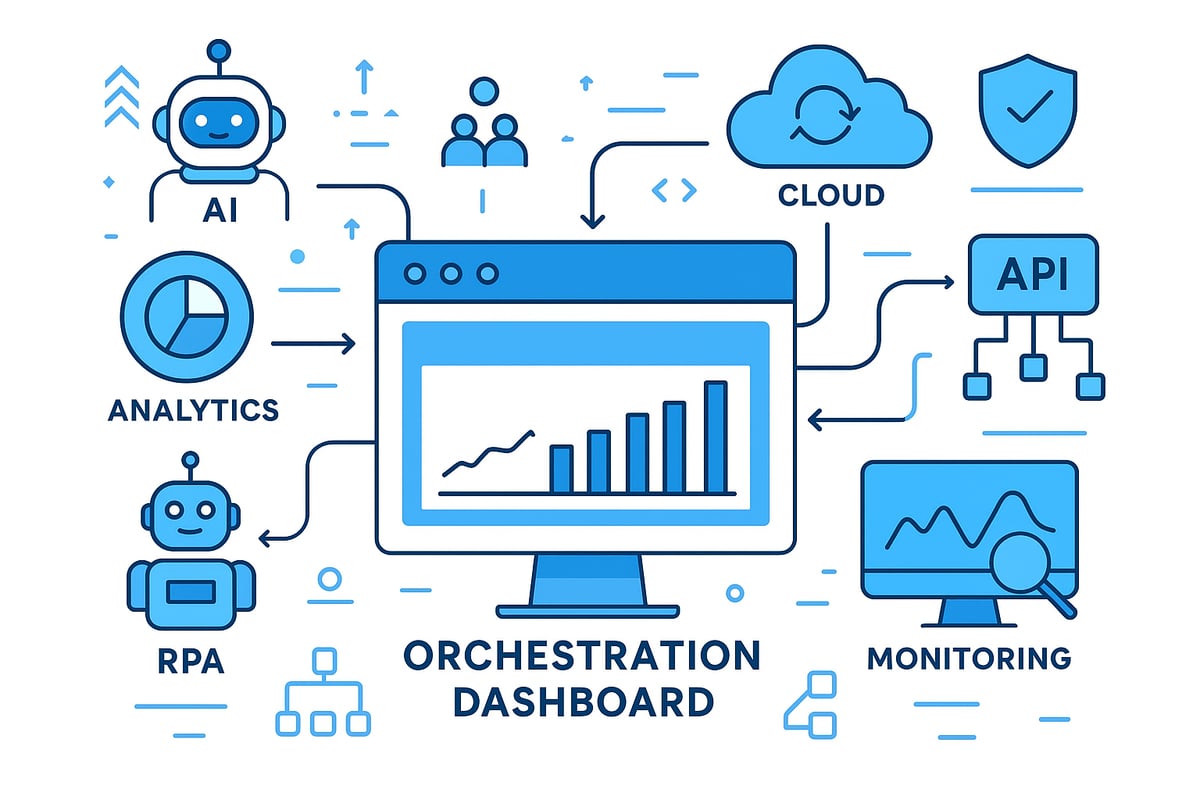
AI orchestration stands on three foundational pillars: integration, automation, and management.
Integration involves connecting diverse AI tools, databases, and business systems. This ensures that each component, from large language models to structured databases, communicates in real time.
Automation enables end-to-end workflows and decision-making processes to run without manual intervention. Automated triggers allocate resources, launch tasks, and optimise operations based on live data.
Management provides the governance layer: monitoring performance, ensuring compliance, and overseeing the entire AI lifecycle. For example, APIs can link generative models directly with business databases, delivering instant insights.
A recent IBM survey of 2,000 organisations found that integration and automation are the top priorities for AI orchestration. This highlights the growing need for seamless, real-time communication between models and enterprise tools.
Think of AI orchestration as the city-wide traffic system, where each AI agent is a traffic light, but orchestration keeps the entire flow optimised and safe.
Core Technologies Enabling Orchestration
The technology stack behind AI orchestration is both sophisticated and ever-evolving. Orchestration platforms such as Kubernetes, Azure AI Foundry, LangChain, and Zapier MCP enable organisations to deploy, scale, and manage AI models efficiently.
Data pipelines automate the movement, cleaning, and storage of information, ensuring that AI models always have access to current and accurate data. APIs and connectors facilitate seamless function calls between AI agents and business applications.
Cloud infrastructure provides the scalability and flexibility required for AI orchestration to adapt as business needs grow. For instance, Kubernetes automates the deployment and scaling of AI models, reducing manual overhead.
Notably, by 2026, 75% of new AI applications are projected to be built on cloud-native orchestration platforms. Low-code and no-code orchestration tools are also making advanced automation accessible to a wider range of users.
For a deeper look at orchestration platforms, including real-world examples with Azure AI Foundry, see Azure AI Foundry highlights.
AI Orchestration in Practice
In practical terms, AI orchestration transforms complex workflows into streamlined operations.
Consider automated document processing: an orchestrated pipeline might combine optical character recognition (OCR), natural language processing (NLP), and robotic process automation (RPA) to handle forms end-to-end with minimal human oversight.
Orchestration platforms provide real-time monitoring, dynamically allocate resources, and quickly resolve errors. Maintenance tasks such as patching, updates, and model redeployment are triggered automatically, keeping systems secure and current.
Centralised management also simplifies compliance. In financial services, for example, AI orchestration tools enable automated fraud detection, reporting, and regulatory submissions from a single dashboard.
Data shows a 30% reduction in downtime for enterprises using orchestrated AI systems. This centralised control point is what makes AI orchestration indispensable for modern businesses seeking resilience and agility.
Benefits of AI Orchestration
Unlocking the full potential of intelligent automation hinges on understanding the benefits of AI orchestration. With enterprises rapidly embracing this approach, organisations are achieving new levels of efficiency, collaboration, and governance. Let us explore how AI orchestration is transforming the way businesses operate, scale, and innovate.
Scalability and Efficiency
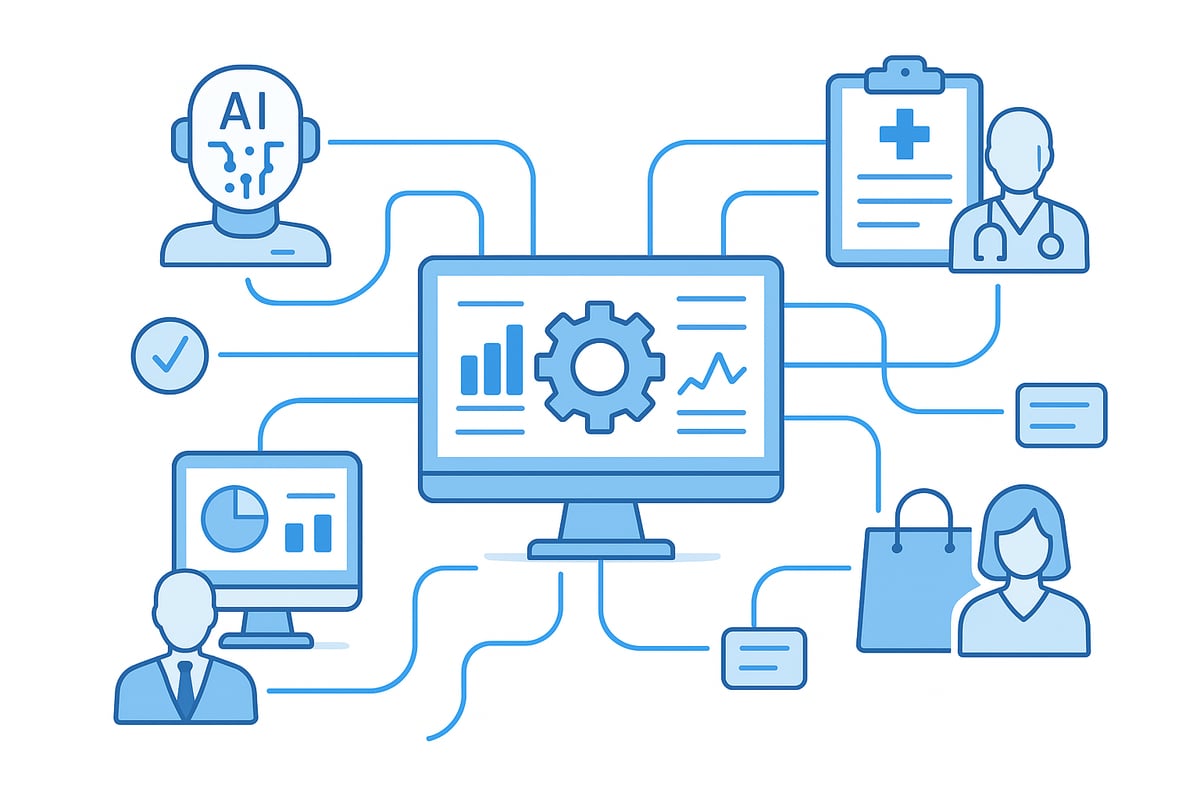
AI orchestration enables enterprises to scale their AI initiatives seamlessly as business demands evolve. By automating resource allocation, organisations ensure their AI systems adapt instantly to changes in workload, whether during peak retail seasons or sudden market shifts. This flexibility removes bottlenecks and helps maintain performance even as data volumes grow.
For example, retailers can use AI orchestration to dynamically scale recommendation engines during busy periods. This not only improves customer experience but also optimises infrastructure costs. According to IBM, orchestrated AI services reach the market 40% faster, allowing companies to respond to trends ahead of competitors.
Key efficiency benefits include:
- Automated handling of repetitive tasks and processes
- Reduced the need for manual intervention in AI operations
- Enhanced productivity for both technical and business teams
Orchestration frameworks such as LangChain and Azure AI Foundry promote modularity, making it easier to add, update, or reuse AI components as business needs shift. By embedding ai orchestration at the core, enterprises create systems that are not just scalable, but also resilient and future-ready.
Collaboration and Performance
AI orchestration transforms how teams work together by providing a centralised workspace for cross-functional collaboration. Data scientists, developers, and business stakeholders can all interact with the same orchestrated workflows, ensuring transparency and rapid issue resolution.
A major advantage is the ability for multi-disciplinary teams to collaborate in real time on AI workflow improvements. When a challenge arises, such as a data pipeline error or a model performance dip, teams can diagnose and resolve issues faster within the orchestration platform.
Key collaboration and performance benefits:
- Shared knowledge base for troubleshooting and workflow optimisation
- Faster bug fixes and post-deployment enhancements
- Consistent monitoring and reporting across AI models
Orchestration tools have led to a 50% improvement in model performance monitoring, according to industry reports. This heightened visibility means AI orchestration not only boosts collaboration but also drives continuous improvement in AI outcomes.
By integrating all components under one orchestration layer, organisations foster a culture of agility and shared responsibility. AI orchestration becomes the glue that binds teams, processes, and technologies together for superior business performance.
Governance, Compliance, and Transparency
Modern enterprises face increasing pressure to ensure governance, compliance, and transparency in their AI deployments. Ai orchestration addresses these needs by providing real-time monitoring, automated reporting, and centralised control over AI workflows.
Healthcare organisations, for instance, use AI orchestration to enforce data privacy and maintain detailed audit trails for regulatory compliance. Transparent, explainable workflows make it easier to demonstrate responsible AI practices to auditors and stakeholders.
Benefits in governance and compliance include:
- Automated compliance reporting and data privacy checks
- Simplified regulatory workflows for legal teams
- Enhanced auditability and traceability of AI decisions
In fact, 65% of regulated enterprises now cite orchestration as essential for meeting compliance requirements, according to IBM. For organisations seeking to implement robust governance, resources such as the Copilot control system & AI governance guide offer practical insights into managing orchestrated AI environments responsibly.
By placing governance at the heart of AI orchestration, businesses build trust, reduce risk, and lay a solid foundation for ethical AI adoption.
Step-by-Step Guide to Implementing AI Orchestration in 2026
Navigating the journey to effective AI orchestration requires a clear roadmap. This step-by-step guide will help your organisation assess readiness, define objectives, select the right platform, design workflows, automate, and ensure compliance. Each phase ensures your AI orchestration strategy is robust, scalable, and aligned with your business goals.
Step 1: Assess Organisational Readiness
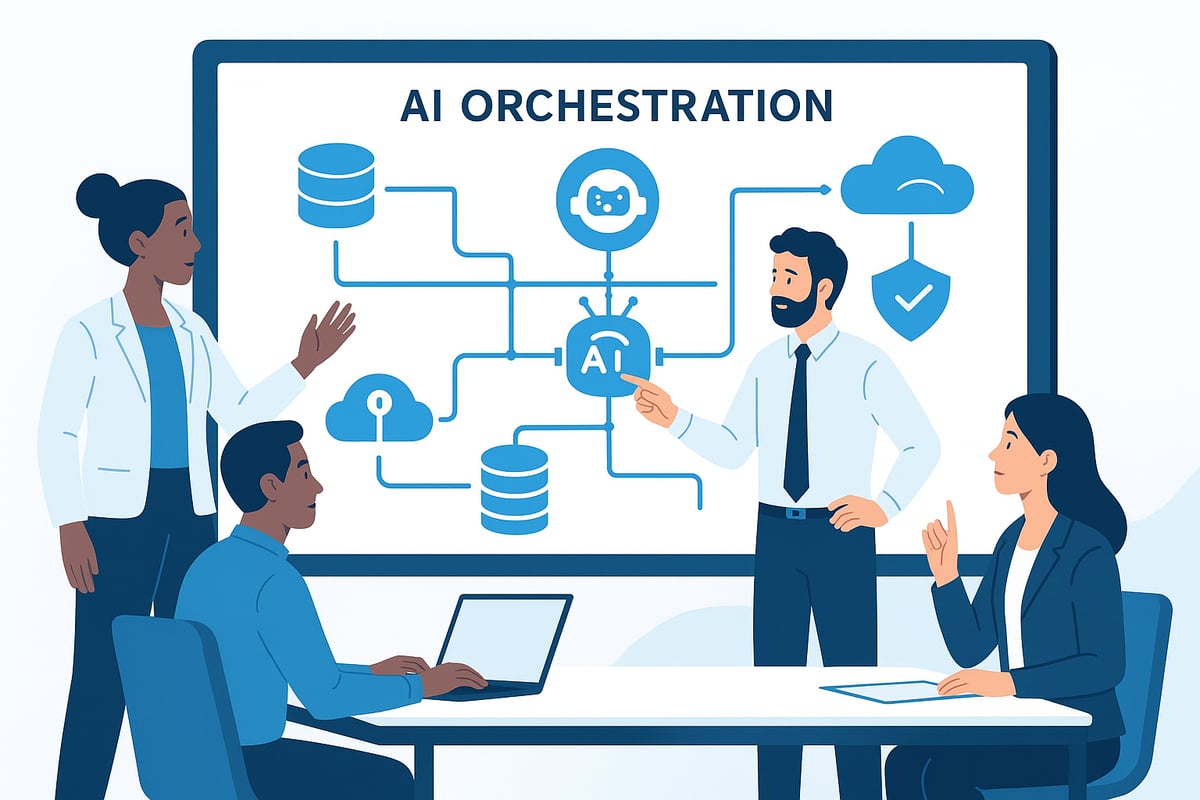
Begin by evaluating your organisation’s current AI maturity and the state of existing workflows. Assess which departments use AI, identify data silos, and pinpoint manual integration points. Bring together stakeholders from IT, business, and compliance to gather a holistic view.
A readiness assessment helps uncover gaps in infrastructure, data management, and expertise. For instance, a manufacturing firm might map its automation landscape, discovering isolated RPA bots and disconnected analytics tools. By recognising these areas early, you lay the groundwork for successful AI orchestration.
Document findings in a central repository. This ensures transparency and guides future steps, creating a foundation for seamless integration.
Step 2: Define Objectives and Use Cases
Set clear, measurable goals for AI orchestration, such as increasing efficiency, improving scalability, or meeting compliance requirements. Engage key business units to prioritise high-impact workflows that benefit most from orchestration.
Focus on a small number of strategic use cases to start. Many enterprises, for example, target fraud detection or automated customer onboarding as initial projects. According to IBM, 70 per cent of organisations begin with one or two pilots to demonstrate value.
Early wins help secure buy-in, build momentum, and provide learning opportunities. By refining objectives at this stage, your AI orchestration efforts will remain aligned with broader business strategy.
Step 3: Select the Right Orchestration Platform
Choosing the ideal platform is critical for effective ai orchestration. Evaluate options such as Kubernetes, Azure AI Foundry, Zapier MCP, or LangChain. Consider factors like scalability, compatibility with existing systems, and ease of use for technical and non-technical users.
Assess support for APIs, data pipelines, and cloud integration. For example, a large enterprise might select Kubernetes to deploy and scale AI models efficiently. Low-code and no-code platforms can broaden adoption across teams, reducing reliance on specialist developers.
Create a checklist to compare platforms based on your specific needs. This ensures the technology chosen supports your organisation’s AI orchestration ambitions now and in the future.
Step 4: Design and Integrate Workflows
Map out end-to-end AI orchestration workflows, detailing each step from data ingestion to final output. Visualise how AI agents, models, and business applications will interact. Use APIs to connect disparate systems and establish data pipelines for real-time processing.
A modular approach is essential. Design workflows so components can be reused or updated independently. For example, retailers often integrate chatbots, inventory systems, and analytics tools to streamline customer service. By 2026, 60 per cent of businesses are expected to adopt modular workflow design.
When integrating workflows, follow best practices for AI orchestration implementation to ensure security, scalability, and efficiency. Modular design not only speeds up development but also enhances agility for future changes.
Step 5: Automate, Monitor, and Optimise
Once workflows are designed, leverage AI orchestration tools to automate triggers, decision points, and maintenance routines. Implement real-time monitoring with dashboards that provide alerts on performance, errors, and compliance issues.
Platforms can automatically allocate resources, scale capacity, and handle routine updates. For instance, a healthcare provider might automate data compliance checks, reducing manual workload and risk. IBM reports a 30 per cent reduction in operational costs for organisations using automated monitoring.
Continual optimisation is crucial. Analyse performance data, adjust workflows, and refine models to ensure sustained value from your AI orchestration investment. Automation not only improves efficiency but also supports resilience and uptime.
Step 6: Ensure Governance and Compliance
Integrate governance frameworks into your AI orchestration strategy from the outset. Set up audit trails, automated compliance checks, and reporting systems to meet regulatory requirements and industry standards.
For example, a law firm might orchestrate workflows for managing sensitive client data, ensuring that every action is logged and privacy is maintained. Automated compliance reporting reduces the risk of human error and ensures timely submissions.
Governance is not optional. It safeguards your organisation’s reputation and builds trust with stakeholders. By embedding these controls, ai orchestration becomes a reliable backbone for responsible AI deployment.
Real-World Use Cases of AI Orchestration
Businesses across every sector are embracing AI orchestration to unify processes, boost agility, and drive measurable value. Let us explore how this powerful approach is transforming operations in the real world.
Enterprise Automation Across Industries
Ai orchestration is reshaping core operations for leading enterprises. In manufacturing, automated quality control and predictive maintenance ensure equipment uptime and faster defect detection. Financial institutions rely on AI orchestration to coordinate fraud detection, risk analysis, and regulatory reporting, reducing manual intervention and error.
Healthcare organisations orchestrate patient data processing, diagnostics, and compliance, supporting clinicians with timely, accurate insights. Retailers achieve seamless personalisation by integrating recommendation engines, supply chain management, and analytics, especially during peak periods. According to recent data, 60 per cent of Fortune 500 companies have deployed ai orchestration for mission-critical workflows.
For example, a global retailer combined chatbots, analytics, and robotic process automation to deliver a unified customer experience. This integration improved response times, reduced costs, and supported rapid scaling. To discover how enterprises are implementing these solutions, see Empowering enterprise AI innovation.
AI Orchestration in the Public Sector
Public sector organisations are increasingly turning to AI orchestration to enhance transparency and service efficiency. Government agencies automate citizen services, streamline document processing, and ensure compliance with evolving regulations.
In education, AI orchestration is used for automated grading, admissions, and administrative workflows, freeing staff for more strategic tasks. For instance, one city council integrated chatbots and data analytics, enabling faster, more accurate responses to public queries and improving service delivery.
Advanced Customer Experience (CX)
Ai orchestration empowers organisations to deliver exceptional customer experiences by connecting chatbots, virtual assistants, and CRM systems. Real-time personalisation and automated support create seamless journeys for customers.
An insurance provider, for example, orchestrated claims processing using AI orchestration across multiple channels. This resulted in quicker settlements and improved satisfaction. Enterprises leveraging these capabilities have seen a 45 per cent rise in customer satisfaction, highlighting the direct impact of coordinated automation.
Intelligent IT Operations
IT teams benefit from AI orchestration by automating incident detection, response, and remediation. Integrating monitoring tools, ticketing systems, and AI agents streamlines operations and minimises downtime.
A leading IT provider orchestrated end-to-end support workflows, from identifying issues to resolving them automatically. This approach led to a 35 per cent reduction in mean time to resolution, freeing IT teams to focus on innovation and long-term improvements.
Stellium Consulting: Enterprise-Grade AI Orchestration Solutions
Stellium Consulting delivers AI orchestration solutions tailored to enterprise needs, leveraging Microsoft Azure, Copilot, and advanced automation tools. Their expertise spans integration, workflow automation, and compliance across finance, healthcare, and manufacturing sectors.
As a Microsoft Solutions Partner, Stellium helps clients design, implement, and optimise intelligent automation strategies that unlock sustainable business value.
The Future of Intelligent Automation: Trends and Predictions for 2026
The landscape of intelligent automation is evolving at breakneck speed, with AI orchestration poised to underpin the next wave of enterprise transformation. As we look towards 2026, a set of defining trends is emerging, shaping how businesses will deploy, manage, and scale AI. These trends are not just technological shifts, but strategic imperatives for organisations determined to stay ahead.
Agentic AI and Collaboration
By 2026, agentic AI will become a driving force. Unlike traditional single-purpose AI models, agentic systems are designed to operate autonomously, collaborating with each other through advanced orchestration platforms. This interconnected approach enables AI agents to share data, make joint decisions, and optimise workflows across departments.
Recent studies show that over 70% of large enterprises plan to deploy agentic AI by 2026, with adoption rates accelerating rapidly. According to Agentic AI adoption statistics for 2026, businesses are already realising significant efficiency gains. AI orchestration acts as the backbone, enabling these autonomous agents to work in harmony, driving productivity and innovation.
Hyperautomation and Integration
Hyperautomation is set to redefine how businesses approach process improvement. By combining robotic process automation (RPA), machine learning, and ai orchestration, companies can automate entire end-to-end processes. This integration not only streamlines operations but also reduces manual intervention and error rates.
For example, leading logistics firms now orchestrate AI across IoT devices, automating supply chain management. A recent IBM report projects that by 2026, 80% of enterprises will rely on ai orchestration to manage hybrid and multi-cloud environments. The synergy between hyperautomation and orchestration unlocks unprecedented operational agility.
Low-Code/No-Code and Democratisation
The rise of low-code and no-code platforms is democratising access to AI orchestration. Business users, not just data scientists, can now design, deploy, and manage AI-powered workflows with minimal coding. This shift accelerates innovation, allowing organisations to respond quickly to market changes.
Low-code orchestration tools lower barriers for non-technical teams, fostering collaboration and rapid prototyping. By 2026, experts predict that a majority of new AI workflows will be developed using these accessible platforms. AI orchestration becomes a unifying layer, empowering all employees to contribute to digital transformation.
Explainable and Trustworthy AI
As AI systems grow more complex, explainability and trust are critical. Orchestration platforms are evolving to provide greater transparency, enabling organisations to audit and understand AI-driven decisions. This is especially vital in regulated sectors, where accountability is non-negotiable.
Innovative frameworks are emerging to embed governance and assurance directly into AI orchestration systems, ensuring ethical deployment and compliance. By making workflows auditable, businesses can build trust with customers and regulators alike. This trend supports responsible AI adoption and long-term sustainability.
Edge AI and the Future Enterprise
Edge computing is transforming where and how AI operates. With AI orchestration, enterprises can manage distributed AI models running at the network edge, close to data sources or users. This approach enables real-time analytics, lower latency, and improved resilience.
In sectors like logistics, orchestrating AI across fleets of IoT devices is already delivering faster, smarter decision-making. By 2026, edge AI orchestration will be essential for organisations seeking to harness the full potential of intelligent automation. For a deeper dive into these trends, see 7 AI trends shaping 2026.
Looking ahead, AI orchestration is set to become a strategic imperative for digital transformation and sustained competitive advantage. Enterprises that embrace these trends will be best positioned to lead in the era of intelligent automation.
As we’ve explored, mastering AI orchestration is the key to unlocking intelligent automation and transforming how your business operates in 2026. If you’re ready to take the next step—whether it’s integrating powerful AI tools, streamlining workflows, or ensuring compliance—let’s make it happen together. At Stellium Consulting, we specialise in helping enterprises like yours design and implement tailored AI solutions that empower your teams and drive real results. If you want to see how orchestrated automation can work for your organisation, why not Explore our Enterprise AI Solutions?