
The AI of Microsoft represents one of the most comprehensive and mature artificial intelligence ecosystems available to enterprises today. With billions invested in research, strategic partnerships with industry leaders like OpenAI, and deep integration across their entire product portfolio, Microsoft has positioned itself as a transformative force in enterprise AI adoption. For organisations seeking to leverage AI capabilities whilst maintaining security, compliance, and seamless integration with existing systems, understanding Microsoft’s AI landscape has become essential for strategic technology planning.
Understanding Microsoft’s AI Ecosystem Architecture
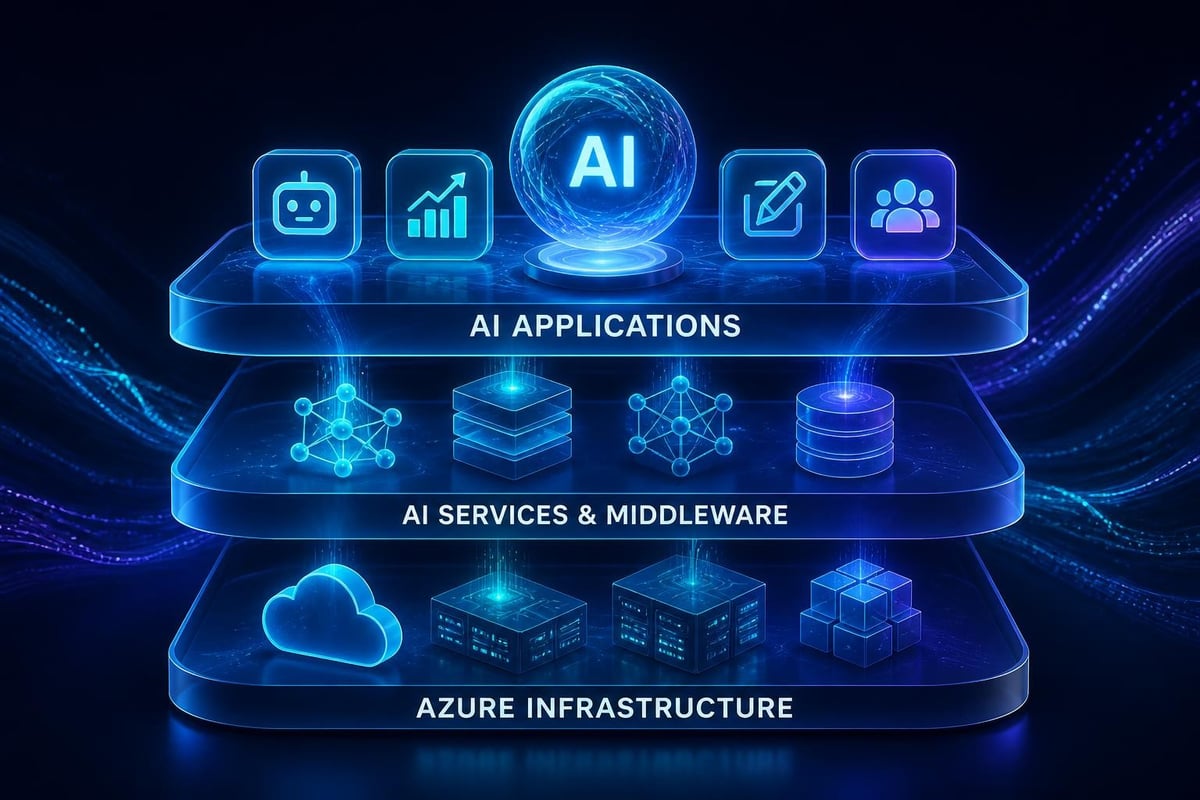
The AI of Microsoft extends far beyond standalone applications, encompassing a carefully orchestrated ecosystem of interconnected services, platforms, and tools. This architecture spans from cloud infrastructure through Azure AI services to end-user productivity applications embedded with intelligent capabilities.
At the foundation lies Azure AI, Microsoft’s cloud-based platform offering machine learning, cognitive services, and AI infrastructure. This provides enterprises with building blocks for custom AI development, including pre-trained models, neural network frameworks, and scalable computing resources. Azure OpenAI Service brings cutting-edge large language models directly into enterprise environments with enterprise-grade security and compliance features.
The platform approach enables organisations to:
- Deploy custom AI models whilst maintaining data sovereignty
- Integrate AI capabilities into existing applications through APIs
- Scale computational resources based on workload demands
- Maintain security and compliance across all AI operations
- Access the latest models through managed services
Azure AI Services and Cognitive Capabilities
Azure AI Services provide pre-built AI capabilities that organisations can implement without extensive data science expertise. These services span vision recognition, natural language processing, speech analysis, and decision-making algorithms.
| Service Category | Primary Capabilities | Enterprise Use Cases |
|---|---|---|
| Vision | Image analysis, object detection, OCR | Document processing, quality control |
| Language | Text analytics, translation, understanding | Customer service, content analysis |
| Speech | Recognition, synthesis, translation | Meeting transcription, accessibility |
| Decision | Anomaly detection, personalisation | Fraud detection, recommendations |
These building blocks enable rapid AI implementation across diverse business scenarios. Manufacturing organisations utilise vision services for quality inspection, whilst financial institutions deploy decision services for risk assessment and fraud prevention.
Microsoft Copilot: AI Integration Across Productivity
The AI of Microsoft finds perhaps its most visible expression in the Copilot family of products, which embed intelligent assistance directly into familiar workplace applications. This represents a fundamental shift from AI as a separate tool to AI as an integrated capability within existing workflows.
Microsoft 365 Copilot transforms how knowledge workers interact with documents, emails, presentations, and data. Rather than requiring users to switch context or learn new interfaces, Copilot brings AI capabilities into Word, Excel, PowerPoint, Outlook, and Teams. Recent research demonstrates that Microsoft 365 Copilot significantly impacts productivity when properly implemented within organisational workflows.
Copilot Deployment Considerations
Successful Copilot implementation requires thoughtful planning beyond simple licence procurement. Organisations must address data governance, user training, and integration with existing business processes.
Data preparation forms the foundation of effective Copilot deployment. The tool’s effectiveness depends heavily on access to well-structured, properly secured organisational data. This means:
- Auditing and cleansing existing data repositories
- Implementing appropriate permission structures
- Ensuring compliance with data retention policies
- Creating clear data classification frameworks
- Establishing governance policies for AI-generated content
Change management proves equally critical. Employees require not just technical training but also guidance on when and how to leverage AI assistance effectively. Forward-thinking organisations create internal champions, develop use case libraries, and establish feedback mechanisms to continuously refine their Copilot strategies.

Specialised Copilot Applications for Security and Development
Beyond general productivity, the AI of Microsoft extends into specialised domains through purpose-built Copilot applications. These targeted tools address specific professional workflows with domain-tuned capabilities.
Copilot for Security
Security operations centres face overwhelming volumes of alerts, threats, and incidents requiring rapid analysis and response. Microsoft Copilot for Security applies AI to incident investigation, threat analysis, and remediation guidance, significantly reducing response times whilst improving accuracy.
The security-focused Copilot integrates with Microsoft Sentinel, Defender products, and third-party security tools to provide unified threat intelligence. Security analysts can query the system in natural language, receiving synthesised insights drawn from multiple data sources alongside recommended response actions.
Key capabilities include:
- Incident summarisation across multiple alerts and data sources
- Threat intelligence enrichment with contextual information
- Guided remediation with step-by-step response procedures
- Natural language queries for security data exploration
- Knowledge base integration incorporating organisational security policies
GitHub Copilot for Development
Software development represents another domain where the AI of Microsoft delivers substantial productivity gains. GitHub Copilot, available through both IDE integration and command-line interfaces, assists developers with code generation, debugging, and documentation.
Research on GitHub Copilot CLI adoption within Microsoft itself demonstrates significant engineering productivity improvements, with developers completing tasks faster whilst maintaining code quality. The tool learns from vast repositories of public code whilst respecting intellectual property boundaries.
Strategic Positioning and Market Approach
Microsoft’s comprehensive strategy distinguishes the AI of Microsoft from competitors offering point solutions or standalone services. Microsoft’s approach to AI emphasises integration, responsibility, and accessibility across their entire product ecosystem.
This manifests in several strategic decisions that impact enterprise adoption:
| Strategic Element | Implementation | Enterprise Impact |
|---|---|---|
| Integration depth | AI embedded across all products | Reduced fragmentation, unified experience |
| Partnership model | OpenAI collaboration with proprietary development | Access to cutting-edge models with control |
| Deployment flexibility | Cloud, hybrid, and edge options | Adaptability to regulatory requirements |
| Responsible AI framework | Built-in safeguards and governance tools | Risk mitigation and compliance support |
The company has increasingly positioned itself as providing end-to-end AI systems rather than component services, with Microsoft reportedly instructing salespeople to emphasise this comprehensive approach when competing with standalone AI providers.
Data Sovereignty and AI Implementation
One critical consideration for enterprises deploying the AI of Microsoft concerns data ownership and intellectual property protection. Microsoft CEO Satya Nadella has warned that organisations essentially pay twice for AI: once with subscription fees and again with the valuable proprietary data used to train and refine models.
This raises important questions about:
- Where organisational data resides when processing AI requests
- How training data gets used to improve models
- What guarantees exist against data exposure to competitors
- Whether organisations retain full ownership of AI-generated content
Microsoft addresses these concerns through Azure AI’s architecture, which processes enterprise data within customer-controlled environments. Commercial data commitments ensure that customer data doesn’t train public models, and regional deployment options support data residency requirements.
Implementing Robust Governance Frameworks
Successful AI deployment requires governance structures matching the technology’s capabilities and risks. Organisations should establish:
- Clear policies defining acceptable AI use cases
- Approval workflows for AI-generated content publication
- Audit mechanisms tracking AI interactions and decisions
- Training programmes ensuring appropriate AI utilisation
- Review processes for monitoring AI effectiveness and risks
These frameworks prove particularly important as AI capabilities expand across the organisation, touching increasingly sensitive business functions and decision-making processes.
Security Enhancements Through AI
Beyond productivity applications, the AI of Microsoft increasingly powers security improvements across the Windows ecosystem and cloud infrastructure. Microsoft leverages AI for vulnerability detection, identifying code vulnerabilities more rapidly and comprehensively than traditional methods.
This represents a dual aspect of AI in enterprise environments: AI both creates new security considerations and provides tools for addressing them. Organisations must simultaneously protect AI systems from adversarial attacks whilst utilising AI capabilities for enhanced security monitoring.

Integration with Business Applications
The AI of Microsoft extends beyond productivity tools into business application platforms, particularly through Dynamics 365 and the Power Platform. These integrations demonstrate how AI capabilities enhance core business processes across sales, customer service, finance, and operations.
Dynamics 365 Copilot brings conversational AI into customer relationship management and enterprise resource planning. Sales professionals receive AI-generated email drafts, meeting summaries, and opportunity insights. Customer service agents access AI-powered case summarisation and solution recommendations drawn from knowledge bases and previous interactions.
Power Platform AI Builder enables business users to create custom AI models without coding expertise. Organisations can build form processors extracting data from documents, prediction models forecasting business outcomes, or object detection models for visual quality control.
These capabilities democratise AI across organisations, moving sophisticated technology from specialist data science teams into the hands of business users. However, this democratisation requires appropriate governance ensuring consistent quality and compliance standards.
Cost Considerations and ROI Analysis
Implementing the AI of Microsoft requires substantial financial investment spanning licences, infrastructure, training, and ongoing support. Organisations must carefully evaluate return on investment across multiple dimensions.
Direct costs include:
- Per-user licence fees for Copilot services
- Azure consumption charges for AI workloads
- Premium capacity for Power Platform AI features
- Training and change management programmes
- Data preparation and governance implementation
Productivity gains manifest through reduced task completion times, improved decision quality, and enhanced employee satisfaction. However, quantifying these benefits requires measurement frameworks established before deployment to establish baselines and track improvements.
Research suggests that AI tools like Copilot can significantly enhance productivity, but realisation depends heavily on effective implementation, user adoption, and ongoing optimisation.
Future Developments and Strategic Planning
The AI of Microsoft continues evolving rapidly, with new capabilities, models, and integration points emerging regularly. Microsoft’s AI initiatives focus on developing increasingly capable systems whilst maintaining alignment with human values and organisational goals.
Enterprises planning AI strategies must balance current implementation with flexibility for future developments. This suggests:
- Building modular architectures accommodating new capabilities
- Establishing governance frameworks scaling with AI proliferation
- Developing internal expertise rather than complete vendor dependence
- Creating feedback mechanisms capturing lessons learned
- Maintaining awareness of emerging capabilities and competitive offerings
The rapid pace of AI advancement means that strategies established today will require regular revision. Organisations benefit from treating AI implementation as an ongoing programme rather than a discrete project with defined endpoints.
Partner Ecosystems and Implementation Support
Successfully deploying the AI of Microsoft often requires expertise beyond internal IT capabilities. The Microsoft partner ecosystem includes specialists who understand both the technology and industry-specific implementation challenges.
Partners provide services spanning:
- Strategic consulting defining AI roadmaps aligned with business objectives
- Technical implementation configuring, customising, and integrating AI services
- Data preparation structuring information for optimal AI effectiveness
- Change management driving user adoption and workflow transformation
- Ongoing optimisation refining implementations based on usage patterns
Selecting appropriate partners requires evaluating industry expertise, technical certifications, and demonstrated experience with similar organisational challenges. Microsoft Solutions Partners demonstrate validated capabilities through rigorous assessment and customer success metrics.
The AI of Microsoft represents a comprehensive ecosystem transforming how enterprises operate, from employee productivity through security operations to customer engagement. Successfully leveraging these capabilities requires strategic planning, thoughtful governance, and expert implementation support.
Stellium Consulting partners with organisations to navigate Microsoft’s AI landscape, delivering tailored solutions that enhance business processes whilst maintaining security and compliance. As a Microsoft Solutions Partner specialising in AI-powered enterprise solutions, we help businesses implement, optimise, and scale their Microsoft AI investments to achieve measurable transformation.