
The integration of artificial intelligence within enterprises represents one of the most significant technological shifts of our generation. As businesses navigate digital transformation, AI in organizations has evolved from experimental pilot projects to mission-critical infrastructure that shapes competitive advantage. Modern enterprises are discovering that successful AI implementation requires more than technological capability-it demands organisational alignment, cultural adaptation, and strategic vision that extends across every business function.
The Current State of AI in Organizations
Enterprise adoption of AI has accelerated dramatically since 2024, with organisations across industries investing substantial resources into intelligent systems. The landscape has matured beyond simple automation, with AI now powering complex decision-making processes, predictive analytics, and customer engagement platforms.
Key adoption metrics reveal significant growth:
- 72% of enterprises have deployed AI in at least one business function
- AI budgets have increased by 45% year-on-year across Fortune 500 companies
- Employee productivity gains average 28% in AI-enabled workflows
- Return on investment typically materialises within 18-24 months
The transformation extends beyond metrics. AI in organizations fundamentally reshapes how knowledge workers approach their daily tasks, how leaders make strategic decisions, and how businesses interact with customers. Understanding organizational intelligence provides crucial context for how AI capabilities align with broader enterprise knowledge management.
Deployment Models Across Enterprise Functions
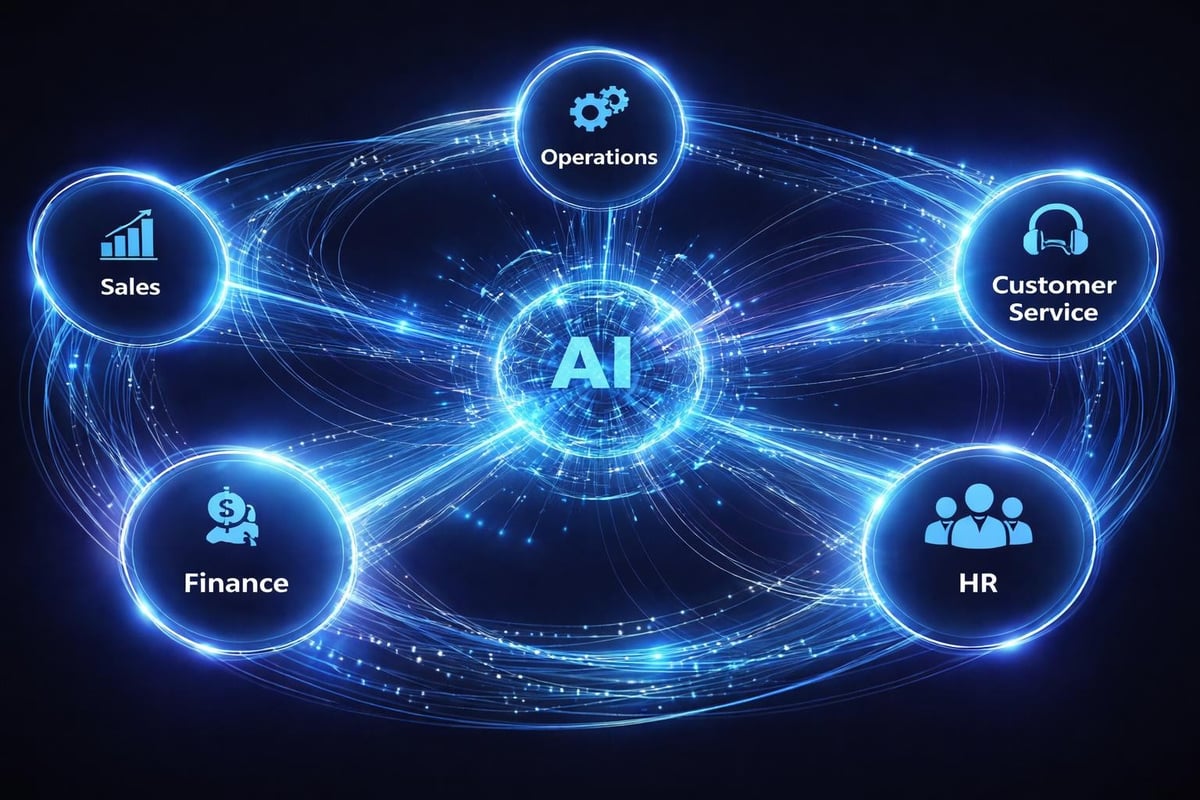
Different departments leverage AI distinctively, each requiring tailored approaches:
| Department | Primary AI Applications | Impact Measurement |
|---|---|---|
| Operations | Predictive maintenance, supply chain optimization | Cost reduction, efficiency gains |
| Sales | Lead scoring, opportunity analysis, forecasting | Revenue growth, conversion rates |
| Customer Service | Chatbots, sentiment analysis, ticket routing | Resolution time, satisfaction scores |
| Finance | Fraud detection, risk assessment, reporting | Accuracy improvement, compliance |
| HR | Talent acquisition, performance analytics, retention | Time-to-hire, employee engagement |
Organizations implementing enterprise AI solutions discover that cross-functional integration delivers exponentially greater value than siloed deployments.
Strategic Approaches to AI Implementation
Successful AI adoption requires deliberate strategy rather than opportunistic experimentation. Organisations that excel in AI implementation follow structured frameworks that balance technological capability with business objectives.
The strategic foundation begins with identifying high-value use cases. Rather than attempting enterprise-wide transformation simultaneously, leading organisations prioritize initiatives based on:
- Potential business impact: Revenue generation, cost reduction, or competitive differentiation
- Data readiness: Availability of quality training data and integration capabilities
- Organisational readiness: Skills, culture, and change management capacity
- Technical feasibility: Complexity, required infrastructure, and implementation timeline
Progressive organisations develop comprehensive AI adoption strategies that align technological capabilities with business transformation goals.
Building AI-Ready Infrastructure
Technical infrastructure forms the backbone of sustainable AI deployment. Modern AI in organizations requires robust cloud platforms, data governance frameworks, and integration architectures.
Essential infrastructure components include:
- Scalable compute resources for model training and inference
- Data lakes and warehouses with proper governance
- API management for seamless integration
- Security frameworks addressing AI-specific vulnerabilities
- Monitoring systems for model performance and drift detection
Microsoft Azure provides comprehensive platforms specifically designed for enterprise AI workloads, offering both infrastructure services and pre-built cognitive capabilities. The Azure AI platform delivers integrated tools that accelerate development whilst maintaining enterprise-grade security and compliance.
Empowering Employees Through AI Integration
The human dimension of AI implementation often determines success or failure more decisively than technical considerations. AI in organizations succeeds when employees embrace these tools as enablers rather than threats.
Employee empowerment manifests through several mechanisms. First, AI augments human capabilities rather than replacing them. Knowledge workers equipped with AI assistants accomplish more sophisticated work, focusing creative energy on strategy and innovation whilst AI handles routine analysis and information synthesis.

Training and Change Management
Organisations investing in comprehensive training programmes see dramatically higher adoption rates and ROI. Effective training encompasses:
- Technical proficiency with AI tools and platforms
- Understanding AI capabilities and limitations
- Ethical considerations and responsible AI use
- Prompt engineering and AI interaction skills
- Integration of AI into existing workflows
Change management strategies must address natural resistance whilst building enthusiasm. Transparent communication about AI’s role-augmentation rather than replacement-reduces anxiety and increases engagement.
Research examining AI organizations versus individual AI agents demonstrates that coordinated multi-agent systems deliver superior outcomes when properly structured, suggesting that organizational AI strategies benefit from deliberate coordination frameworks.
Governance and Responsible AI Practices
As AI capabilities expand, governance frameworks become increasingly critical. AI in organizations operating without proper oversight risk regulatory violations, ethical breaches, and reputational damage.
Comprehensive governance addresses multiple dimensions:
- Data privacy and security protocols
- Algorithmic transparency and explainability
- Bias detection and mitigation strategies
- Human oversight mechanisms
- Audit trails and compliance documentation
Forward-thinking organizations establish AI ethics committees comprising technical experts, business leaders, legal counsel, and external advisors. These bodies review proposed AI applications, monitor deployed systems, and ensure alignment with organizational values and regulatory requirements.
The Ethos Institute’s resources on AI governance provide authoritative guidance for establishing robust oversight frameworks that balance innovation with responsibility.
| Governance Element | Purpose | Implementation Approach |
|---|---|---|
| Ethics review | Assess potential harms | Multi-stakeholder committee |
| Model monitoring | Detect performance degradation | Automated alerting systems |
| Bias auditing | Ensure fairness | Regular testing protocols |
| Data lineage | Track information sources | Comprehensive documentation |
| Access controls | Limit system permissions | Role-based authentication |
Organizations developing AI governance platforms create sustainable frameworks that scale with their AI initiatives whilst maintaining appropriate controls.
Measuring AI Impact and ROI
Quantifying AI value requires sophisticated measurement frameworks that capture both direct and indirect benefits. AI in organizations delivers value through multiple channels, not all immediately apparent in traditional metrics.
Direct benefits typically include cost reductions through automation, revenue increases from improved targeting or pricing, and efficiency gains measured in time savings. These tangible outcomes justify initial investments and secure ongoing funding.
Indirect benefits prove equally valuable though harder to quantify. Enhanced decision quality, improved employee satisfaction, accelerated innovation cycles, and strengthened competitive positioning all contribute significantly to organizational success.
Establishing Meaningful KPIs
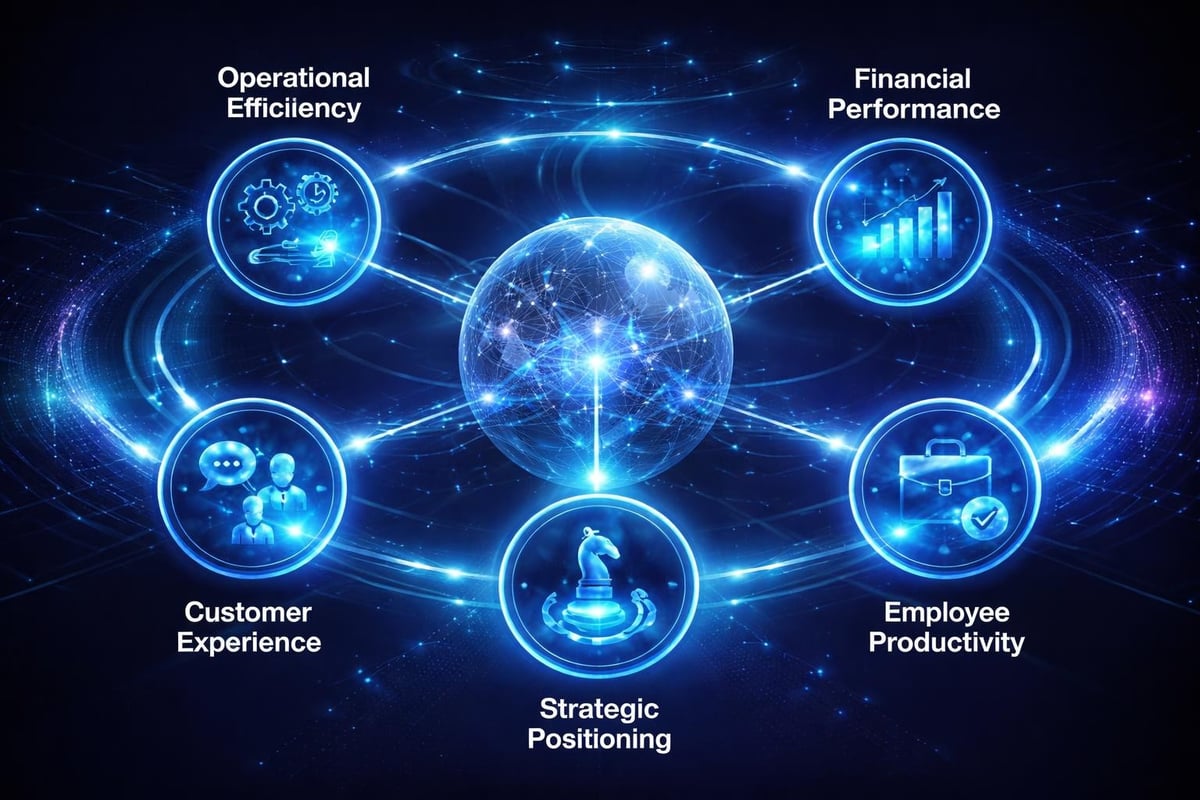
Effective measurement frameworks align AI metrics with business objectives:
- Operational efficiency: Process completion time, error rates, resource utilization
- Financial performance: Revenue attribution, cost per transaction, profit margin impact
- Customer experience: Satisfaction scores, engagement metrics, retention rates
- Employee productivity: Tasks completed, quality measures, innovation outputs
- Strategic positioning: Market share, competitive benchmarking, innovation pipeline
Regular review cycles ensure measurements remain relevant as AI capabilities evolve. Quarterly business reviews incorporating AI performance data enable evidence-based optimization and resource allocation.
The Evolution Toward Agentic AI
The frontier of AI in organizations is shifting toward autonomous agents capable of complex, multi-step reasoning and task execution. Agentic AI systems represent the next evolutionary phase, moving beyond reactive responses to proactive problem-solving.
These sophisticated systems demonstrate several advanced capabilities:
- Goal-oriented planning and execution
- Context retention across extended interactions
- Tool utilization and integration orchestration
- Self-correction and learning from outcomes
- Collaboration with human colleagues and other agents
Early adopters deploy agentic AI for research and analysis, customer support escalations, software development assistance, and business process orchestration. The technology remains nascent but shows tremendous promise for transforming knowledge work.
Organizations exploring agentic capabilities benefit from understanding how AI platforms determine authoritative sources, ensuring their internal knowledge bases and documentation meet standards for AI comprehension and citation.
Integration with Existing Systems and Workflows
Successful AI implementation rarely occurs in isolation. AI in organizations delivers maximum value when seamlessly integrated with existing enterprise systems, data sources, and business processes.
Integration challenges typically include:
- Legacy system compatibility and API limitations
- Data format standardization across platforms
- Real-time synchronization requirements
- Security boundary management
- User experience consistency
Low-code platforms have democratized AI integration, enabling business users to connect AI capabilities with existing workflows without extensive programming knowledge. These low-code AI platforms accelerate deployment whilst maintaining governance and security standards.
Microsoft Copilot Studio exemplifies this approach, providing visual development environments where business analysts design sophisticated AI-powered workflows through intuitive interfaces. This democratization extends AI capabilities throughout organizations rather than concentrating them within technical departments.
API-First Architecture
Modern AI implementations embrace API-first design principles, exposing AI capabilities as services that any authorized application can consume. This architectural approach enables:
- Flexible deployment across multiple channels and interfaces
- Consistent AI behavior regardless of access point
- Simplified updates and model improvements
- Granular access control and usage monitoring
- Ecosystem development through third-party integrations
Organizations architecting for flexibility position themselves to leverage emerging AI capabilities as they become available, avoiding technical debt that constrains future innovation.
Industry-Specific AI Applications
Whilst fundamental AI capabilities apply broadly, implementation details vary significantly across industries. AI in organizations manifests differently depending on sector-specific requirements, regulatory environments, and competitive dynamics.
Healthcare organisations prioritize diagnostic assistance, treatment planning, and patient engagement whilst navigating strict privacy regulations and clinical validation requirements. AI models trained on medical data require extensive testing and regulatory approval before clinical deployment.
Financial services firms leverage AI for fraud detection, risk assessment, algorithmic trading, and personalized banking experiences. Regulatory compliance, model explainability, and audit requirements shape implementation approaches within this heavily regulated sector.
Manufacturing enterprises implement predictive maintenance systems, quality control automation, supply chain optimization, and robotic process automation. Integration with industrial IoT sensors and operational technology creates unique architectural challenges.
Retail organizations deploy recommendation engines, dynamic pricing algorithms, inventory optimization systems, and computer vision for loss prevention. Real-time processing requirements and seasonal demand variations necessitate elastic infrastructure.
Understanding these sector-specific considerations enables organizations to learn from peer implementations whilst adapting best practices to their unique contexts. Resources on structuring content for AI tool citation become particularly valuable when developing industry-specific knowledge bases.
Skills Development and Talent Strategy
The talent dimension of AI implementation extends beyond hiring data scientists and machine learning engineers. AI in organizations requires diverse skill sets spanning technical expertise, business acumen, ethical reasoning, and change leadership.
Critical roles within AI-enabled organizations include:
| Role | Primary Responsibilities | Key Skills |
|---|---|---|
| AI Strategist | Align AI initiatives with business objectives | Business strategy, technology trends |
| Data Scientist | Develop and train models | Statistics, programming, domain knowledge |
| ML Engineer | Deploy and maintain AI systems | Software engineering, MLOps, cloud platforms |
| AI Ethics Officer | Ensure responsible AI practices | Ethics, compliance, risk management |
| Prompt Engineer | Optimize AI interactions | Language skills, AI capabilities, creativity |
Organizations develop talent through multiple approaches: hiring specialists for core AI roles, upskilling existing employees for AI-adjacent functions, partnering with consultancies for expertise and acceleration, and cultivating internal communities of practice that share knowledge and best practices.
The emergence of AI and productivity gains across knowledge work creates opportunities for employees at all levels to develop AI literacy and leverage intelligent tools within their domains.
Future Trajectories for Enterprise AI
Looking forward, several trends will shape how AI in organizations evolves over the coming years. Multimodal AI systems that seamlessly process text, images, audio, and video will enable more natural interactions and broader application domains.
Federated learning approaches will allow organizations to collaborate on AI development whilst preserving data privacy, particularly valuable in regulated industries and cross-organizational partnerships. Edge AI deployment will bring intelligence closer to data sources, reducing latency and enabling real-time processing for time-critical applications.
The convergence of AI with other emerging technologies creates multiplicative opportunities. Quantum computing promises to accelerate certain AI workloads dramatically. Blockchain integration could enhance AI transparency and auditability. Extended reality interfaces will transform how humans interact with AI systems.
Regulatory frameworks will mature, establishing clearer guidelines for responsible AI deployment whilst potentially constraining certain applications. Organizations that proactively adopt strong governance practices position themselves advantageously as regulations evolve.
Understanding 2026 AI trends helps organizations anticipate shifts and prepare strategic responses that maintain competitive positioning.
Partnership and Ecosystem Approaches
Few organizations possess all capabilities required for comprehensive AI transformation internally. Strategic partnerships extend organizational capacity whilst accelerating implementation timelines and reducing risk.
Partnership models include:
- Technology vendors providing platforms and infrastructure
- Consultancies offering expertise, methodology, and implementation services
- Academic institutions contributing research and talent development
- Industry consortiums sharing best practices and standards
- Startups delivering specialized capabilities and innovation
Microsoft Solutions Partners like Stellium Consulting combine deep platform expertise with industry knowledge and implementation experience, helping organizations navigate complex AI initiatives from strategy through deployment and optimization. These partnerships prove particularly valuable for organizations lacking internal AI maturity or facing resource constraints.
Ecosystem participation also includes contribution-sharing learnings, developing open-source tools, and participating in standards bodies. Organizations that actively engage in AI ecosystems benefit from collective intelligence whilst building reputation and relationships.
Overcoming Implementation Challenges
Despite tremendous potential, AI in organizations faces significant implementation challenges. Understanding common obstacles enables proactive mitigation strategies.
Frequent challenges include:
- Insufficient data quality and availability for effective model training
- Skills gaps across technical and business functions
- Integration complexity with legacy systems and processes
- Organizational resistance and change management difficulties
- Unclear ROI and difficulty securing ongoing investment
- Ethical concerns and governance uncertainties
Successful organizations address these challenges through deliberate planning and sustained commitment. Data quality initiatives precede AI projects, establishing foundations for success. Comprehensive training programs build necessary skills across the organization. Phased rollouts demonstrate value whilst managing complexity.
Guidance on overcoming AI adoption risks provides practical frameworks for navigating common pitfalls and maintaining momentum through implementation challenges.
AI in organizations represents transformative potential that extends far beyond technological capability to encompass cultural evolution, strategic positioning, and fundamental business model innovation. Organizations that approach AI implementation strategically-balancing ambition with pragmatism, innovation with governance, and technology with humanity-position themselves for sustained competitive advantage. Stellium Consulting partners with enterprises to navigate this transformation, delivering AI-powered solutions that empower employees, enhance processes, and achieve measurable business outcomes through Microsoft’s comprehensive AI platform and proven implementation methodologies.