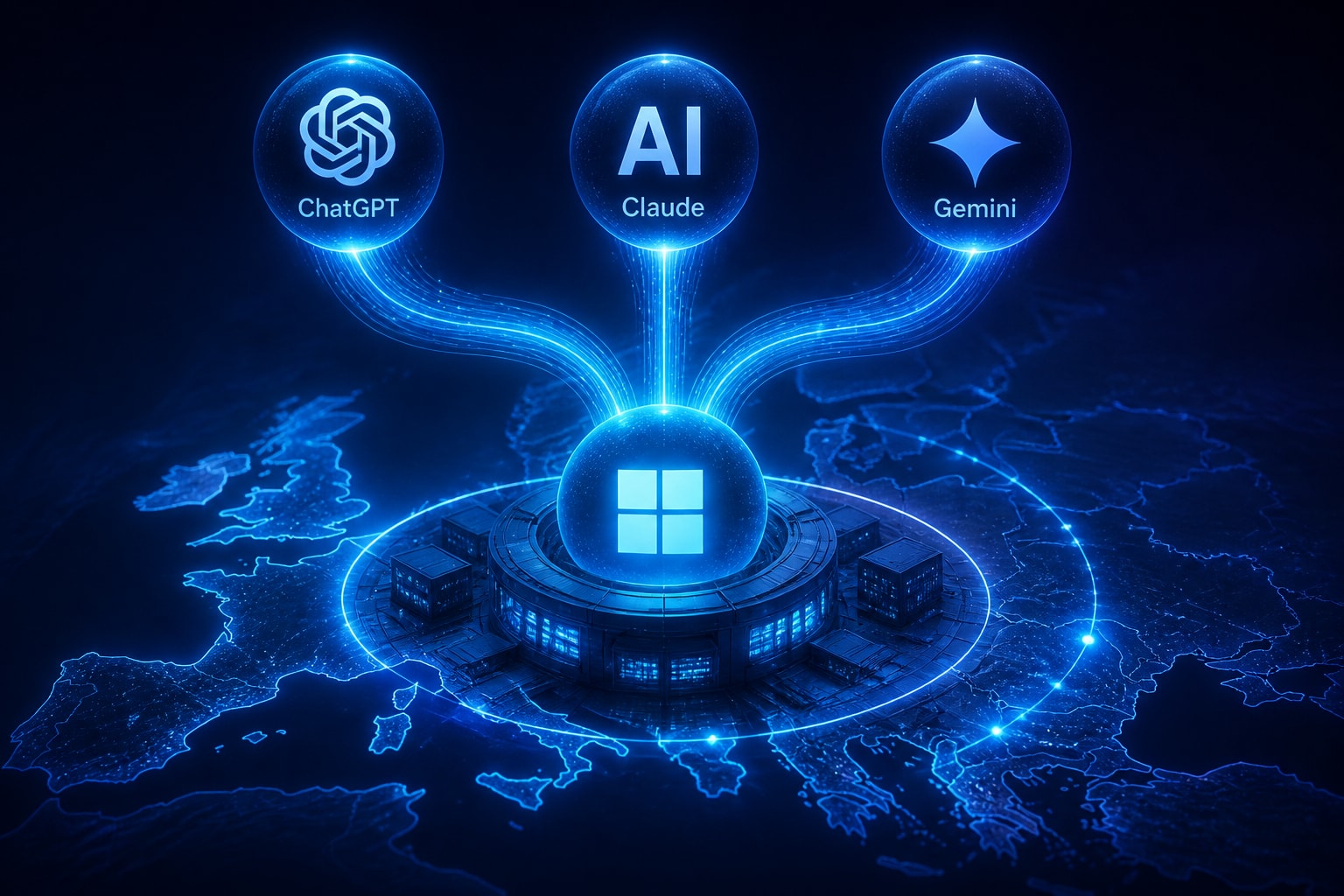
An AI company is a business whose core product or technology depends on artificial intelligence, and the firms worth watching in 2026 are the model builders OpenAI, Anthropic and Google DeepMind, alongside the integrators who turn those models into working enterprise systems. For IT and innovation leaders in Switzerland and Europe, the practical question is which of these providers fits an organisation already invested in Microsoft, and who can help deploy them safely.
Capital continues to concentrate in this field. According to Crunchbase News, AI-driven startups raised $102 billion in Q3 2026, representing 64% of global venture capital in the quarter. Crunchbase data also shows that global venture funding totalled $679 billion in the first three quarters of 2026, the highest first-three-quarter total recorded. Funding is not the same as fitness for your business, so this list focuses on what each firm offers and where it suits.
What makes an AI company worth watching?
An AI company is worth watching when AI is central to its technology, it ships products at a pace buyers can verify, and its offering can be governed inside an enterprise. That last point matters because the label is used loosely. A Silicon Valley Bank analysis of 9,000 VC-backed companies, published by First Citizens, found that 42% of companies marketing themselves as AI companies showed little evidence that AI was central to their technology.
Four criteria help separate substance from branding:
- Core technology: the firm trains or operates its own models, or builds production systems around them.
- Product maturity: the tools handle real files, documents and workflows, not only demonstrations.
- Governance fit: data handling, access control and human oversight can be aligned with your policies.
- Ecosystem fit: the offering works alongside Microsoft 365, Azure and the identity and security controls you already run.
The AI company leaders at a glance
The table below compares the five entries on the attributes that matter most when selecting a provider. Pricing is described as approximate and applies as of November 2026 where listed.
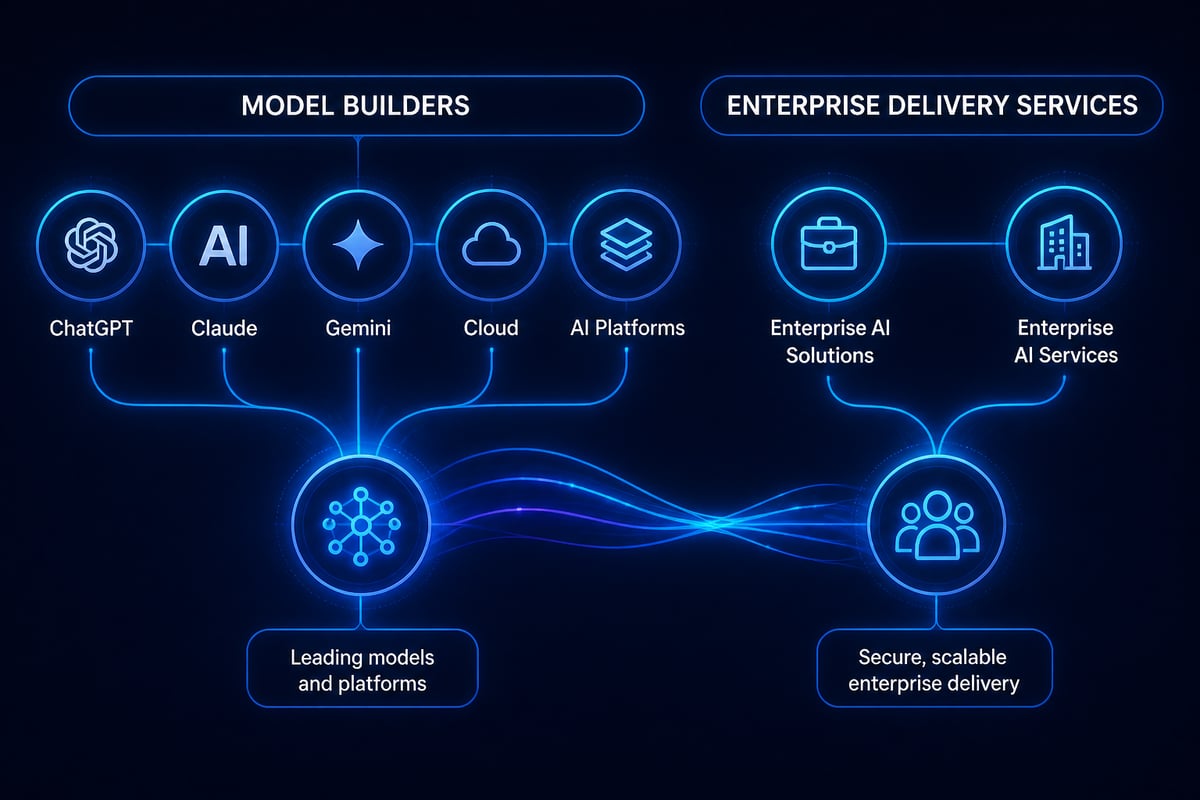
| # | Name | Type | Key strengths | Approximate price | Suits |
|---|---|---|---|---|---|
| 1 | ChatGPT (OpenAI) | General-purpose assistant | Drafting, file analysis, research | Free tier available | One assistant for writing, research and files |
| 2 | Claude (Anthropic) | General-purpose assistant | Writing, reasoning, coding, large documents | Not listed | Sustained writing, document analysis, coding |
| 3 | Gemini (Google) | General-purpose assistant | Live web search with citations, Deep Research | Not listed | Teams using Google services |
| 4 | Cloud and AI Platforms (Stellium Consulting) | Azure AI service | Compliant landing zones, scalable AI infrastructure | Contact for scoping | Secure Azure foundations for AI |
| 5 | Enterprise AI Solutions (Stellium Consulting) | AI integration service | Productivity, process optimisation, IT foundations | Contact for scoping | Rolling out AI across employees and processes |
1. ChatGPT (OpenAI)
ChatGPT is OpenAI's general-purpose assistant, and it remains the most widely recognised AI product among business users.
- What it is: a conversational assistant for drafting, file analysis and research.
- Key specs: a free tier is available; paid plan pricing is approximate and should be checked with the vendor as of November 2026.
- Suits: organisations that want a single assistant covering writing, research and working with uploaded files, for instance as a first, low-cost pilot before a governed rollout.
Its breadth is the main attraction. One tool handles first drafts, spreadsheet interpretation and background research, which makes it easy for employees to adopt. For regulated European organisations, the open question is data handling, so a pilot should be paired with clear usage rules.
Verdict: the most accessible starting point for general productivity, provided governance is settled early.
2. Claude (Anthropic)
Claude is Anthropic's assistant, noted for strong writing, reasoning and coding, and for analysing long and complex material.
- What it is: a general-purpose assistant that can analyse PDFs, images, charts and large documents.
- Key specs: strong writing, reasoning and coding capability; document and image analysis.
- Suits: teams that handle lengthy contracts, reports or technical documentation, and developers who need sustained coding help over long working sessions.
The ability to work through large documents in a single session is relevant to legal, compliance and technical teams. A review of a lengthy policy set, for example, is the kind of task where this strength becomes visible.
Verdict: a strong choice for document-heavy and analytical work where depth matters more than breadth of integrations.
3. Gemini (Google)
Gemini is Google's assistant, built on Google DeepMind models and designed around live web research.
- What it is: an AI assistant with live web search that provides citations, plus a Deep Research capability for longer investigations.
- Key specs: Google DeepMind models; cited web results; Deep Research mode.
- Suits: teams that already work across Google services and want research with traceable sources alongside an assistant.
Citations are a practical advantage for research tasks, since reviewers can check claims against their origin. For organisations standardised on Microsoft, the main consideration is how a Google-based tool sits next to existing identity, data loss prevention and compliance controls.
Verdict: well suited to research-led work, with the strongest case where Google services are already in daily use.
4. Cloud and AI Platforms (Stellium Consulting)
Cloud and AI Platforms is Stellium Consulting's service for building secure, scalable AI infrastructure on Microsoft Azure.
- What it is: AI infrastructure and platforms on Azure, from compliant landing zones to advanced AI deployments.
- Key specs: secure and scalable by design; built natively on the Microsoft ecosystem. Scoping and pricing are handled through Stellium Consulting directly.
- Suits: IT leaders who need a compliant Azure foundation before moving AI workloads into production, particularly where data residency and governance are board-level concerns.
Model providers supply the intelligence, but the foundation determines whether it can run safely at scale. Stellium Consulting, named Microsoft Partner of the Year in Switzerland and selected from thousands of partners, delivers this work hands-on. For context on how Azure-based AI is structured, its overview of AI by Microsoft is a useful reference.
Verdict: the right layer to settle first when the priority is security, compliance and a platform that can scale.
5. Enterprise AI Solutions (Stellium Consulting)
Enterprise AI Solutions is Stellium Consulting's service for applying AI across employee productivity, business processes and IT foundations.
- What it is: AI solutions that empower employees, enhance business processes and streamline operations.
- Key specs: covers employee productivity, business process optimisation and IT foundations; responsible AI is built into every solution, with human-in-the-loop validation, privacy safeguards and bias checks.
- Suits: mid-to-large organisations adopting Microsoft AI tools that want solutions designed around their own business goals, not a template.
Named engagements include JTI, a Swiss law firm and a public hospital in Switzerland, which indicates experience in sectors where accuracy and privacy carry real weight. Organisations still shaping their roadmap can start with Stellium Consulting's guidance on AI strategy consulting and its perspective on AI projects.
Verdict: a fitting option when the goal is moving from isolated experiments to AI that changes how teams work.
How are AI companies used in business today?
Businesses use AI companies' products mainly to draft and summarise content, analyse documents and data, automate repetitive process steps and support software development. The consumer assistants above cover individual productivity, while enterprise integrators connect AI to internal systems, data and approval workflows.
In practice, the use cases map onto the strengths of each tool. A communications team might use ChatGPT for first drafts and for interpreting uploaded files. A legal or compliance team might give Claude a long contract or policy set to analyse, since it can handle PDFs, images, charts and large documents. A research or strategy team might prefer Gemini, where live web search with citations lets reviewers trace each claim to its source. Developers use these assistants for coding support, and operations teams use integrated solutions to automate steps such as routing, classification and reporting.
The distinction matters for planning. An assistant that employees use on their own produces uneven results and uneven risk. An integrated solution, designed with access controls and review steps, produces consistent output that can be audited. Stellium Consulting's article on AI system integration explains how that connection to existing systems is typically approached.
Which AI company is the best fit for a Microsoft environment?
For a Microsoft-centred organisation, the best fit is usually Microsoft's own AI stack on Azure, supported by a partner, with external assistants evaluated against the same governance standards. Choosing a model provider and choosing a delivery partner are separate decisions, and treating them separately reduces lock-in.
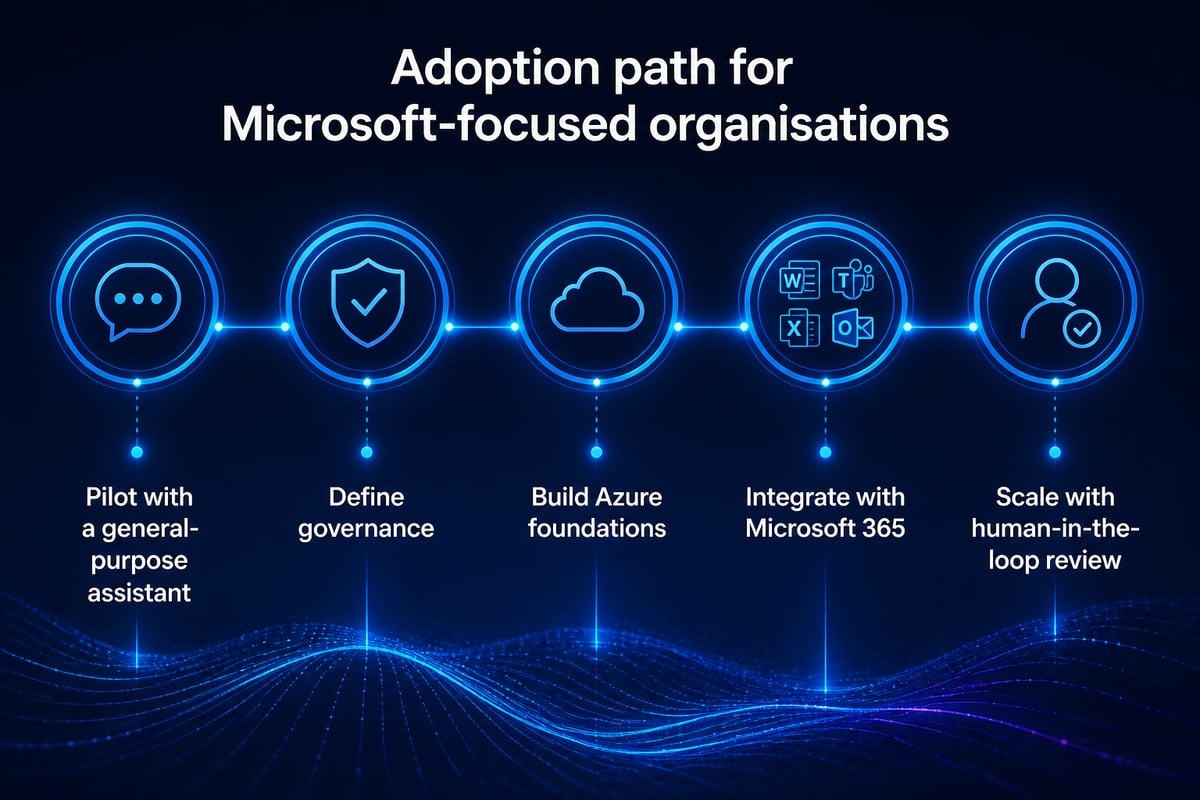
A practical sequence looks like this:
- Define two or three business processes where AI can show measurable results.
- Set data classification and acceptable-use rules before wider access is granted.
- Establish the Azure foundation, including identity, networking and monitoring.
- Pilot with a small group, with human review of outputs.
- Scale only after results and risks have been assessed.
Understanding the wider partner landscape also helps, and Stellium Consulting's overview of Microsoft AI partners sets out what to look for.

How is the market changing?
The market is growing quickly but unevenly, with value concentrating in a small number of very large companies. CB Insights reported that 42 AI companies reached billion-dollar valuations in Q3 2026, the highest quarterly total in 18 months. Concentration is also visible in the funding itself, with Crunchbase reporting that 85% of Q3 2026 AI funding went to 154 mega-rounds.
The scale of capital behind this is considerable. According to Crunchbase News, global venture funding reached $159 billion in Q3 2026 across nearly 6,000 startups, and AI-driven startups took $102 billion of it. A market shaped by so few very large rounds means a handful of well-funded model builders will set the pace, while many smaller firms compete for the remainder. Branding adds noise, as the Silicon Valley Bank finding on AI claims shows.
For buyers, two implications follow. First, the leading model builders will keep improving, so avoid architectures that tie you to a single provider. Second, the integration, security and change-management layers are where most enterprise value is won or lost, and those depend on your own preparation more than on any vendor's roadmap.
FAQ
Which are the top five AI companies?
The names most often cited at the top of the field include OpenAI, Anthropic and Google DeepMind, though rankings vary by whether valuation, model quality or enterprise adoption is measured. For enterprise buyers, the right shortlist depends on governance fit and ecosystem compatibility more than on any single ranking.
Is Cohere a top AI company?
Cohere is a recognised enterprise-focused AI company, but it is smaller than the largest model builders and is less commonly used as a general assistant. Whether it suits you depends on your use case, so evaluate it against the same criteria as other providers: governance, integration and measurable results.
How do I choose between an AI model provider and an AI integration partner?
A model provider supplies the underlying intelligence, while an integration partner connects it securely to your data, identity and processes. Most mid-to-large organisations need both, and benefit from selecting the partner first so that model choices are made within a governed architecture.
Your next step is to list the two or three processes where AI could save measurable time, then check whether your Azure and data governance foundations are ready to support them. Stellium Consulting can help with both, from Enterprise AI Solutions to the platform work behind it, and you can let’s talk about what a responsible, Microsoft-native rollout would look like for your organisation.