
An AI cloud is a cloud environment that provides the compute, data services and machine-learning tooling needed to build, train and run AI workloads without owning the hardware. For enterprise teams, the practical question is which platform fits existing data, security obligations and skills. This article compares five leading options and then covers how to choose between them.
Adoption is no longer the open question. In Flexera's 2025 survey of 759 cloud decision-makers and users, most organisations were using or experimenting with AI/ML PaaS services, and most were using generative AI either extensively or sparingly. The harder part is production. A 2025 Nutanix survey of IT and business decision-makers found that most respondents cited difficulty scaling compute-intensive AI from development to production.
What an AI cloud means for enterprise teams
An AI cloud bundles four things: elastic compute (including accelerators), managed machine-learning services, access to foundation models, and the governance controls that surround them. Enterprises rarely buy these in isolation. They buy them alongside identity management, data platforms and compliance tooling.
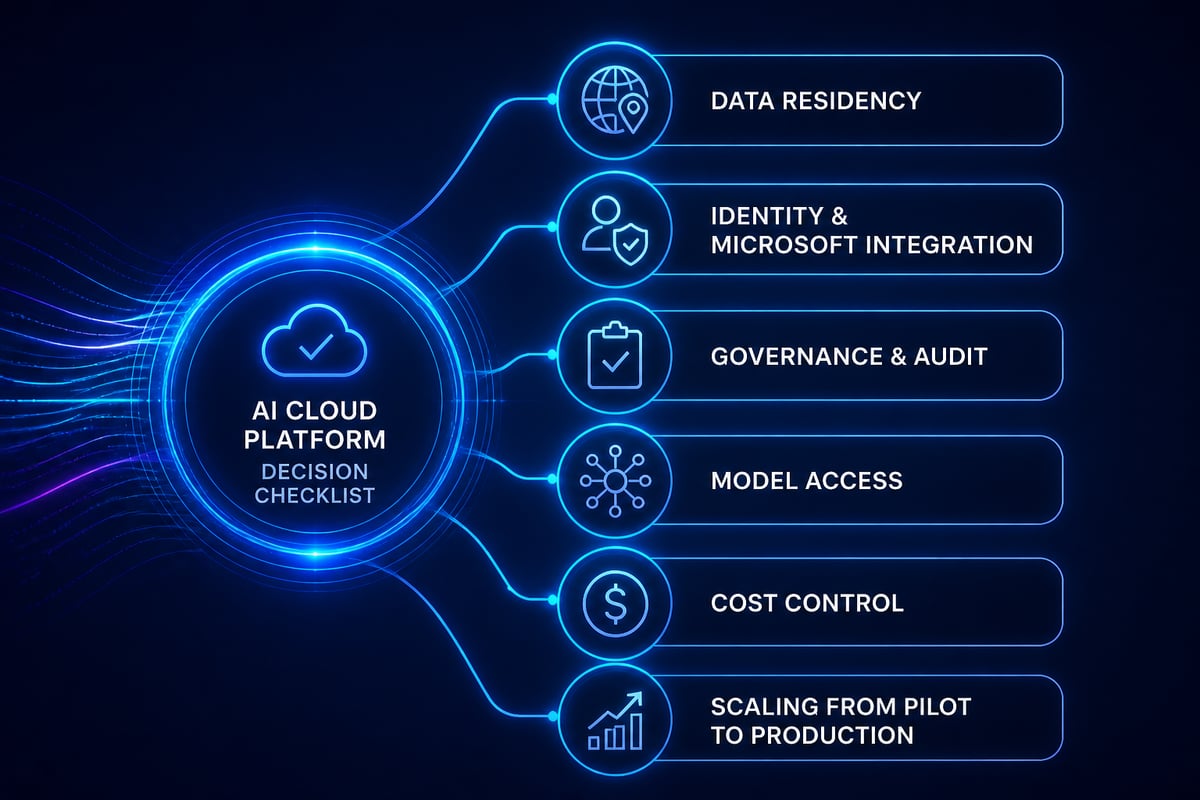
For organisations in pharma, finance, insurance, energy and the public sector, three requirements usually decide the shortlist:
- Data residency and sovereignty: the ability to keep data in a chosen European or Swiss region.
- Integration with existing systems: identity, collaboration tools and data estates already in place.
- Governance: audit trails, access controls and human review of AI outputs.
Cost matters too, but pricing across all three platforms is consumption-based, so the bill depends on how workloads are designed rather than on a list price alone.
1. Amazon SageMaker
Amazon SageMaker is Amazon Web Services' managed service for building, training and deploying machine-learning models. It suits data science teams that want a dedicated environment for the full model lifecycle, from data preparation through to a hosted endpoint. Because it sits inside AWS, it draws on the same identity, storage and networking services that many enterprises already operate, which reduces the amount of new infrastructure to approve and secure. That matters given Flexera's 2025 finding that most organisations were using or experimenting with AI/ML PaaS services, so most teams are now choosing among established platforms rather than starting from scratch.
- Pricing model: pay-as-you-go, with charges depending on the AWS services and resources used. A SageMaker workload therefore bills across compute, storage and any adjacent services it touches, not only the machine-learning layer.
- Listed rates: SageMaker Catalog costs $10 per 100,000 requests, and metadata storage costs $0.40 per GB. These two lines relate to cataloguing and governing data assets, so they scale with how many teams query the catalogue and how much metadata you keep.
- Free tier: 250 hours of sc.t3.medium notebooks are free for the first two months. That is enough for a small team to prototype a model and judge the notebook workflow before any spend begins.
- Best for: building, training and deploying machine-learning models.
Verdict: a mature choice for teams that run custom model development at scale and already operate on AWS. Cost forecasting needs care because the bill spans several services, so model realistic usage across all of them before committing.
2. Google AI Cloud Platform
Google's AI cloud platform is Google Cloud's environment for developing and deploying AI workloads. It suits teams whose data and analytics already sit on Google Cloud, since keeping models close to the data they learn from avoids moving large datasets between providers. Cloudera's 2025 survey of more than 1,500 IT leaders found data integration was the most frequently cited technical limitation for AI workloads, which makes that proximity a practical advantage rather than a convenience. An organisation with an established analytics estate on Google Cloud can start from existing pipelines instead of building new ones.
- Pricing model: prices are listed in USD, and local-currency charges may apply. Finance teams outside the United States should therefore expect exchange-rate effects when reconciling invoices against budgets.
- Free usage: new customers receive $300 in free credits, and more than 25 products offer free usage up to monthly limits. The credits suit a structured pilot, while the monthly limits allow low-volume services to run at no cost during evaluation.
- Best for: developing and deploying AI workloads on Google Cloud.
Verdict: a strong option for analytics-led organisations, with generous entry credits that make early evaluation inexpensive. Treat the credits as a time-limited allowance and plan the pilot so that its results are conclusive before they run out.
3. Microsoft Azure AI
Microsoft Azure AI is the collection of AI services on Azure, covering application development and document-processing services. It is the natural fit for organisations built around Microsoft 365, Entra ID and the wider Microsoft ecosystem, because users, permissions and policies can carry across from the systems they already manage. That continuity shortens security review, which is often the slowest step when a pilot approaches production. Document-heavy sectors such as insurance, finance and the public sector tend to see the quickest practical gains from the document-processing services.
- Pricing model: pay-as-you-go pricing is available, and Azure prices are listed in USD worldwide under the Microsoft Customer Agreement. A single set of commercial terms applies across regions, which simplifies procurement for organisations operating in several countries.
- Free tier: Azure AI Document Intelligence includes a free tier of up to 500 pages per month. A claims, contracts or regulatory-submission team could test extraction on a representative batch of real documents before paying for volume.
- Best for: building AI applications and using document-processing services.
Verdict: the most direct path for Microsoft-centred enterprises, particularly where document-heavy processes such as claims, contracts or regulatory submissions are in scope. Sample documents that reflect your messiest real inputs, not tidy examples, so the free tier gives an honest accuracy signal.
4. Stellium Consulting Cloud and AI Platforms
Stellium Consulting's Cloud and AI Platforms service is a delivery offering rather than a hyperscaler: it provides secure, scalable AI infrastructure and platforms on Microsoft Azure, from compliant landing zones to advanced AI deployments. It suits IT leaders who have chosen Azure and need the foundations built correctly. The need is real: a 2025 Nutanix survey found that most respondents cited difficulty scaling compute-intensive AI from development to production. Much of that difficulty comes from security, networking and governance being retrofitted after a pilot succeeds, and this service puts them in place at the start.
- Scope: compliant landing zones through to advanced AI deployments, so one partner can carry a programme from the first governed environment to production-grade workloads.
- Approach: AI solutions built natively on the Microsoft ecosystem, with responsible AI practices such as human-in-the-loop validation, privacy safeguards and bias checks. Building natively means the result integrates with the identity and collaboration tools a Microsoft-centred organisation already runs.
- Pricing: contact Stellium Consulting for scoping.
- Best for: regulated organisations that need a compliant Azure foundation for AI.
Verdict: a delivery partner choice that complements Azure AI rather than competing with it. It is most valuable where internal teams lack the capacity to design a compliant environment while also delivering use cases.
5. Stellium Consulting AI Landing Zone Quick-Start
The AI Landing Zone Quick-Start is a 4-week setup of a compliant, reusable Azure environment ready for AI workloads. It suits teams that want a governed starting point before committing to larger AI programmes. A landing zone fixes the structural decisions early, such as how subscriptions are organised, how identities and access are controlled and how network boundaries are drawn. Settling these once avoids rebuilding them for every project, which is where many pilots lose time and consistency.
- Duration: 4 weeks, a fixed window that lets sponsors plan the start of pilot work around a known date.
- Output: a compliant, reusable Azure environment prepared for AI workloads. Reusable means later use cases inherit the same controls instead of each team negotiating its own security review.
- Pricing: contact Stellium Consulting for details.
- Best for: organisations that need a compliant environment in place before pilots begin.
Verdict: a time-boxed route to a governed AI cloud foundation on Azure. It pairs naturally with a first bounded pilot, since the environment is ready when the use case is chosen and the governance questions have already been answered.
Comparison of the AI cloud options
| Option | Provider | Type | Free entry | Best for |
|---|---|---|---|---|
| Amazon SageMaker | AWS | Managed ML platform | 250 notebook hours (sc.t3.medium), first 2 months | Building, training and deploying ML models |
| Google AI Cloud Platform | Google Cloud | AI platform | Approx. $300 credits for new customers | AI workloads on Google Cloud |
| Microsoft Azure AI | Microsoft | AI services | 500 pages per month (Document Intelligence) | AI applications and document processing |
| Cloud and AI Platforms | Stellium Consulting | Delivery service on Azure | Not applicable | Compliant Azure AI foundations |
| AI Landing Zone Quick-Start | Stellium Consulting | 4-week setup service | Not applicable | Compliant, reusable Azure environment |
How to choose the right AI cloud
Start with the estate you already run. A platform that integrates with your identity provider, collaboration tools and data stores removes more friction than any single model feature.
Data readiness is the next filter. In Cloudera's 2025 survey of more than 1,500 IT leaders, data integration was the most frequently cited technical limitation for AI workloads. The same survey reported that most respondents had AI at least somewhat integrated into core business processes, and many reported significant success. Platform choice matters less than whether your data can reach the models cleanly.
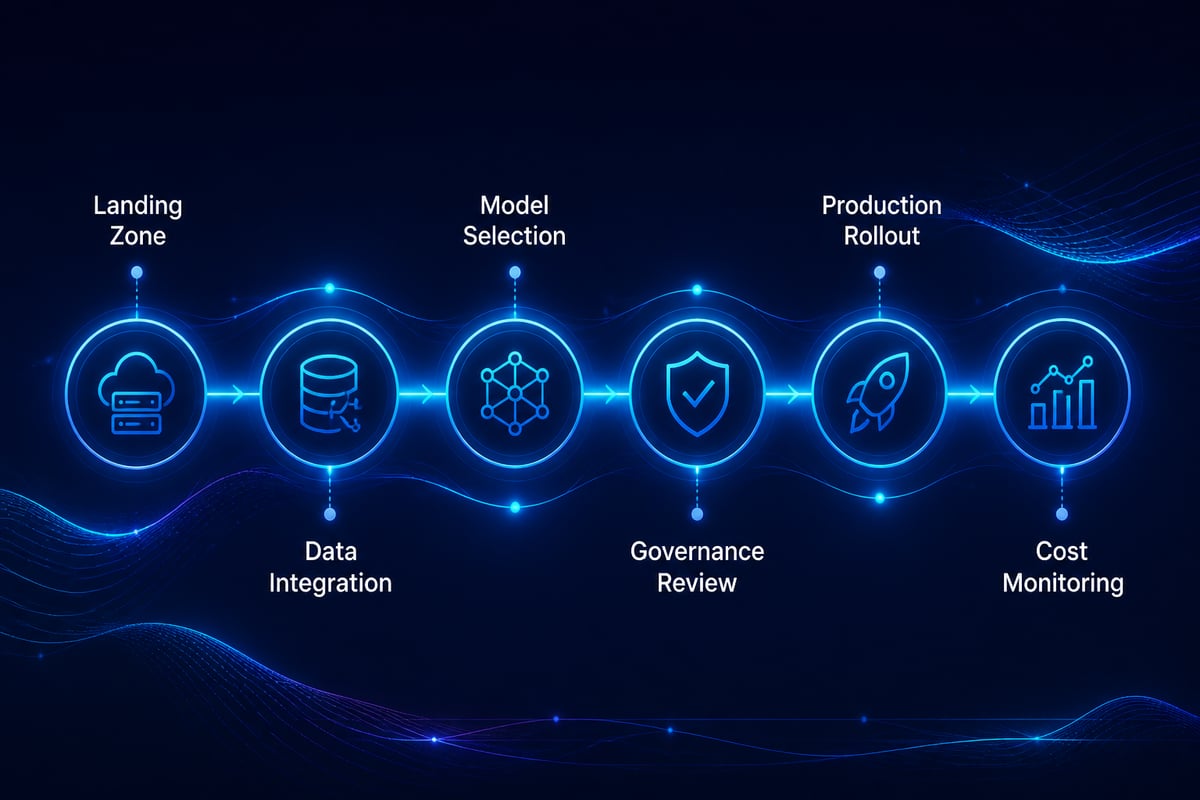
A practical evaluation sequence looks like this:
- Map the use cases and the data they touch, including classification and residency needs.
- Confirm which regions and certifications your regulators and internal risk teams require.
- Run a bounded pilot using the free tiers or credits listed above.
- Define governance before scale: who validates outputs, how bias is checked, how access is logged.
- Model consumption costs against realistic volumes, since all three platforms bill on usage.
Governance and responsible AI in regulated sectors
Governance should be designed in before the first workload goes live. For pharma, finance, insurance, energy and public services, that means human review of consequential outputs, privacy safeguards and routine bias checks, applied consistently across every model and use case.
Stellium Consulting builds these controls into its solutions as standard, with human-in-the-loop validation at the centre. As a Microsoft Solutions Partner and Microsoft Partner of the Year in Switzerland, it has delivered engagements for clients including JTI, a Swiss law firm and a public hospital in Switzerland.
Related tooling can support the wider programme. Teams that need external subject-matter input for AI strategy or sector validation may find an expert network such as Exact Insight useful. Teams building multi-step AI pipelines that must survive failures can look at DBOS, which adds durable, observable workflows and queues to application code.

Avoiding common scaling problems
The Nutanix finding cited earlier, that most respondents reported difficulty scaling AI from development to production, points to a pattern. Pilots succeed in isolated environments, then stall when they meet production security, data pipelines and cost controls.
Three habits reduce that risk:
- Build on a governed foundation first. A reusable landing zone avoids rebuilding security and networking for each project.
- Budget for data work. Integration and quality typically absorb more effort than model selection.
- Set cost guardrails early. Usage-based billing rewards monitoring and penalises open-ended experimentation.
Hardware and storage choices still matter for hybrid scenarios. Organisations that keep some workloads on-premises may source components through suppliers such as Origin Storage.
Your next step is to select one use case and run a bounded pilot on the AI cloud that best matches your existing Microsoft estate, using the free tiers and credits above to keep early costs low. Stellium Consulting can help you set up the foundations, including the AI Landing Zone Quick-Start, a 4-week setup of a compliant, reusable Azure environment. If you want a clear view of the right platform and governance model for your organisation, Let’s Talk and we will work through it with you.